
Limited-time Udemy offer
$9.99
Project Management From Initiation To Closing With AI
Unlimited redemptions
Available until September 19, 2026 6:21 PM PDT
2A2133BF88C8DF36C1AA
The framing in most project management training creates a false binary. On one side sits predictive delivery: waterfall, gate reviews, requirements locked before development begins, change requests treated as exceptions. On the other side sits agile delivery: sprints, backlogs, working software over comprehensive documentation, embrace of change. The implicit message is that you choose one and run your project accordingly. In practice, that choice is rarely available. Most projects in established organizations operate inside a web of constraints that prevent a pure approach in either direction, and the PM who arrives expecting to run a textbook agile project will spend months fighting the environment instead of managing the work.
Those constraints are not arbitrary. Fixed-price contracts require a defined scope at signing because the legal agreement demands it. Regulatory compliance requirements dictate the sequence of validation steps because the regulator dictates it, not the project team. Executive governance cycles run on quarterly or annual rhythms tied to board approval processes that no PM has the authority to change. Annual budget authorizations require a cost baseline months before the project team fully understands the work. Vendor relationships are typically built on milestone payments and contractual deliverables, not sprint velocity, though some engagements use agile-friendly contracts structured around capacity or rolling-wave statements of work. Each of these constraints pulls the project toward predictive structure, and they are largely non-negotiable. This is not a failure of organizational maturity. It is the operational reality of doing project work inside institutions that exist for reasons beyond the current project.
None of this means agile delivery is impossible. It means agile delivery must be combined with predictive governance. Teams can run sprints. Executives cannot receive status updates in sprint-velocity terms. Backlogs can evolve. Vendor contracts cannot. Retrospectives can improve the team's process. Regulatory submission sequences cannot. Hybrid is not a compromise between two better options. It is an honest reading of the environment most project managers actually operate in, and treating it as such is the starting point for managing it well.
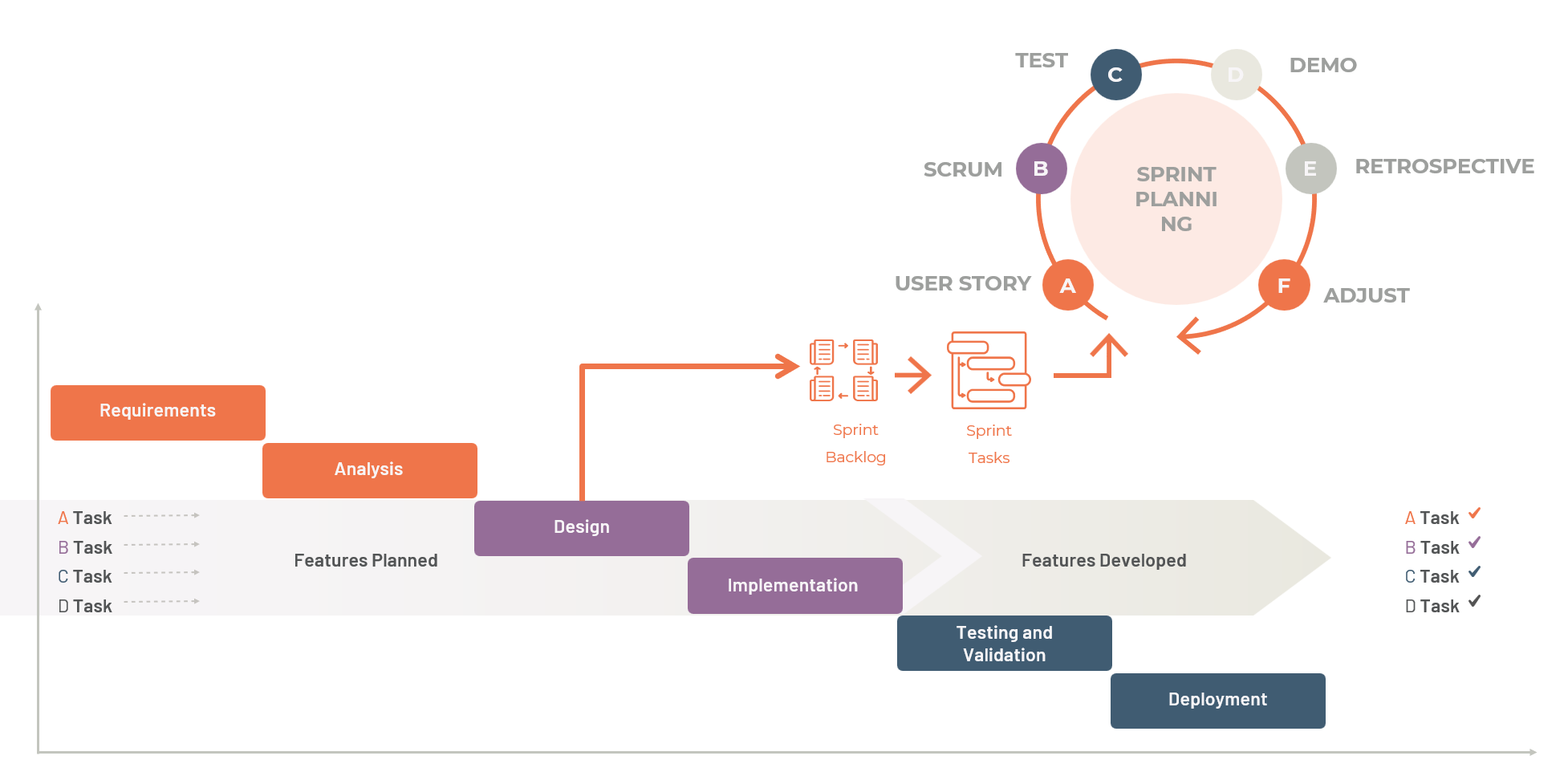
A well-designed hybrid project has two distinct layers that run simultaneously but operate by different rules. Getting clarity on which layer each decision belongs to is the most useful organizing principle available to a PM navigating mixed constraints.
The governance layer runs predictively. It covers the formal structure that the organization, its stakeholders, and its external obligations require: phase boundaries and gate reviews, executive approval checkpoints, budget authorizations, contract milestones with defined deliverables, regulatory compliance reporting, and major stakeholder communications at the steering committee level. This layer operates on a predictive timeline with defined approval events at fixed points. The sponsor and steering committee see a milestone-based view of the project. They are not interested in sprint velocity or backlog refinement. They are accountable for budget, schedule, and contractual commitments, and they need a predictive view of those dimensions. The PM owns this layer entirely.
The delivery layer runs adaptively. Within each governance phase, the team organizes its work into time-boxed sprints. The team maintains and refines the product backlog continuously. Sprint planning sessions commit the team to a specific body of work for the coming two weeks. Sprint reviews generate direct feedback from users and stakeholders who see working increments rather than documentation. Retrospectives drive process improvement inside the team. The daily and weekly rhythm of the delivery layer is agile: inspect and adapt, deliver working product, incorporate feedback early. The team owns this layer. A Scrum Master or delivery lead runs the ceremonies. Backlog ownership belongs to the product owner. The PM does not attend standups to collect status. The PM does attend sprint reviews, monitors cross-workstream dependencies, and watches for risks that may need governance-layer attention, but does not manage tasks or override the team's process.
The PM's job is to manage both layers simultaneously, and the primary challenge of that job is managing the conflicts that arise when the two layers collide. Consider what happens when a governance gate is approaching while a sprint is mid-flight. The gate requires a formal deliverable: a signed-off scope baseline, a completed design document, a vendor acceptance record. The team is mid-sprint, committed to a different set of work. Someone has to decide whether the sprint absorbs the gate deliverable, the gate moves, or a specific team member temporarily exits the sprint to produce the governance artifact while the rest of the team continues. There is no single right answer. There is only the PM, holding both timelines in view, making a call and managing the consequences. Similarly, when a vendor contract requires scope confirmation at the end of a planning phase, the PM must translate whatever the sprint backlog contains at that moment into contractually confirmable language, knowing the backlog will continue to evolve inside the phase. The translation is the PM's responsibility. Neither the vendor nor the development team will do it for them.
A government agency is replacing a legacy case management system that has been in production for eleven years. The system handles benefit eligibility determinations, and the data it contains is subject to privacy legislation with specific retention and auditability requirements. The project has a fixed budget appropriation approved by the legislature, which means the cost baseline is set before the agency fully understands the scope. Three vendor contracts are in place: one for the software platform, one for data migration, and one for system integration. Each contract includes milestone payments tied to defined deliverables. The regulatory environment requires that system validation follows a specific sequence, that each validation stage is documented against written test plans, and that sign-off at each stage comes from a designated compliance officer. None of these constraints are negotiable. They are the water the project swims in.
At the same time, the users who will work with the new system have spent eleven years with a system that was built around the workflows of 2013. They cannot fully articulate what they need from a new system because they have never seen one. Describing their current process in detail is within reach. Identifying what frustrates them is also possible. But they cannot produce a complete requirements specification from which a team would build an ideal system, because knowing what you need from something you have never used is genuinely difficult. The agency's IT leadership learned this on the previous modernization project, which produced a comprehensive requirements document over six months, built to that document for a year, and then watched users reject the output as unusable at UAT. Analysts had written the requirements by observing the legacy system, but had not accounted for the tacit knowledge and informal workarounds that determined how work actually got done.
The delivery model for this project runs both layers in parallel. At the governance layer: the project has five defined phases (Initiation, Design, Build, Validation, Deployment), each closing with a formal gate review. Budget tracking runs against the predictive cost baseline. Vendor milestone payments are tied to phase completions and defined deliverables within each phase. The compliance officer reviews and signs off at defined validation checkpoints. Steering committee status updates happen monthly with milestone-based reporting. At the delivery layer: within the Build phase, the development team runs two-week sprints. Each sprint delivers a working increment of the new system. Sprint reviews bring in actual users, specifically the caseworkers who will use the system daily, to evaluate what was built and provide direct feedback. The product owner, an agency representative with authority to make priority decisions, maintains and refines the backlog between sprints. Feedback from sprint reviews directly changes what the team builds in the next sprint.
The regulatory validation sequence holds because it must. Budget tracking runs against the predictive baseline because the legislature requires it. Vendor milestones land on time because the contracts demand it. And the users get a system that reflects how they actually work because the sprint reviews gave them a mechanism to shape the product throughout delivery rather than only at the end. The hybrid model serves both objectives. This is hybrid working as intended: not as a compromise, but as an accurate response to the project's actual conditions.
Midway through the Build phase, the compliance officer announces that a specific data migration validation step must occur before the next sprint review, because an audit is scheduled and the auditor will expect to see that checkpoint complete. The sprint team is two days into a sprint committed to building the case assignment workflow. The PM has three options: pause the sprint and redirect the team to the validation task (disrupts the sprint commitment, delays the user-facing feature); have the data migration vendor complete the validation independently while the sprint continues (requires PM coordination effort and may surface issues the sprint team needs to respond to); or reschedule the sprint review by three days to allow the validation to complete first (changes the sprint calendar, affects user availability). The PM evaluates each option against both layers and makes a call. This is not a process question. It is a judgment call that requires someone who holds both layers simultaneously. That person is the PM.
One of the practical challenges in hybrid projects is that individual decisions arrive without clear labels. A stakeholder asks whether the project can incorporate a new requirement. The sponsor asks for an updated timeline. A team member asks whether the definition of done can be adjusted mid-sprint. Each of these needs to be routed to the right layer, and the PM's ability to route correctly, quickly, is what keeps both layers running without constant friction. The table below maps typical project decisions to their appropriate layer in a hybrid project.
| Decision or Activity | Run Predictively | Run Adaptively |
|---|---|---|
| Legal and regulatory milestone commitments | Yes: fixed sequence, formal sign-off required | No |
| Vendor contract deliverables and payment milestones | Yes: contractually defined, cannot shift without amendment | No |
| Executive budget reporting and reauthorization | Yes: aligned to organizational budget cycles | No |
| Sponsor and steering committee status updates | Yes: milestone-based view, governance-level granularity | No |
| Risk escalation above team threshold | Yes: formal risk register, change control if needed | Team-level risks are managed within the sprint; only risks that cross team boundaries or carry external impact escalate to the governance layer |
| Feature delivery sequencing within a phase | No | Yes: product owner prioritizes the backlog |
| Team-level work planning and task management | No | Yes: sprint planning, daily standup, team self-organization |
| Quality improvement and process changes | No | Yes: retrospectives drive team-level adaptation |
| User feedback incorporation | No | Yes: sprint reviews generate feedback that updates the backlog |
| Daily team coordination | No | Yes: standup, team channels, direct collaboration |
| Definition of done adjustments | No (unless compliance-driven) | Yes: retrospective or sprint planning decision |
| New requirement from sponsor mid-project | Evaluate scope impact at governance layer | If approved, enter backlog and prioritize adaptively |
The bottom row in that table is the one that trips up most hybrid projects. A sponsor introduces a new requirement mid-project. The instinct, especially in organizations that have been told they are "doing agile now," is to treat it as a backlog item and absorb it into the next sprint. But the requirement may carry scope, budget, and schedule implications that belong at the governance layer first. The PM evaluates those implications, brings the requirement through change control if the impact crosses defined thresholds, and then, once approved at the governance layer, hands it to the product owner to enter into the backlog. The two layers work in sequence on that decision. Neither layer short-circuits the other.
Hybrid projects fail in predictable ways. Understanding these patterns before they appear is considerably more useful than diagnosing them afterward, when the team is already operating in ways that are difficult to reverse.
The first and most common failure is treating agile ceremonies as administrative overhead layered on top of a traditionally managed project. The organization adopts the vocabulary: sprints, standups, backlogs, retrospectives. The vocabulary is genuine. But the management style underneath it does not change. Standups become status reports delivered to the PM, who notes what each person is working on and where they are behind. Sprint reviews become demos where stakeholders watch the team present completed work but do not participate in evaluating it or providing feedback that will shape the next sprint. Teams cancel retrospectives when deliverables are late, which is precisely when they are most needed. The team maintains the product backlog in a tool, but the PM determines priority based on the original project plan rather than allowing the product owner to sequence based on value and feedback. The team goes through agile motions. None of the actual benefits of the agile approach accrue: no early feedback loop, no team ownership of process, no adaptive response to emerging information. The organization spends more time in meetings and produces worse results than it would have with a straightforwardly predictive approach. This is the worst possible outcome: agile cost without agile benefit.
The second failure is allowing the governance layer to reach into the delivery layer and override sprint commitments. A PM who permits the sponsor to add scope to the current sprint because "it's urgent" is teaching the team a lesson that cannot easily be untaught: sprint commitments are suggestions, not agreements. Once a team learns that an executive phone call can change the sprint mid-flight, sprint planning becomes theater. Why commit to a scope of work when someone will modify it in the third day of the sprint? The team stops planning seriously. Velocity becomes meaningless. The predictability that makes sprint-based delivery valuable evaporates. Protecting sprint commitments is not obstinance. It is what makes the delivery layer functional. When urgent work genuinely must enter the current sprint, the PM's response is to negotiate what comes out, not to simply add to what the team has already committed. The sponsor may not like hearing that, but a PM who cannot hold that conversation is not serving either layer.
The third failure is applying agile vocabulary while preserving the actual decision structure of a directive management culture. Management announces, "We're agile now." Leaders tell teams they are self-organizing. Someone creates backlogs. But every significant decision still flows through the PM for approval. A developer who identifies a better technical approach must escalate it to the PM, who consults with the architecture committee, which meets biweekly. A team member who notices the definition of done is missing a testing requirement brings it to the PM, who adds it to the agenda for the next status meeting. The product owner cannot reprioritize the backlog without the PM's sign-off, which requires alignment with the original project plan. The team carries the label "self-organizing" but cannot self-organize. They carry the label "empowered" but must escalate for permission. The vocabulary is agile; the culture is not. This failure is harder to fix than the first two because it requires organizational change that goes beyond the PM's authority. But the PM can at least be honest about what kind of project they are running, which allows them to manage it consistently rather than inconsistently.
There is a specific and irreplaceable role that the PM plays in a well-functioning hybrid project, and it is worth naming precisely because it is often misunderstood. The PM in a hybrid environment is not the process owner for the delivery layer (the Scrum Master covers that) and not the decision authority for the business case (the sponsor covers that). The PM is the person who holds both layers simultaneously and manages the interface between them. That interface is where the most consequential work of the project happens, and it is where the PM's contribution is most visible.
Managing the interface means translating between the two layers in both directions. Upward: the PM takes sprint-level velocity data and delivery trends and translates them into the milestone-based forecast the sponsor needs to understand whether the project is on track to hit its phase gate commitments. A sponsor who hears "the team completed twenty-two story points last sprint" has no useful information. A sponsor who hears "at current pace we will complete the user-facing features by the end of week eight, which gives us two weeks of buffer before the phase gate" has information they can act on. Downward: the PM takes governance constraints (a fixed phase end date, a vendor deliverable due in three weeks, a compliance checkpoint that requires specific documentation) and translates them into boundaries the team can work within. The team does not need to understand the contract structure. They need to know that the API integration must be complete and testable by week six because the vendor requires it for their milestone payment, and that this is a fixed constraint, not a negotiable one. The PM provides that boundary. The team plans within it.
Resolving conflicts between the layers is the most demanding part of the integration role. When the adaptive layer runs into the predictive layer's requirements, someone has to make a call. When a sprint review surfaces feedback that would require a scope change touching a contractual deliverable, someone must evaluate whether the change can be absorbed, whether it requires a contract amendment, and whether it is worth pursuing at all given the cost and timeline implications. If the governance gate falls in two weeks and the team's sprint cadence puts the next sprint review one day after it, someone must decide whether to move the review, compress the sprint, or present the gate deliverable based on the previous sprint's output. These decisions require a person who understands both the governance layer's constraints and the delivery layer's operating logic. The Scrum Master understands the delivery layer but not the contract. The sponsor understands the governance layer but not the sprint. Understanding both falls to the PM, and the integration is the PM's unique contribution.
This is also the answer to a question that practicing PMs sometimes ask: what is my role in an agile or hybrid project if the team is self-organizing and the product owner is managing the backlog? The answer is that self-organization at the delivery layer is entirely compatible with active management at the governance layer, and someone must connect those two layers to each other. In a purely agile product environment with no external governance constraints, a Scrum Master and a product owner can run the team effectively without a traditional PM. But most projects are not that environment. They have contracts, compliance requirements, executive governance cycles, vendor relationships, and stakeholders who require milestone-based accountability. In that environment, the PM's governance management function is not redundant. It is the thing that makes adaptive delivery possible within the constraints the organization actually operates under. The PM creates the space for the team to work adaptively by managing the predictive layer that surrounds them. That is not a diminished role. It is a distinct and necessary one.
A hybrid project PM is preparing for a monthly steering committee update. The delivery team runs two-week sprints and tracks work in story points. The steering committee tracks progress in milestone completions against a project schedule. The PM cannot present velocity data to the steering committee; it means nothing to them. Instead, the PM maps the last two sprints' output against the planned deliverables for the current phase, calculates the completion percentage for each milestone's constituent features, and presents a milestone-based forecast updated from the actual sprint data. The team's adaptive delivery is feeding the predictive view. The steering committee gets the information they need to make governance decisions. Teams continue working in sprints without changing their process. Both audiences remain unaware of the translation, and that invisibility is the sign that it was done well.
The PM who masters this integration role becomes genuinely valuable in hybrid environments, and genuinely rare. Most practitioners are trained in one mode or the other. Traditional PMs often struggle to create adaptive delivery space for teams because they default to directive management. Agile practitioners often struggle to manage the governance layer because they learned to treat it as bureaucratic overhead rather than a legitimate set of constraints with real consequences. The PM who can hold both, translate between them, and manage the conflicts that arise when they collide is not just competent. That PM is the person organizations want running their most complex and constrained projects.
The next chapter examines AI as a project management tool: what it genuinely changes about how PMs work, what it does not change, and where the boundaries of useful AI assistance currently sit.
Move beyond guesswork and status reporting. This course helps you measure real progress, spot problems early, and make confident decisions using proven project performance techniques. If you manage complex projects and want clearer visibility and control, this course is built for you.
This is not abstract theory. You’ll work step by step through Earned Value Management (EVM), learning how cost, schedule, and scope come together to show true performance. You’ll build a solid foundation in EVM concepts, understand why formulas work, and learn how performance data actually supports leadership decisions.
You’ll master Work Breakdown Structures (WBS), control accounts, and budget baselines, then apply core EVM metrics like EAC, TCPI, and variance analysis. Through a detailed real-world example, you’ll forecast outcomes, analyze trends, and understand contingencies and management reserves with confidence.
Learn how experienced project managers monitor performance, communicate results clearly, and take corrective action before projects slip. With practical exercises and hands-on analysis, you’ll be ready to apply EVM immediately. Enroll now and start managing performance with clarity and control.
Explore the CourseHK School of Management helps you take Lean Six Sigma to the next level without the overwhelm. Master advanced statistical tools, Excel-based analysis, and real-world improvement techniques to solve complex problems with confidence. Practical skills, tools, and guidance you can apply right away. Covered by Udemy's 30-day refund policy.
Learn MoreUnlimited redemptions
Available until September 19, 2026 6:21 PM PDT
2A2133BF88C8DF36C1AA