
Limited-time Udemy offer
$9.99
Project Management From Initiation To Closing With AI
Unlimited redemptions
Available until September 19, 2026 6:21 PM PDT
2A2133BF88C8DF36C1AA
Most people who work in organizations using agile have heard of Scrum. Far fewer can tell you precisely what it is. They describe it as a meeting structure, or a way of running software teams, or loosely synonymous with agile itself. None of those definitions hold up. Scrum is, by its own formal description, a lightweight framework for developing, delivering, and sustaining complex products. Every word in that sentence is doing work. Lightweight means it has very few rules. Framework means the rules create a container inside which the team makes its own decisions about how to work. Complex products means Scrum is designed for situations where the solution is not fully known at the start, where discovery happens as you go, and where feedback from working software changes what you build next. If you are executing a fully specified, repeatable process, Scrum is not the right tool.
What Scrum is not matters just as much as what it is. Scrum is not a methodology. A methodology prescribes specific practices: use test-driven development, write your specifications this way, structure your code in these layers. Scrum says nothing about engineering practices. A team can run excellent Scrum and write terrible code, or run Scrum and practice rigorous test automation. The framework does not care. Scrum is also not a process in the traditional project management sense. It does not produce a Gantt chart, a resource allocation plan, or a work breakdown structure. It does not assume that you can define the full scope of a project before work begins. And Scrum is not interchangeable with agile. Agile is a set of values and principles described in the Agile Manifesto. Scrum is one specific framework that puts some of those values into practice. Calling your organization agile because you hold daily standups is like calling yourself a chef because you own a frying pan.
Inside the framework, Scrum defines exactly three accountabilities, five events, and three artifacts. The accountabilities are: Product Owner, Scrum Master, and Developers. The events are: Sprint Planning, Daily Scrum, Sprint Review, Sprint Retrospective, and the Sprint itself (which is the container event that holds the other four). The artifacts are: Product Backlog, Sprint Backlog, and Increment. That is the entire structure. Everything else, every engineering practice, every tool, every team norm, every collaboration pattern, the team invents. This is both Scrum's great strength and its most common point of failure. Teams that understand why these constraints exist use the open space productively. Teams that treat the three accountabilities and five events as administrative overhead and fill the rest of the sprint with old habits get neither the discipline of traditional project management nor the learning speed of a true agile approach.
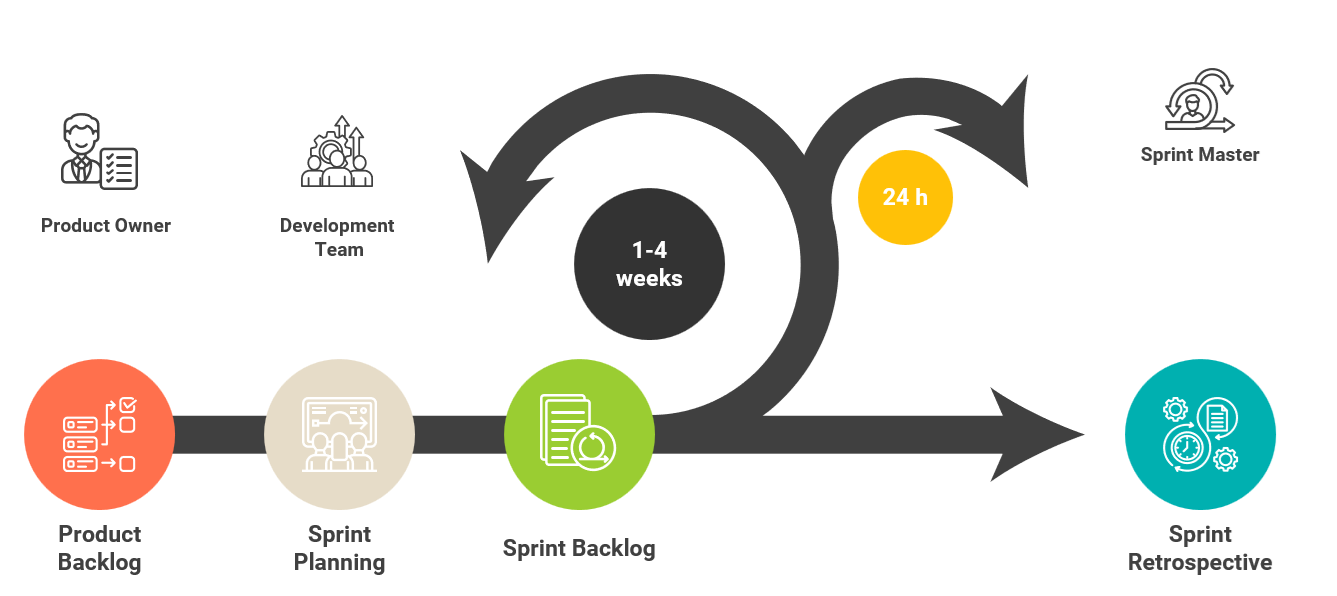
A sprint is a fixed-length iteration, typically one to four weeks, during which the team produces a potentially releasable increment of the product. Two weeks has become the de facto standard for most software teams, though teams working on hardware, complex data systems, or heavily regulated environments sometimes run three or four weeks. The exact length matters less than the consistency: once a team chooses a sprint length, it keeps it. A sprint that keeps getting extended is not a sprint. It is a mini-waterfall project with a different name.
Each word in that definition carries meaning worth unpacking. Fixed-length means the sprint ends on the scheduled date regardless of whether all planned work is complete. This is the rule that teams most often want to bend and the rule that generates the most learning when followed faithfully. When a sprint ends on time and the team has completed six of its eight planned items, that outcome is informative: the team overcommitted, or the work was more complex than estimated, or an unplanned interruption consumed days that were not accounted for. The gap between planned and completed is signal. When teams are allowed to extend a sprint until the planned work is done, that signal disappears. The sprint feels like a success because everything was finished, but the real lesson, that the team cannot estimate reliably or does not protect its capacity, never surfaces. A team that extends sprints does not get better at estimating. It gets better at hiding the problem.
Potentially releasable means the increment meets the team's quality standard at the end of the sprint. "Mostly done" does not qualify. Neither does "done except for testing" or "done enough to show in a demo." The increment must be in a state where the organization could choose to release it to users if it wanted to. This does not mean the organization will release it every sprint. It means the team does not accumulate hidden technical debt or partially built features that create dependencies across sprints. Teams that routinely produce increments that are "90 percent done" are effectively pushing risk into future sprints, where it compounds. A team discovers in Sprint 7 that the thing they marked nearly complete in Sprint 4 actually requires a substantial rework to be truly shippable.
Increment means the team adds something new to what already existed. At the end of each sprint, the product is better than it was at the start, in a concrete, demonstrable way. The increment builds on prior increments. This is how a product grows over time: not in one large release after months of development, but in small, inspectable, usable additions that accumulate sprint by sprint. Combined with the sprint goal, which is a one-sentence statement of what the sprint is trying to achieve, the increment becomes the evidence that the goal was met. A sprint goal like "enable customers to track their order in real time" makes it unambiguous whether the sprint succeeded. Teams that commit to sprint goals rather than just sprint task lists produce more coherent work, because every member of the team knows not just what they are building but why it matters to the person who will use it.
Scrum distributes accountability across three accountabilities in a way that is elegant in theory and frequently misunderstood in practice. These accountabilities are not job titles: they are specific responsibilities that must be held by a specific person on the team. Organizations that assign the wrong person to an accountability, or split an accountability across multiple people, or layer a traditional management structure on top of Scrum without adjusting what those managers actually do, tend to produce the outward appearance of Scrum without its benefits.
The Product Owner is accountable for maximizing the value of the product. That accountability lives in a single person. Committees cannot own the product backlog. A rotating cast of stakeholders cannot set priorities. The PO is the single point of decision-making about what is on the backlog, in what order, and what each item means when Developers have questions. This concentration of authority is uncomfortable in organizations accustomed to managing by consensus, but it is not arbitrary. Teams that get contradictory prioritization signals from multiple stakeholders cannot make coherent decisions about where to focus. The product backlog becomes a political artifact that reflects organizational power dynamics rather than customer value. A strong Product Owner prevents that deterioration. What makes a PO effective is not just decision-making authority but the quality of the decisions: deep knowledge of what customers need, close enough connection to users to validate assumptions, and enough availability to answer the team's questions in hours rather than days. A Product Owner who is available for one hour a week is a bottleneck wearing a job title.
The Scrum Master is accountable for the effectiveness of the Scrum team. This is a coaching and facilitation role, not a management role. The Scrum Master facilitates the events (making sure sprint planning starts on time, the daily standup stays focused, and the retrospective produces actual action items rather than a list of complaints), coaches the team on Scrum practices and agile principles, removes organizational impediments that block the team's progress, and protects the team from external interference during the sprint. Teams frequently misunderstand that last responsibility. Protecting the team does not mean ignoring legitimate business needs. It means creating a predictable working environment where Developers can complete what they commit to. A team that gets pulled off sprint work by ad hoc requests mid-sprint cannot close the feedback loop that makes Scrum work. The Scrum Master's job is to make that visible and address it at the organizational level, not to absorb it silently. What makes a Scrum Master effective is a combination of deep knowledge of agile principles, genuine coaching skill, and enough organizational credibility to have honest conversations with people who have more authority than the team. A Scrum Master who cannot challenge organizational dysfunction is a meeting facilitator, not a Scrum Master.
Developers are the people who do the work of creating the product increment. Scrum specifies that Developers are self-organizing and cross-functional. Self-organizing means the team members collectively decide how to approach the work. No one outside the team tells them which developer works on which feature, how to structure their testing, or how to divide tasks during the sprint. The team makes those decisions. Cross-functional means the team collectively holds all the skills necessary to deliver the increment without depending on people outside the team for day-to-day work. A team that needs external approval before testing, or external resources to complete a build, or external sign-off before closing a task is not truly cross-functional. It has external dependencies baked into its process. Developers are also accountable as a unit, not individually. If the team leaves three of the eight sprint backlog items unfinished at the end of the sprint, the whole team owns that outcome, not the individual whose tasks are incomplete. This collective accountability creates the conditions for genuine collaboration: team members help each other, share knowledge, and swarm on blocked items rather than working in parallel silos and declaring individual success while the team fails.
A mid-sized software company adopts Scrum and assigns the role of Scrum Master to the team's senior developer, reasoning that the most technical person should guide the team. Within three sprints, the Scrum Master is also making technical architecture decisions, reviewing pull requests, and spending a third of every sprint writing code. The retrospectives are short and conflict-free because no one challenges someone who also controls code reviews. The daily standups drift into technical design discussions because the Scrum Master is also the technical lead. The team is running Scrum ceremonies, but the Scrum Master role has been absorbed into the development role, and the coaching and organizational protection functions are simply not happening. Scrum roles work when the accountabilities are actually separate.
Scrum's ceremonies and artifacts are not arbitrary. They are designed around three empirical pillars that explain why the framework is structured the way it is. Understanding the pillars makes every Scrum event make sense as a system. Treating the events as procedures to follow without understanding what they are supposed to produce is the most reliable path to a team that holds all the ceremonies and gets none of the benefit.
Transparency is the first pillar, and the most foundational. It means the real state of the work must be visible to everyone who has a stake in the outcome. The sprint board should reflect actual status, not optimistic status. A task that moved from "to do" to "in progress" three days ago and has not moved since is not just behind schedule. It is a signal: the work was harder than expected, or there is a blocker no one has raised, or the team member working on it needs help. A sprint board where all tasks move to "done" in the final two days of the sprint is not a sign that the team works best under pressure. It is a sign that the board is not being updated honestly throughout the sprint, which means it is not functioning as a transparency tool. Velocity charts that are adjusted retroactively, sprint goals that are quietly revised mid-sprint without acknowledgment, and "done" items that turn out to need rework in the next sprint are all transparency failures. They are also human and understandable: people do not like reporting bad news, particularly to stakeholders who have shown they respond to bad news poorly. The Scrum framework creates the structural expectation of transparency; the Scrum Master's job is to create the psychological safety that makes honest reporting possible.
Inspection is the second pillar. It is the mechanism that converts transparency into useful information. Scrum builds inspection into every event. The Daily Scrum inspects progress toward the sprint goal each day: is the team on track, and if not, what needs to change today? At sprint's end, the Sprint Review inspects the increment: does the product actually do what the team thought it would do, and does it satisfy the customers and stakeholders who will use it? The Retrospective then turns that lens on the team's own process: how did the team work together, what slowed them down, and what should change in the next sprint? Inspection only produces value if it is honest. A sprint review where the Product Owner politely nods at a demo that does not actually solve the user problem is not an inspection. It is a performance. A retrospective that surfaces the same three complaints sprint after sprint without any change to the underlying causes has stopped being an inspection and become a ritual. The question inspection asks is always the same: does reality match the plan, and if not, what does that mean?
Adaptation is the third pillar, and the one that closes the loop. Inspection without adaptation is just documentation. When the Daily Scrum reveals that the team is behind on the sprint goal, the team adapts the plan for the remaining sprint days. A Sprint Review that shows the increment does not meet user needs prompts the Product Owner to adapt the backlog. When the Retrospective surfaces a recurring process problem, the team adapts its working agreements to address it. The adaptation does not have to be large. A team that discovers in a retrospective that their definition of "done" is too ambiguous and tightens it by one specific criterion has performed an act of adaptation. The value of adaptation compounds over time. A team that consistently adapts based on honest inspection improves steadily. A team that holds the ceremonies but does not change anything based on what it learns is running an expensive theater production.
A development team at a financial services firm has been running Scrum for eighteen months. Their retrospectives are well-facilitated and produce a list of action items every sprint. When an outside consultant reviews the last twelve retrospective records, he finds the same five issues appearing in eight of the twelve sprints: unclear acceptance criteria, late feedback from the Product Owner, interrupted sprints from support escalations, technical debt slowing feature development, and insufficient time for testing. None of these issues have been resolved. The team adapts the list. It does not adapt the process. The retrospective has become a safety valve for team frustration rather than a mechanism for improvement. Inspection without the organizational will to act on findings produces very detailed records of a team that is not getting better.
A direct corrective for common misapplications is worth stating plainly, because the misapplications are widespread and they produce organizations that are frustrated with Scrum for problems that are not Scrum's fault.
Scrum is not a guarantee that projects finish faster. This is the most common misunderstanding and the source of the most predictable disappointments. Scrum is a mechanism for learning faster and failing earlier. A team that discovers in Sprint 3 that its core technical assumption was wrong has not failed. It has succeeded at the core purpose of the framework: surfacing problems when they are cheap to fix rather than when they are expensive. A team six months into a twelve-month waterfall project that discovers the same problem has a much more serious situation on its hands. The comparison that matters is not "how fast does Scrum deliver" versus "how fast does waterfall deliver." The comparison is "when do you find out what is wrong?" Scrum finds out earlier. That finding has value even when it is painful.
Scrum is not an excuse to skip planning. This misunderstanding takes a different form: teams that misread agile's preference for "responding to change over following a plan" as permission to not plan at all. Sprint planning is mandatory. Release planning, the work of thinking across multiple sprints about what will be delivered and when, is still necessary for stakeholders and business decisions. Roadmap thinking, the work of understanding where the product is going over a longer horizon, is still necessary for the Product Owner to make coherent prioritization decisions. The difference between agile planning and waterfall planning is not that agile teams plan less. It is that agile teams plan differently: at multiple levels, with progressively more detail as the work gets closer, and with explicit acknowledgment that plans will change as learning accumulates.
Scrum is not a lightweight substitute for engineering quality. The Definition of Done is the team's explicit quality standard: the criteria that must be met before any item can be called complete. Teams under schedule pressure often want to relax the Definition of Done to get more items to "done" by the end of the sprint. This is one of the most reliable paths to compounding technical debt. An item that is done by a relaxed standard becomes a liability that slows down future sprints. The teams that deliver the fastest over a sustained period are not the ones that cut quality corners in early sprints. They are the ones that maintain rigorous quality standards and pay off technical debt proactively, because they know that slow is smooth and smooth is fast. The Definition of Done is not negotiable under sprint pressure. If the definition cannot be met, the item is not done.
Scrum is not appropriate for every project. Work that is highly sequential, where step B genuinely cannot begin until step A is fully complete, does not benefit from sprint-based iteration. Contractually fixed work, where scope, schedule, and cost are all locked and cannot change in response to learning, does not benefit from a framework designed to accommodate change. Work that is deeply regulatory, where every deliverable requires external approval before the next phase can begin, may need a hybrid approach that respects the approval cadence while using iterative practices within phases. Using Scrum for projects where its core mechanisms do not apply produces all of the overhead of Scrum's ceremonies and none of the learning benefit. The question to ask before adopting Scrum is not "are we doing agile?" but "does our work involve enough uncertainty that frequent inspection and adaptation will improve our outcomes?" If the answer is yes, Scrum is worth understanding deeply. If the answer is no, a different approach deserves serious consideration.
The next chapter covers the four Scrum ceremonies in depth, examining how Sprint Planning, the Daily Scrum, the Sprint Review, and the Sprint Retrospective connect into a self-correcting delivery loop that learns from every sprint.
Build a practical project management process from initiation to closing with our Project Management: From Initiation to Closing with AI course. Learn how to move from informal project coordination to a structured, repeatable approach using PMBOK-aligned workflows, real examples, and professional templates.
This hands-on course follows a complete project lifecycle. You will learn how to write a project charter, define scope, build a work breakdown structure, develop a schedule, estimate costs, manage risks, engage stakeholders, execute the work, monitor performance, and close the project properly.
You will also learn how to use AI tools to accelerate project management work. The course includes reusable prompts, downloadable templates, assignments, and worked examples that show how project documents connect from one stage to the next.
The course is designed for professionals, team leads, coordinators, analysts, and new project managers who need practical skills they can apply at work. Enroll now and build the confidence to manage projects with structure, clarity, and control.
Explore the CourseStandard IT controls can disrupt the industrial systems they are meant to protect. Learn how to assess OT risk, design zones and conduits, apply IEC 62443 security levels, use MITRE ATT&CK for ICS, and establish passive asset visibility without risking production. Eight reconstructed incidents connect attacker techniques to the controls that failed, giving you the vocabulary and judgment to make credible security decisions from day one.
Explore the CourseUnlimited redemptions
Available until September 19, 2026 6:21 PM PDT
2A2133BF88C8DF36C1AA