Introduction to Project Management
What Project Management Actually Is
Project management is the disciplined practice of turning ideas into delivered outcomes. It applies structured thinking, practical skills, and a set of proven tools to guide work from a vague beginning to a successful close. Think of it as both a roadmap and a steering wheel. The roadmap shows where the work needs to go. The steering wheel is how you adjust when conditions change, and they always change. Good project management increases predictability, reduces waste, and produces results that stakeholders actually care about.
But the most important thing to understand from the start is what project management is not. It is not mostly administrative. It is not about updating spreadsheets or filling in templates. The paperwork exists, and you will produce it. The core work is making things happen through other people: aligning expectations across groups that may not naturally agree, surfacing problems before they grow into crises, and keeping everyone pointed at the same outcome even when pressure builds and circumstances shift. The best project managers are not the ones with the most detailed plans. They are the ones who can adapt when the plan meets reality, and who can do it without losing the team or the stakeholder's confidence.
What Makes Something a Project
A project is a temporary effort undertaken to create a unique result. Those two words, temporary and unique, do most of the conceptual work. Temporary does not mean short. A construction project can run four years. An enterprise software rollout can take longer than that. What makes it temporary is that it has a defined beginning and a defined end. When those boundaries disappear, the work stops being a project and becomes ongoing operations instead. Unique means the outcome has never been produced in exactly this form before. You may have built office space before, but not this office, in this location, for this team, at this cost, under these constraints. The fact that it resembles past work does not make it routine. Each project is a specific response to a specific situation.
This distinction matters practically, not just conceptually. Operations benefit from standardization. You want a consistent, repeatable process for work your organization performs day after day. Running payroll, handling customer support tickets, producing monthly financial reports: these are operations. You improve them by making them more efficient and consistent. Projects demand something different: deliberate adaptation. The plan you build at the start will not survive contact with reality unchanged. The question is not whether the plan will shift. The question is whether you are positioned to recognize when it needs to shift, and to make that adjustment with intention rather than by accident.
There is a third dimension worth adding to the temporary and unique definition: value. A project is not successful simply because it was delivered. A project succeeds when it creates a result worth creating. Building a system on time and under budget is meaningless if no one uses it. Launching a product that was perfectly planned and executed is a failure if the market did not need it. The real test of any project is whether the effort invested produced an outcome that generated genuine benefit for the people it was meant to serve. That question should sit in the background of every significant decision you make as a project manager.
Why Organizations Run Projects
Organizations launch projects because they need to create something that does not exist yet, or fundamentally change something that does. The triggering reasons fall into consistent patterns: a new regulation that forces compliance work, a market opportunity that demands a new product, a strategic repositioning that requires an entirely different capability, a quality failure that needs fixing before it becomes a legal problem, a competitor move that cannot be ignored. In every case, the project represents the organization's chosen mechanism for moving from its current state to a different, better state.
This is the link that project managers sometimes lose sight of when they are deep in the details of schedules and resource conflicts. Every project connects back to a reason that mattered enough for someone to approve budget, assign people, and commit organizational energy to it. That link is the anchor for every difficult decision you will face during delivery. When scope creep starts to grow, that link tells you what is essential and what is not. When resources are cut, it tells you what to protect. When stakeholders disagree about priorities, it gives you the objective measure against which competing claims can be evaluated. Projects are how strategy becomes reality. Without them, organizational intentions stay in presentations. With them, they become the actual work that people do on actual days.
The Triple Constraint, and Why It Goes Beyond Three
Every project operates inside a set of boundaries, and understanding those boundaries is the foundation of every honest conversation you will have about what a project can actually deliver. The classical model captures this as a triple constraint: scope, time, and cost. Scope defines what you are building. Time defines when it needs to be done. Cost defines how much you can spend to get there. These three are linked in a way that can feel almost inconvenient. Compress the schedule, and either cost rises or scope shrinks. Cut the budget, and either the timeline stretches or deliverables get trimmed. Add scope after the plan is set, and you are almost certainly pushing out the end date, increasing the budget, or both. Understanding this tension is not pessimism. It is the foundation of every honest trade-off negotiation with sponsors, stakeholders, and teams. When someone asks for more, faster, and cheaper, the triple constraint is the tool that makes the trade-off visible rather than invisible.
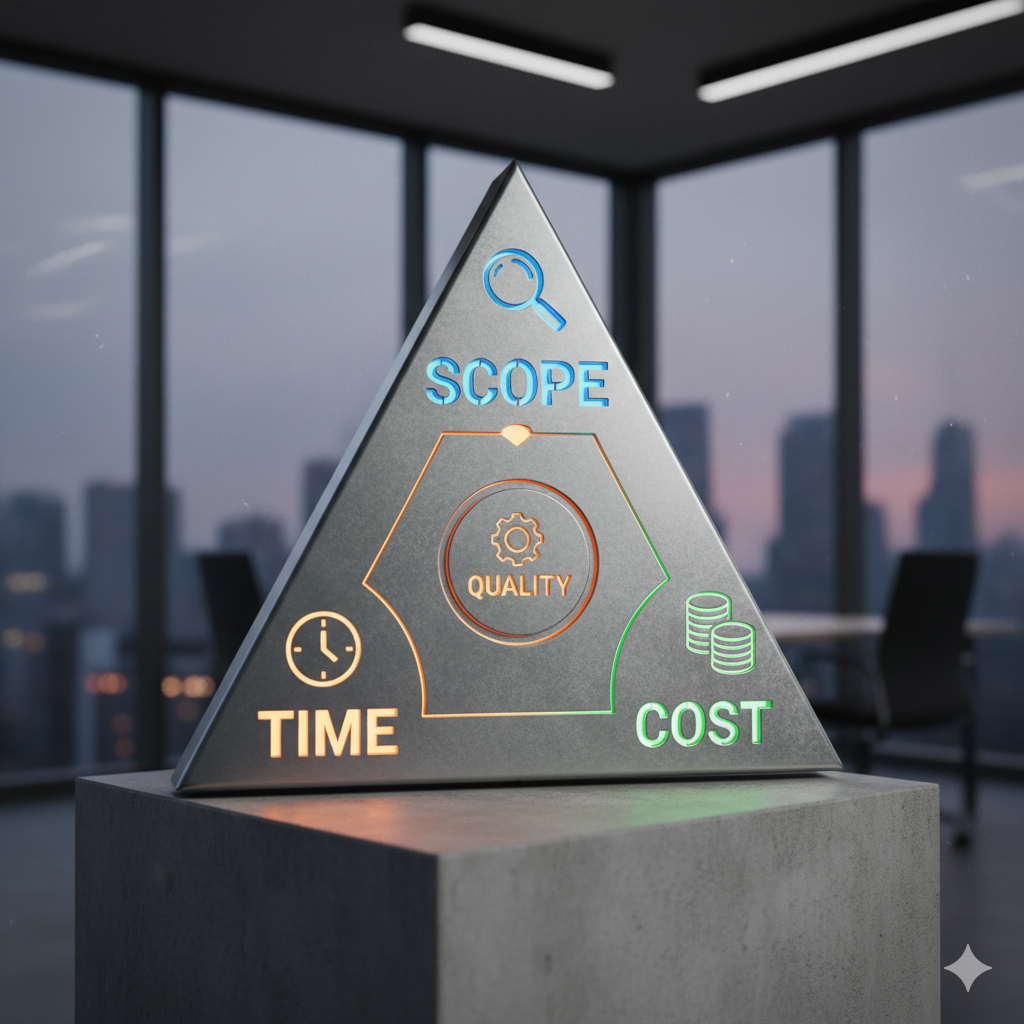
Modern project practice recognizes that three constraints are not quite enough to capture the full picture. Quality belongs on that list. Cutting scope to hit a deadline is a legitimate trade-off only if the reduced scope is still fit for purpose. Cutting quality is a different kind of trade-off, one with downstream consequences that rarely show up in the project schedule but show up prominently in user experience, rework costs, and reputation damage afterward. Resource availability is a separate problem from budget. You may have the money to hire three additional engineers, but the engineers you need may not exist or may not be free when you need them. Unmanaged risk creates a hidden tax on every other constraint: when risks materialize, they consume cost contingency, compress schedule margins, and force scope decisions under pressure rather than in advance. And stakeholder expectations, left unmanaged, tend to surface as formal objections at the worst possible moment. Managing all of these together is the actual job. A project manager who watches only scope, time, and cost while ignoring quality, resource availability, risk exposure, and stakeholder readiness is watching the wrong set of dials.
The Value Projects Create
Projects create value, and that value takes different forms depending on the project's purpose. Financial value is the most straightforward kind to measure: new revenue streams, cost reductions, efficiency gains that free capacity for higher-value work. A logistics company building a route optimization system is pursuing financial value. A manufacturer automating a manual quality assurance process is pursuing it too. These projects can be evaluated against a clear return on investment, which makes trade-off decisions during execution more quantifiable.
Strategic value is harder to put in a spreadsheet but often more important. Entering a new market before a competitor, building a data capability that positions the organization for a future pivot, establishing a brand presence in a geography where none existed before: these investments do not always generate immediate financial return, but they change what the organization can do next. The value is in the option the project creates, not only the output it delivers. For project managers working on strategic initiatives, this distinction matters because the usual cost and schedule metrics may not capture whether the project is succeeding at what it was actually meant to accomplish.
Social value matters for organizations whose mission is explicitly public or community-facing. A government agency building a new transit system, a healthcare network implementing an electronic records platform, a nonprofit developing a community resource hub: in these cases the return is measured in safer streets, better health outcomes, or stronger community services. These measures are harder to quantify, which does not make them less real. Understanding what kind of value a project is meant to create changes how you evaluate decisions throughout the project. Speed may be the priority for a strategic project. Quality may be the priority for a public safety project. Cost may be the priority for a cost-reduction project. The value type shapes the constraint priority, which shapes every decision that follows.
The Project Lifecycle
Projects move through phases, and those phases provide a shared language for where the work stands at any given time. The five-phase structure that most practitioners recognize is initiation, planning, execution, monitoring and controlling, and closing.
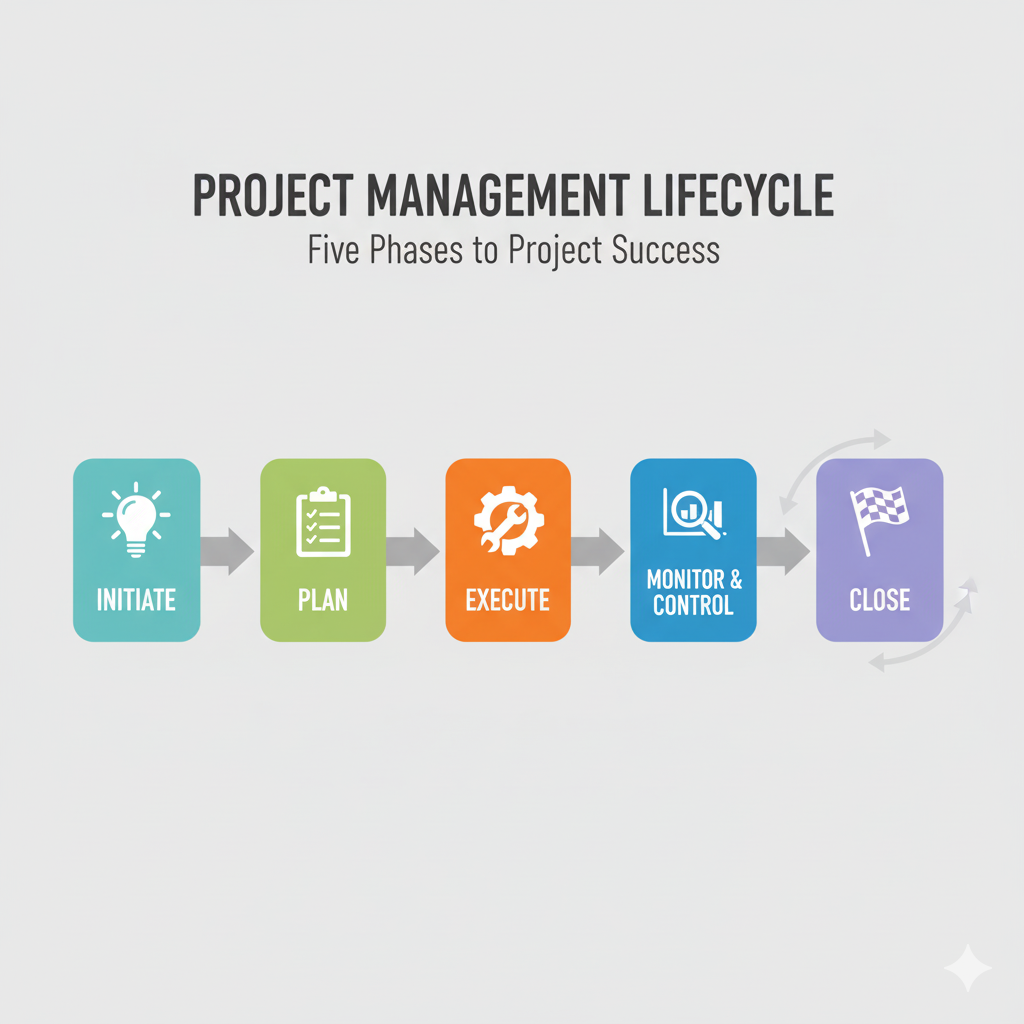
Initiation is where a project gets authorized. The goal is established, the business case is confirmed, the right sponsor is engaged, and the project is formally recognized as something the organization has decided to pursue. Without formal initiation, projects often exist in an ambiguous state where everyone assumes someone else is driving and no one has the authority to make real decisions. Initiation produces the project charter, the document that formalizes the project's existence and gives the project manager the authority to apply organizational resources toward the defined objective.
Planning is where the team figures out how to deliver what was authorized. Scope gets defined in detail. A schedule gets built. Costs get estimated. Risks get identified and analyzed. Resource needs get assessed. All of this comes together in a baseline plan that serves as the shared reference against which progress will be measured. Planning is not about predicting the future perfectly. It is about creating a framework for recognizing when reality is diverging from expectation, so that adjustments can be made deliberately rather than by crisis. A good plan is not a constraint on the team. It is a shared definition of success that every decision from that point forward can be measured against.
Execution is where the actual work gets done. Deliverables are produced, teams are managed, vendors are engaged, and the project generates real outputs. This is the phase that most people think of when they imagine what a project looks like, because it is the visible and active part. But execution without the foundation of solid initiation and planning is how projects drift into the kind of trouble that is expensive and embarrassing to fix.
Monitoring and controlling runs in parallel with execution throughout the project. It is not a separate phase that happens after execution. It happens continuously: tracking progress against the plan, identifying deviations early, assessing their impact, and making adjustments before small variances become unrecoverable gaps. The project manager who checks progress only at major milestones is operating blind between them. By the time a milestone reveals a problem, the options for addressing it are already limited.
Closing wraps up the work. Deliverables are confirmed as complete and accepted. Team members and contracts are formally released. Lessons learned are documented. And the project is officially ended. A project that is never formally closed tends to keep consuming resources, generating change requests, and pulling PM attention long after the core work is done. Closing disciplines ensure that the investment in the project is properly accounted for and that what the team learned has a chance of benefiting whoever runs a similar project next.
These phases are a guide, not a straitjacket. A small internal project might compress initiation and planning into a single working session. A large program might run planning activities in overlapping waves as the work unfolds. What does not change is the underlying logic: authorize before you plan, plan before you execute, track as you execute, and wrap up properly when you are done.
On her first day as project manager for a new internal software tool, Maya walked into a kickoff meeting to find developers already debating architecture, a designer mid-wireframe, and a whiteboard covered in competitor research. The energy in the room was real. Then she asked one question: "Has anyone defined what we are actually building?" The room went quiet. The lead developer's response was delivered with conviction: "We know what we're building. Planning is where projects go to die." But there was no charter, no agreed scope, no budget clarity, no milestone dates. Maya's task was not to slow the team down. It was to redirect the energy. She called a focused two-hour working session built around five questions: What are we building? What are we not building? Who needs to approve it? When does it need to be done? What do we have to spend? What came out of that session was not a constraint on the team's creativity. It was a shared definition of success, the thing every decision afterward could be measured against. A project that skips planning does not move faster. It moves confidently in the wrong direction.
Tailoring: The Right Process for the Right Project
There is no single correct approach that works for every project. A three-week product sprint at a startup and a five-year infrastructure program at a government agency have almost nothing in common in terms of scale, formality, governance, and process depth. Applying the same level of rigor to both is wrong in opposite directions: too heavy for the sprint, too light for the program.
Tailoring is the practice of selecting and calibrating your process to fit the actual project in front of you. For simple efforts, a lightweight approach with visual task boards, brief planning sessions, and informal check-ins may be entirely sufficient. For complex or high-risk work, deeper analysis, formal baselines, structured change control, and documented decisions are what keep large numbers of people coordinated over long timelines. Tailoring is not cutting corners. It is choosing the level of process that delivers predictable results for this project, not some hypothetical average project. The factors that should guide your tailoring decisions include the size and duration of the project, the level of risk and uncertainty involved, the organizational culture and its project management maturity, the experience level of the team, and any regulatory or compliance requirements. A project that is small, familiar, and low-risk needs less formal scaffolding. A project that is large, novel, and involves regulatory approval needs considerably more.
| If the project is... | Consider... |
|---|---|
| Small, short, low-risk, and familiar to the team | Visual task board, brief planning session, informal check-ins, lightweight documentation |
| Cross-functional with external dependencies and moderate uncertainty | Project charter, stakeholder map, risk log, schedule baseline, change log |
| Large, novel, high-risk, regulated, or expensive to recover from if wrong | Formal governance, documented baselines, structured change control, formal approvals at each phase gate |
Common Pitfalls
Projects fail in recognizable ways. Understanding these patterns before you encounter them is one of the most practical things you can take from this chapter, because these are the traps that catch experienced project managers who know better, not just beginners on their first assignment.
Vague goals are the most damaging trap, and the most common. When the project's objective is unclear, every team member fills in the gaps with their own interpretation. Design heads one direction. Engineering heads another. By the time the project is deep in execution, the divergence is substantial and expensive to correct. If you cannot write down what done looks like in terms that everyone involved can agree on, the project is not ready to proceed to planning.
The planning phase is also the one people most often try to skip. Teams eager to build, or under pressure to show early momentum, compress it or eliminate it entirely. The instinct to start building feels productive. What it produces in practice is work that needs to be redone once the actual requirements become clear. The time invested in planning pays back at a multiplier during execution.
Risks left unaddressed do not stay manageable. They escalate, compound with other risks, and arrive as crises at the worst possible moment. The project manager who acknowledges that a risk is real but postpones dealing with it is borrowing against a debt that will come due, usually at exactly the point in the project when the team has the least capacity to absorb the impact.
Informal changes are where plans go to die slowly. Every project receives change requests, and some are legitimate improvements. The trap is allowing them to happen without evaluation, approval, or impact assessment. Each informal change adds scope, cost, or complexity without the plan reflecting the addition. Over time, the gap between the plan and what is actually being built becomes so large that the plan is useless as a management tool. By then, no one can answer the question everyone eventually asks: are we on track?
Stakeholders who are only informed, not meaningfully engaged, tend to wait until the worst moment to surface objections. Requirements that were never raised during planning appear during acceptance testing. Expectations that were never aligned with project reality show up as rejection at delivery. Discovering these gaps at the end of a project costs far more than surfacing them at the start.
Finally, a plan built on full-time commitment from people who have other jobs is not a plan. It is an optimistic assumption that will fail on contact with the actual week. Resource availability, not just resource identity, must be confirmed before the plan is baselined. The name on a task means nothing if the person is committed at twenty-five percent and the task requires eighty.
How to Think Like a Project Manager
Project management is as much a mindset as a skill set. The technical tools matter. The process knowledge matters. But the practitioners who consistently deliver are identifiable by how they think about work, not only by what tools they use.
Outcome focus is the starting point. Before accepting any task, raising any concern, or making any recommendation, connect it to the project's objective. Not "what are we doing" but "what are we trying to achieve, and how will we know when we have achieved it?" Outcome focus keeps the team oriented toward the destination even when the path is changing. It also surfaces the right trade-off questions early, before the wrong decision gets embedded in the work.
Early problem surfacing is the discipline that separates project managers who prevent crises from those who manage them. Waiting until a problem is fully confirmed before raising it means the options for addressing it are already narrowing. Raising a problem when it is a signal, not yet a certainty, gives the organization time to make a real decision rather than a desperate one. The instinct to hold off until you have more information is almost always wrong.
Communication discipline means simple, frequent, honest updates with the right people at the right time. The project manager who over-communicates creates noise. The one who under-communicates creates fear and speculation. The calibration is a skill, but when in doubt, bias toward clarity and frequency over silence.
Finally, treat the plan as a living guide, not a contract. A plan is the best available picture of how the work will unfold given what you knew when you created it. As you learn more, the plan updates. The project manager who defends the original plan against contradicting evidence is not managing. They are pretending. The one who updates the plan based on what is actually happening, communicates the changes clearly, and adjusts expectations accordingly is doing the real work.
Planning for Change Before It Arrives
There is a difference between a project that responds to change and a project that was built to absorb it. Responding to change is reactive: something unexpected happens, the team scrambles, and the project manager negotiates for adjustments. Building for adaptability is different. It means designing the project approach from the start in ways that reduce the cost of adjustment when conditions shift, as they always do on any project of meaningful complexity. This is not the same as assuming the plan will fail. It is a recognition that the information you need to plan phase three in detail does not exist at the start of phase one, and that the risks you cannot yet see deserve the same respect as the ones you can already name.
Several habits make a project approach genuinely adaptable. Rolling wave planning is one: plan near-term work in depth and leave later phases at a higher level of abstraction until more is known. Reserve sizing is another: contingency reserves should reflect the actual probability and impact of identified risks, not a conventional percentage that may be too thin or too generous for the specific project in front of you. Pre-approved response paths for high-impact risks are a third. Instead of inventing a response under pressure when a major risk materializes, the team has already agreed what to do if it does. These approaches reduce the gap between what the project plan assumes and what execution actually requires.
Team resilience matters here too, and it is easy to underinvest in. A team where critical knowledge lives in one person, where only one engineer understands the integration architecture or only one coordinator holds the vendor relationships, is fragile whether the plan acknowledges it or not. Cross-training, documented handoffs, and knowledge-sharing habits reduce the project's exposure when a key person is unavailable. None of this eliminates uncertainty. What it does is reduce the cost of navigating it, which over the course of a real project is often the difference between a managed setback and a derailment.
Where Your Project Lives: Organizational Structure
Projects do not exist in a vacuum. They live inside organizations, and the structure of those organizations shapes nearly every practical reality of how a project gets managed. The amount of authority a project manager holds, how easily resources can be secured, how decisions get made and who makes them: all of this depends on where projects sit within the organizational design. Understanding this is not background knowledge. It is practical knowledge you will use from the first day of any project you lead.
Functional organizations are built around departments: engineering, marketing, finance, operations. Work flows through these departments, and functional managers control both the work and the people who do it. Project managers in functional organizations typically hold limited formal authority. When they need an engineer or a designer, they must negotiate with the functional manager who owns those people. That manager's department priorities may or may not align with the project's priorities. Project managers in functional settings spend significant effort on influence and negotiation because their formal authority does not match their actual responsibility. Getting things done requires relationship currency, clarity of communication, and persistence.
Matrix organizations blend functional departments with project structures. Team members report to both a functional manager and a project manager, which gives the project manager more influence than in a purely functional setup but also creates friction. In a weak matrix, the functional manager still holds most of the authority. In a strong matrix, the project manager holds more. In a balanced matrix, authority is genuinely shared, which means decisions often require coordination between both. Matrix organizations are common in large organizations that run multiple simultaneous projects while maintaining stable functional departments.
Projectized organizations are built around projects themselves. Teams are fully dedicated to the project, and the project manager holds real authority over the work, the budget, and the team. When the project ends, the team disbands or moves to a new project. Consulting firms, construction companies, and defense contractors often operate this way. The project manager in a projectized organization has the clearest mandate and the most direct control, but also the most direct accountability when things go wrong.
Most real organizations sit somewhere on the spectrum between these three types, and the hybrid reality is often more complicated than any model captures cleanly. The practical question to answer as a project manager is simple: when you need something, what actually happens? Who decides? If the decision runs through you, you are in a projectized environment. If it runs through someone else who has competing priorities, you are in a functional or weak matrix environment, and your approach to influence and communication needs to reflect that reality.
| Functional | Matrix | Projectized | |
|---|---|---|---|
| PM authority | Low — limited formal authority; influence through relationships | Shared — negotiated with department managers | High — full authority over the project |
| Team dedication | Part-time — members split across department work | Part-time to full-time — varies by matrix strength | Full-time — team dedicated to the project |
| Resource control | Department manager controls who works on what | Shared between PM and department manager | Project manager controls team and budget |
| How PM gets things done | Influence, negotiation, relationship currency | Influence plus some formal authority | Direct direction and decision-making |
| Common in | Stable organizations with dominant ongoing operations | Large organizations running multiple simultaneous projects | Consulting firms, construction, defense contracting |
When you are new to an organization or a project, three questions quickly reveal where you actually sit on this spectrum. Who controls the people assigned to your project? Who has the authority to approve changes to scope, schedule, or budget? And when you disagree with a functional manager about a resource or a priority, whose call is it? The answers tell you more about your real working authority than any org chart does.
The Project Management Office
Many organizations that run multiple concurrent projects have a Project Management Office, commonly called a PMO. The PMO is the organizational unit responsible for setting project management standards, maintaining governance frameworks, and in some cases directly managing projects on behalf of the organization. PMOs vary considerably in how much authority they hold. A supportive PMO acts as a resource center: it provides templates, training, historical project data, and best practices, but it does not mandate how individual projects are run. Project managers in supportive PMO environments have significant discretion over how they approach the work. A controlling PMO requires compliance. It mandates the use of specific methodologies, reporting formats, or governance gates, and it monitors whether projects are following them. The structure creates consistency and accumulates organizational learning across projects, at the cost of flexibility. A directive PMO goes furthest: it directly manages projects, assigns project managers from its own staff, and takes hands-on ownership of delivery. In directive PMO environments, the PMO is not a support function. It is the delivery function, and the project manager reports into it rather than drawing from it as a resource.
When you work with a client organization, you may also interact with their PMO. That PMO may have specific requirements about how projects are governed, how status is reported, or how change requests are processed. Identifying what the client's PMO needs from you early, and establishing that relationship before you are already in the middle of a problem, prevents the kind of friction that surfaces at exactly the wrong moment.
The PM's Relationships
Every project involves three fundamental relationships, and how you manage each one determines much of the project's outcome.
The relationship with the project sponsor is the most consequential. The sponsor is the senior leader who authorized the project, owns the business case, and is accountable for the outcome. Your role in this relationship is to keep the sponsor informed without overwhelming them, to surface decisions only when they genuinely need to make one, and to protect them from surprises. Think of it as driving a truck: the sponsor has set the destination and expects on-time delivery within scope and cost. When the road changes, you call it out, present route options, and get approval before turning. They count on you to drive with calm hands, clear signals, and a steady pace. What sponsors need from you regularly is not a comprehensive status dump. They need two things: evidence that the project is on track across time, budget, and scope, and early notice of any risk or decision that requires their attention. When you bring them problems, bring options and a recommendation alongside them. Sponsors who trust their project manager become powerful allies. The ones kept in the dark become obstacles at exactly the wrong moment.
The relationship with the project team is built on clarity and trust. People who know exactly what they are responsible for, understand how their work connects to the broader objective, and believe that problems raised early will be addressed rather than punished tend to perform far better than those working in ambiguity. Your job as project manager is not to control the work in detail. It is to create the conditions where the work can happen at its best: clear goals, defined accountabilities, obstacles removed promptly, and an environment where it is safe to say "this is not working" before the problem compounds. This approach, often called servant leadership, is not passive. It requires active attention to what is blocking people, deliberate effort to develop team members, and the discipline to resist the temptation to micromanage when pressure builds and deadlines approach.
The relationship with other stakeholders is broader and more easily underestimated. Stakeholders include users, customers, functional managers, regulatory bodies, vendors, and anyone else with an interest in what the project builds or how it builds it. The list is reliably longer than it appears at first. Managing these relationships means understanding what each group actually cares about, not just what they say they want. It means communicating in terms that are relevant to each audience's priorities. And it means identifying early when someone's expectations are drifting away from what the project can realistically deliver, so that the gap can be addressed before it turns into a formal objection at a critical milestone.
The PM as Integrator
The role that is easiest to miss from outside and hardest to replace from inside: the project manager holds all the connections together. Every part of a project connects to every other part. Scope changes drive schedule changes. Schedule changes drive cost changes. Cost changes constrain resource options. Resource constraints create quality risk. Quality risk creates stakeholder satisfaction risk. No individual team member sees all of these connections at once. The project manager does, and the active management of those connections is what separates a project manager from a task tracker.
When the lead engineer proposes changing a technical approach mid-project, the project manager evaluates not just the technical logic but the schedule impact, the cost implication, the downstream effect on testing and deployment, and whether the sponsor needs to be informed before the change is made. When a vendor reports a delay, the project manager maps the dependency chain to understand what else is affected and whether contingency exists to absorb the impact without touching the critical path. When a stakeholder group changes its requirements late in the project, the project manager assesses what the change means for every other constraint, not just the one most directly affected, and presents the trade-off clearly to whoever has the authority to approve it.
This integrating function is why good project managers are not easily replaced by good schedulers, good communicators, or good administrators. Those are skills the project manager also needs. The integrating perspective, the ability to hold all the parts in mind simultaneously and see how changes propagate through the system, is the distinctive competency of the role. It is also the reason the project manager needs to be involved in decisions that individual team members might be inclined to handle independently. The person who sees all the connections is the person who needs to be in the room when a connection is about to change.
Ethics: Your Professional Baseline
Ethics in project management is not a compliance topic. It is not about memorizing rules for a certification exam. It is about how you behave when no one is checking, when the deadline is severe, when a client is pushing for something that makes you uncomfortable, or when a colleague makes a mistake that you alone know about. Ethical behavior under pressure is what builds the professional credibility that makes you effective over a career, not just on a single project. Your credibility becomes a hard asset. It makes approvals smoother, escalations calmer, and outcomes more reliable. When you bend your ethical baseline, the consequences multiply faster than you expect.
The Four Core Values
Professional ethics in project management rests on four values: responsibility, respect, fairness, and honesty. These are not abstract ideals. They are behavioral standards that define how you act when things get complicated.
Responsibility means you own your decisions and their consequences. You acknowledge mistakes directly instead of hoping they go unnoticed. You report risks even when the news is unwelcome. You deliver on commitments, and when you cannot, you say so early and with a recovery plan already forming. Responsibility is not about being perfect. It is about being accountable. The team, the sponsor, and the client need to know that when you say something will happen, you mean it, and that when it cannot, they will hear it from you first. A project manager who filters bad news upward until it becomes unavoidable is a greater risk to the project than the bad news itself.
Respect means you treat every person, regardless of seniority, role, culture, or background, with basic dignity. It shows in specific daily behaviors: listening fully before responding, giving credit publicly for work that deserves it, coaching privately when performance needs attention, keeping critiques about the work rather than the person, and creating meeting formats where quieter voices can contribute rather than being drowned out by the most assertive people in the room. Respect is not a soft concept. It creates the psychological safety that makes teams willing to surface problems early. Teams without it hide problems until those problems become crises.
Fairness means decisions are made on consistent, transparent criteria rather than personal preference or political convenience. Vendor selection uses documented scoring rather than hidden preferences. Work gets assigned based on skills and development goals, not on who complains least about difficult assignments. High-visibility tasks rotate so that the same people are not always receiving the credit and the same people are not always doing the unglamorous work. Facts get separated from opinions in performance conversations. When the rules apply to everyone and decisions can be explained openly, people may disagree with specific outcomes while still trusting the process.
Honesty means you report what is true, not what people want to hear. Sponsors want confidence. Clients want certainty. Stakeholders want good news. Honest reporting means distinguishing facts from forecasts, acknowledging uncertainty with ranges rather than hiding it behind false precision, and never adjusting estimates or metrics to make the picture look better than it is. The short-term comfort of a favorable status report is never worth the long-term damage of a surprise that could have been prevented. Honest project managers build the credibility that earns flexibility when things go wrong. Project managers who have been consistently optimistic in the past get escalations when patience runs out.
Conflicts of Interest
A conflict of interest exists when a personal interest could influence a professional decision. The key word is "could." You do not need to act on the conflict for it to be a problem. You need to disclose it. A project manager who selects a vendor because of a personal relationship with the vendor's principal has compromised the selection process, whether or not that vendor happened to be the best choice. The solution is not to pretend the relationship does not exist. It is to disclose it before the selection begins, excuse yourself from the decision if impartiality is not credibly possible, and document how the situation was handled. Gifts from vendors deserve the same treatment. Follow your organization's policy. Refuse anything that creates even the appearance of obligation. Document borderline situations rather than resolving them silently in your own favor, and seek advice from legal or compliance when you are uncertain. The standard is not "can I justify this to myself?" It is "would this hold up to scrutiny from someone outside this situation?"
Confidentiality and Data Protection
Projects routinely handle sensitive information: budget details, personnel decisions, customer data, intellectual property, strategic plans, and business cases that are not ready for public disclosure. Treating this information carelessly is an ethical failure, not just a policy violation. Protecting it means limiting access to those who genuinely need it, avoiding discussions of confidential details in shared spaces where they can be overheard, securing documents and devices, and reporting suspected data breaches immediately rather than hoping the problem resolves itself quietly. Confidentiality obligations do not disappear when a project ends. The information your project generated remains sensitive long after your involvement with it does. This obligation also extends to AI tools: information entered into an AI system may be stored or used in ways that are not fully transparent. Know your organization's policies on what data may be processed externally before you send anything into an AI tool that has not been specifically reviewed and approved for that use.
Truthful Reporting
Ethical project reporting means presenting metrics that inform decisions, not metrics that decorate status slides. It means explaining your data sources and methods briefly so that readers understand what they are actually looking at. It means showing uncertainty with ranges rather than false precision. A schedule that shows the completion date as June 17 when the actual estimate is somewhere between June 10 and July 5 is not more professional. It is less honest. Ethical reporting means not cherry-picking favorable time windows or excluding data points that complicate the picture. When a baseline needs to change, it changes through the agreed change control process, not by quietly shifting the reference point and hoping no one notices the gap between the old numbers and the new ones. When you report metrics with evidence and context, you build the long-term credibility that earns you the benefit of the doubt when things genuinely get complicated.
Working With Vendors and Partners
Ethical vendor management means treating every vendor in a competitive process with equal access to information. You do not share one bidder's pricing or approach with a competing bidder. You do not use confidential pricing obtained from one vendor to pressure a different vendor into a lower number. You document acceptance criteria before work begins rather than defining them after delivery in a way that conveniently disadvantages the vendor. You resolve disputes using contract terms and documented evidence rather than economic leverage. Strong ethics in vendor relationships attract capable partners and deter the behavior that creates expensive problems late in a project. Weak ethics in vendor relationships invite exactly the behavior they deserve, and the cost shows up in the project.
AI and Ethics
AI tools are increasingly useful in project work: drafting charters from meeting notes, summarizing stakeholder feedback, identifying risks from a project description, and structuring status updates for different audiences. Used well, they compress administrative tasks so the PM can spend more time on judgment, relationships, and decisions that cannot be automated. That said, as AI tools become part of standard project work, new ethical obligations have emerged alongside them. You should disclose when AI-assisted analysis or AI-generated content has materially informed a significant project decision, so that decision-makers understand what they are relying on. You should validate AI outputs with human judgment before acting on them, because AI tools can produce confident-sounding results that are factually wrong. You should not use AI tools to inflate progress figures, generate optimistic forecasts, or mask gaps in analysis. And you should protect the data you feed into AI tools, because that data may contain confidential information belonging to your organization, your clients, or the people your project serves. When AI tools produce results that seem implausible or suspiciously convenient, question them rather than accepting them because they support a conclusion you wanted to reach.
When You See a Problem
Recognizing an ethical problem is only the first step. Acting on it correctly is harder, and harder still when the people involved have more seniority than you do. When you observe something that should not be happening, start with documentation: record what you observed, when, where, and who was present. Then address it at the most direct level possible. Raise it with the person closest to the issue before escalating. If the behavior continues or the risk is significant enough to warrant immediate escalation, use your organization's formal channels, which might include your manager, the legal team, the compliance function, or an ethics reporting line depending on the nature of the situation. Through all of this, maintain confidentiality and avoid public accusations. The goal is to stop the harmful behavior and protect the people affected by it, not to assign blame loudly. Early, calm, documented action prevents harm and protects everyone involved, including you.
A project manager on an infrastructure project in an unfamiliar country was watching the schedule slip. Local regulatory approvals were running twice as long as projected, and the sponsor was asking questions that did not yet have good answers. Over lunch, the local consultant the organization had hired leaned in and offered what he called a practical solution: a payment to the approving official's office would clear the approvals in a week. "Everyone does it here," he said. The framing was a rationalization, not a justification. What he was describing was a bribe. Project managers working in international environments must comply with the laws of their home country, the laws of the host country, and their organization's own code of conduct. In many jurisdictions, paying a foreign official is a criminal offense even when it happens overseas. The project manager's response was immediate: "I will need to look into what is permissible before we make any decisions." The conversation was documented the same day, and the legal and compliance teams were involved before any further action was taken. Schedule pressure, however real, is never a justification for a shortcut that puts the organization, the project manager's professional standing, and potentially their freedom at legal and ethical risk.
Standards and Professional Credentials
If two people both call themselves project managers, you have no immediate way of knowing whether they apply the same practices, use the same terminology, or work from anything resembling a shared framework. One may show up with a detailed plan and structured governance. Another may prefer to stay flexible and work from instinct. Standards exist because this ambiguity is expensive. They create a common language and a shared definition of what good project management looks like, so that organizations, hiring managers, clients, and practitioners can communicate credibly about how work will be managed.
The Project Management Institute, known as PMI, is the largest professional body for project management in the world. Founded in 1969 and operating globally, PMI publishes guidance, frameworks, and practice standards that have shaped how project management is taught and practiced across industries and regions. PMI's most recognized credential is the Project Management Professional, or PMP. A PMP holder has met defined experience thresholds and passed a rigorous exam covering a broad range of project management knowledge. The Certified Associate in Project Management, or CAPM, serves practitioners earlier in their careers who have not yet accumulated the experience required for the PMP. In competitive hiring processes and client procurement evaluations, these credentials are frequently used as a screening criterion and can influence whether a practitioner is selected for an engagement.
PRINCE2, which stands for Projects IN Controlled Environments, operates from a different philosophy. Where PMI frameworks tend to be principle-based and adaptable to a wide range of project types, PRINCE2 is process-driven. It defines specific roles, decision stages, management products, and governance requirements that must be in place for the method to be properly applied. PRINCE2 originated with the UK government and remains widely used in British and European public sector environments, as well as in organizations that require structured, auditable governance as a baseline condition. If you work in government contracting, infrastructure, or large institutional organizations in those regions, you are likely to encounter PRINCE2 credentials and terminology.
Other bodies worth knowing include the International Project Management Association, known as IPMA, which uses a competency-based credentialing model and operates through a network of national associations across Europe, Asia, and other regions. ISO 21500 is an international standard providing a framework-agnostic set of concepts and processes for project management, useful as a reference point in organizations that operate across multiple national contexts. Agile frameworks including Scrum, Kanban, and the Scaled Agile Framework, known as SAFe, originated in software development and have since expanded significantly into other domains. These are not traditional project management standards, but they represent an increasingly significant portion of how project work is actually organized and delivered in practice. Subsequent chapters address them directly.
No single standard is universally correct. A small startup running a three-week sprint does not need a PRINCE2 governance structure. A large infrastructure program managed on informal conversations and gut instinct is a preventable disaster. The framework you draw from should fit the size, risk, culture, and complexity of the project in front of you. Practitioners who understand multiple frameworks have more tools available to them. That flexibility is not confusion. It is professional range, and it is one of the most valuable things you can bring to any project environment.
A credential opens a door. What you do with the knowledge, how you handle pressure, how you communicate, how you build trust with teams and sponsors: those are what determine whether a career in project management produces consistent results or consistent explanations for why results did not materialize. Standards give you a foundation. You build the house yourself.
What's Next
The next chapter, Project Management Essentials, builds on this foundation by moving from the broad definition of what project management is to the specific tools and concepts practitioners use from the earliest stages of any project, including how organizations evaluate and select projects before authorizing them, the financial metrics used to justify project investment, and how project managers think about scope, assumptions, and boundaries before planning begins in earnest.
Reflect
- Think about a project you have managed or participated in. Which of the six common pitfalls listed in this chapter caused the most damage, and what would early action have looked like?
- How would you describe the organizational structure of your current workplace? How does that structure affect your ability to get resources, make decisions, and hold people accountable on a project?
- Look at the three types of value projects create: financial, strategic, and social. Which type best describes the projects you typically work on, and how does the value type change which constraints matter most?
- Where in your professional life have you seen one of the four ethical values, responsibility, respect, fairness, or honesty, compromised under pressure? What happened as a result, and what would the right response have looked like?
- Which PM standard or credential is most relevant to the kind of work you do or want to do? What is the gap between holding that credential and being genuinely good at the work it represents?
Advanced Lean Six Sigma — Data-Driven Excellence
Solve complex problems, reduce variation, and improve performance with confidence. This course is designed for professionals who already know the basics and want to apply advanced Lean Six Sigma tools to real business challenges.
This is not abstract statistics or theory-heavy training. You’ll use Excel to perform real analysis, interpret results correctly, and apply tools like DMAIC, SIPOC, MSA, hypothesis testing, and regression without memorizing formulas or relying on expensive software.
You’ll learn how to measure baseline performance, analyze process capability, use control charts to maintain stability, and validate improvements using statistical evidence. Templates, worked examples, and structured walkthroughs help you apply each concept immediately.
Learn through a complete, real-world Lean Six Sigma project and develop the skills to lead data-driven improvements with credibility. If you’re ready to move beyond basics and make decisions backed by data, enroll now and take your Lean Six Sigma expertise to the next level.
Explore the Course
Build the Sprint Reporting System, Not Another Prompt
AI Systems with Claude is our own course for Scrum Masters and Agile Project Managers, taught against one running project across eight teaching sections. You build five working systems and keep them: the sprint report machine, the retro intelligence system, the stakeholder comms engine, the backlog health monitor, and the risk and dependency tracker. Direct from HK School of Management, not on Udemy.
See What Is Included