
Limited-time Udemy offer
$9.99
Leadership For Project Managers Leading People And Projects
Unlimited redemptions
Available until September 18, 2026 5:09 PM PDT
66D6FD5906E09C4284FE
There is a category of project risk that almost never appears in a formal risk register: the knowledge your team builds as it works has no owner except the person who built it. The engineer who cracked the tricky API limitation carries that solution in their head. The analyst who figured out why the vendor data was arriving corrupted learned something the team will need again. The logistics coordinator who found the workaround when the scheduled vendor fell through figured out something worth keeping. When those people leave, what they know leaves with them, unless the project made capturing it part of how the team works.
Managing project knowledge is an active process that runs throughout execution, not a documentation event at the project's close. Many projects treat knowledge capture as an end-of-project documentation task. Projects that build lightweight sharing habits during execution are more likely to repeat fewer mistakes and make better use of what the team has already learned. The scenario below shows what skipping it actually costs.
In week three, the senior integration specialist found a workaround for a tricky API problem that unblocked the team and saved two weeks of work. The PM thanked her in a status update, and nobody wrote anything down.
Six weeks later, she handed in her resignation. That same afternoon, another team member came to the PM stuck on what sounded like the same limitation. Buried in a two-month-old Slack thread was a message that might have helped him, but he had never seen it.
The PM did not ask for a knowledge transfer session. He sent one email: "Can you write three sentences about that API fix from week three: what the problem was, what you did, and where any notes live?" She sent the note that evening. The other team member read it the next morning and resolved the issue within the hour. At the next standup, the PM added a standing question: "What did we learn this week that someone else might need?" A shared file with entries from that question had seventeen entries by project close. Three of them prevented real problems in the following month.
Effective knowledge management comes down to three elements: the people on your team, the habits you build together, and the tools you give those habits a home in. Of the three, habits matter most and are skipped most often. A sophisticated knowledge management system that nobody uses produces nothing. A five-minute standing question at the end of each team meeting, where someone records what the team learned that week, produces something searchable and useful six weeks later when someone needs it.
As PM, the job is to make knowledge-sharing visible, normal, and expected — not something that only happens when someone is explicitly asked to write a formal document. A quick process note when someone finds a better approach, a short entry in a shared file when a workaround unblocks a problem, and the standing question in the standup that asks what the team learned this week. None of this requires a platform or a policy. It requires intent, and it requires the PM to model the expectation until the team does it without being prompted.
The output most people associate with knowledge management is the lessons learned register. That matters, but if it is the only output the project is looking for, most of the value is being left behind. Effective knowledge management also produces updates to the management plans themselves. When the team discovers that a process step is taking twice as long as estimated and finds a better approach, that insight should change how future work is planned, not just get filed in a document at project close. The update to the plan is the knowledge becoming useful.
Two types of knowledge require different management approaches. Explicit knowledge is documented and transferable: a written workaround, a lessons-learned entry, a process note in a shared file that another team member can read and act on without a conversation. Tacit knowledge is embedded in people: the engineer who knows from experience which integration approach tends to fail under certain conditions, the coordinator who reads a vendor situation correctly because she has navigated that relationship before. Explicit knowledge is captured. Tacit knowledge is shared through working relationships, deliberate pairing, and structured handoffs, and it is the harder and more valuable kind to preserve.
For years in the automotive industry, stopping the production line was a decision reserved for management. Plants calculated the cost in thousands of dollars per minute, and halting production was too consequential for an individual line worker to trigger alone. Then organizations started giving individual workers the authority to stop the line the moment they spotted a quality defect. Not after the shift. Not after filing a report. Right then. The results were dramatic, not because the cost of stopping disappeared, but because the cost of not stopping was finally understood. A defect caught at the source costs almost nothing to fix. The same defect caught after it has been built into ten more assemblies and shipped to a customer costs multiples of that in rework, in relationship damage, and in credibility that is slow to recover.
That logic applies to every project deliverable. A quality problem caught before a deliverable moves downstream is cheap and fast to address. The same problem found by the client after delivery is expensive in ways that go well beyond the rework itself. This is why quality management in execution is not an end-of-phase review. It is a daily discipline built into how the team works.
Quality assurance focuses on the processes used to build the project: are we following the right steps? Quality management is broader. It asks whether the right steps are being followed and whether those steps are producing deliverables that meet the acceptance criteria defined in the quality plan. In execution, you are doing both. The team follows defined processes, and the PM evaluates whether the work produced actually meets the standards the project committed to. The quality plan built during planning is the reference. Execution is where the team acts on it every day, and where the PM holds the standard consistently.
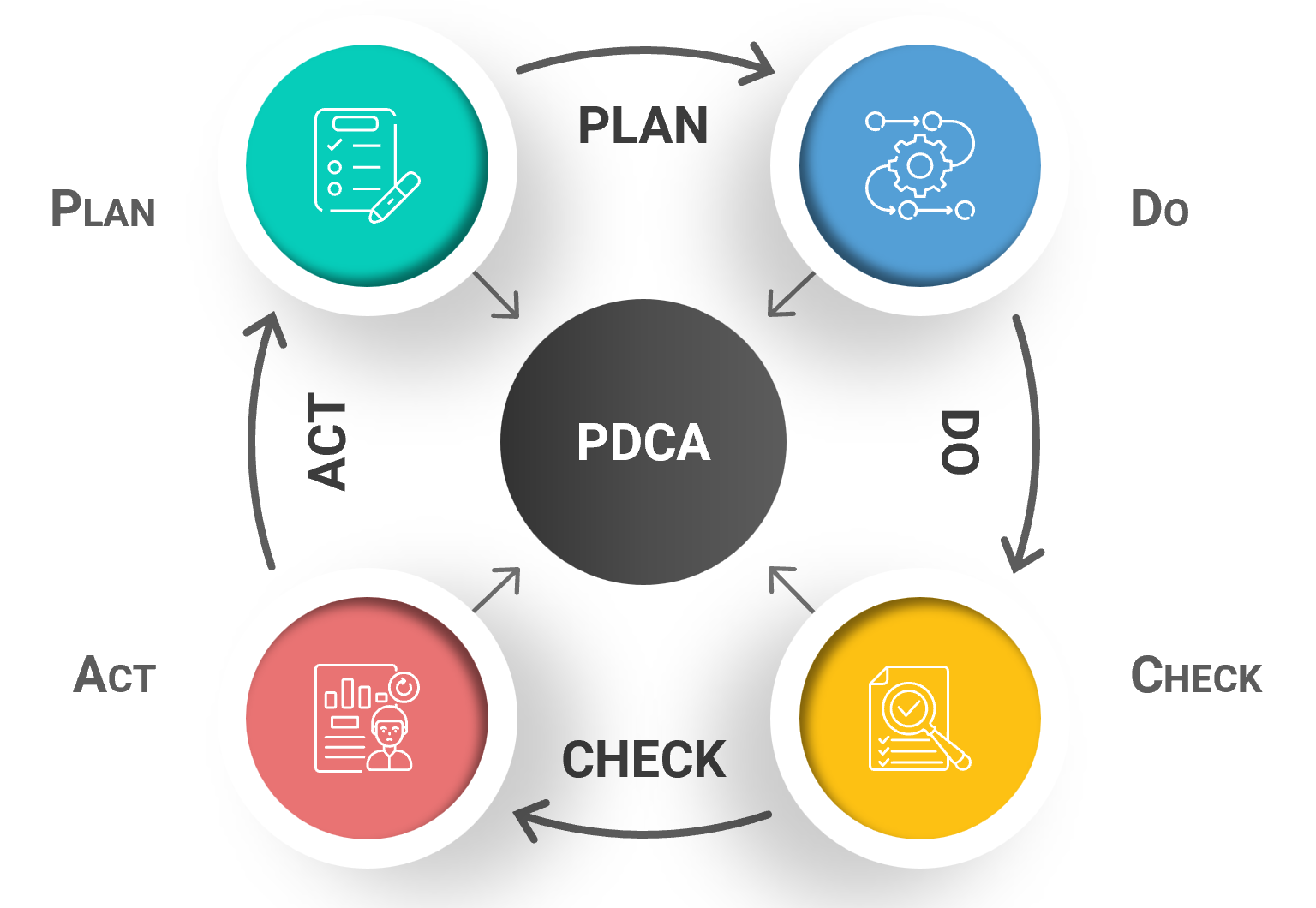
The Plan-Do-Check-Act cycle is often mapped to the project's major phases: planning resembles Plan, execution resembles Do, monitoring and controlling resembles Check, and closing resembles Act. That mapping is useful as a starting point, but PDCA also runs in smaller loops inside execution itself. The team tries a process, checks whether it is working, and adjusts before defects compound. In the Do step, the job is execution with quality built into the work itself, not inspected onto it afterward. The quality plan is not a document to reference at project closure. It is the set of standards the team works against in execution, and the PM's job is to make sure those standards are understood, followed, and enforced consistently, not posted on a wall and forgotten.
The phrase "quality is everyone's job" gets repeated often enough to feel empty. But it points to something real. A defect a team member catches before handing their work off costs almost nothing to fix. A defect the client finds after delivery costs multiples of that. Managing quality in execution means building a team culture where people take responsibility for what they hand off, where raising a quality concern is encouraged rather than interpreted as criticism, and where the standards in the quality plan are known and actually followed.
You cannot inspect quality into a project from the outside. The PM who reviews every deliverable personally and signs off on everything has not built a quality culture — they have built a bottleneck. The PM's job is to set the standard, model what it looks like to care about the work, and respond in a way that reinforces the expectation when someone raises a concern rather than works around it. Quality during execution comes from the team, and the team takes its cues from how the PM behaves when the pressure is on and the schedule is tight.
A quality audit reviews whether the project's processes are being followed and whether those processes are producing the expected results. It is distinct from quality control, which checks whether a specific deliverable meets its acceptance criteria. A quality audit checks whether the process used to create deliverables is the right one and is being consistently applied. Audits can be conducted internally by the PM or a team member designated for that role, or by an external quality function. They typically produce findings: gaps between the process the project committed to following and what it is actually doing. Those findings become inputs to process improvement and, where significant, to formal change requests that update the project management plan.
The next chapter, Acquiring Resources, moves from the processes the team runs to the question of who and what the team needs to run them. Acquiring the right people, equipment, and materials at the right time is what makes the schedule executable rather than aspirational.
Build a practical project management process from initiation to closing with our Project Management: From Initiation to Closing with AI course. Learn how to move from informal project coordination to a structured, repeatable approach using PMBOK-aligned workflows, real examples, and professional templates.
This hands-on course follows a complete project lifecycle. You will learn how to write a project charter, define scope, build a work breakdown structure, develop a schedule, estimate costs, manage risks, engage stakeholders, execute the work, monitor performance, and close the project properly.
You will also learn how to use AI tools to accelerate project management work. The course includes reusable prompts, downloadable templates, assignments, and worked examples that show how project documents connect from one stage to the next.
The course is designed for professionals, team leads, coordinators, analysts, and new project managers who need practical skills they can apply at work. Enroll now and build the confidence to manage projects with structure, clarity, and control.
Explore the CourseLearn how to use AI to create charters, WBSs, schedules, risk registers, and executive reports while staying in control. This course gives you prompt templates and practical workflows based on real project work. Practical skills, tools, and guidance you can apply right away. Covered by Udemy's 30-day refund policy.
Learn MoreUnlimited redemptions
Available until September 18, 2026 5:09 PM PDT
66D6FD5906E09C4284FE