
Limited-time Udemy offer
$9.99
Project Management From Initiation To Closing With AI
Unlimited redemptions
Available until September 19, 2026 6:21 PM PDT
2A2133BF88C8DF36C1AA
Catch a quality problem during planning and it costs roughly one unit to fix. Catch it during execution and you are looking at ten. Let it reach the customer and the cost balloons to a hundred times what early detection would have required. That ratio is not a warning label. It is the organizing logic behind every quality decision a project manager makes. The goal is not to inspect quality in at the end. It is to design quality in from the beginning, so the expensive conversations never happen.
Confusing quality with grade creates real planning problems, and the distinction is worth being clear about. Grade describes the feature level of a product: its category, its designed tier, the capabilities it was built to offer. Quality describes whether the product actually delivers what it promised at whatever grade it was designed to be. A budget hotel and a luxury hotel are different grades. Either one can be high quality or low quality, depending on whether it delivers what the guest was told to expect. Low grade is a deliberate design choice. Low quality is a failure to deliver on the promise. When you plan for quality, you are planning for the second thing, not the first.
Quality has three dimensions, and all three must be present for a deliverable to genuinely meet the standard. The first is fitness for use: the delivered product does the job it was designed to do, under the conditions it will actually operate in, not just in a controlled test environment. The second is conformance to requirements: the product matches the specifications agreed during scope planning, not a better version, not a close-enough version, but exactly what was specified. The third is predictability: the product behaves consistently under normal use and does not degrade or fail unexpectedly in the field. A product that works brilliantly in testing but falls apart in real conditions is still a quality failure, even if it passed every inspection before delivery.
Quality without specificity is good intention, nothing more. Acceptance criteria are what turn intention into a measurable standard: the concrete conditions a deliverable must meet to be considered complete. They come directly from the scope statement and requirements documentation, and they answer one question with precision: how will we know this is done correctly? Acceptance criteria must be testable. Not "the system should be fast" but "the system must process a transaction in under two seconds under peak load." If you cannot write a test for it, it is not an acceptance criterion. It is a preference. That distinction matters the moment someone has to decide whether a deliverable passes or fails. Acceptance criteria must also reflect requirements that are not negotiable: safety codes, building standards, regulatory requirements, contractual specifications, or security policies set a floor below which no sponsor trade-off is permitted. Identify those constraints first, before any conversation about what can be adjusted.
The cost of quality splits into two categories: what you invest to get quality right, and what you pay when you do not. Prevention costs are the investments you choose to make up front: design reviews, testing protocols, process planning, and staff training. Appraisal costs are what you spend to confirm the investment worked: inspections, audits, and verification activities. Both are controllable and measurable. The one-ten-one-hundred rule maps directly onto this. A dollar of prevention replaces ten dollars of inspection and a hundred dollars of post-delivery failure. Spend on the front end, and the math works in your favor at every stage that follows.
When quality planning fails, the costs fall into two buckets. Internal failure costs are problems caught before delivery: rework, scrap, re-inspection, re-testing, and the management time each of those consumes. External failure costs are the problems that reach the customer: warranty repairs, recalls, contract penalties, and reputational damage that does not appear on any spreadsheet. Most teams see the visible internal failures. The external costs are larger and harder to quantify: lost future contracts, damaged relationships, leadership distraction. Planning quality in from the start is not caution. It is the rational response to what the numbers actually show when you run them honestly.
A quality management plan is only useful if it includes ways to measure quality during execution, not just at the end. Quality metrics are the specific indicators the project will track: the percentage of deliverables passing first review without rework, defect counts per delivered unit, test case pass rates, or response times against defined thresholds. The right metrics come directly from the acceptance criteria, because they are measuring the same performance standards over time. When a metric drifts out of tolerance, it is an early warning with enough runway to respond. Without defined metrics, quality becomes a conversation about impressions rather than facts, and that conversation almost always happens too late to act on it. A metric without a threshold is a data point, not a decision tool. The useful form pairs a target with an acceptable range: service call response time stays within ten percent of the pre-move baseline during the transition period. That formulation tells you when to act. Tracking alone does not.
Quality planning must account for two distinct activities, and conflating them creates gaps. Quality assurance asks whether the process is set up to produce the right result: reviewing the approach before work starts, auditing procedures to confirm they are likely to catch problems, and verifying that vendor selection criteria required the right standards. Quality control checks whether the output actually met the standard: comparing the post-move inventory against what was packed, running test cases on the security system, verifying cable installations against the approved schematic. You need both. Assurance without control leaves you confident in your process but unverified on what it produced. Control without assurance tends to find problems late, after a poor process has already run for weeks. The quality plan should specify both: which processes get reviewed before and during execution, and which outputs get verified at handoff.
For decades, quality cost theory made an uncomfortable argument. There is an optimal defect level, a point where investing more in prevention costs more than the defects themselves are worth. Two opposing curves made the case. Prevention and appraisal costs climbed steeply as defects approached zero: every incremental improvement more expensive than the last. Failure costs fell as quality rose. Add the curves together and you get a total-cost minimum somewhere short of zero defects. The model was telling organizations there was a level of defects worth tolerating. Chasing perfect quality, by this logic, was economically irrational.
 model.png)
The emerging model challenged that assumption directly. When organizations invest in quality early, in process design, staff training, and prevention built into the work itself, prevention spending does not rise exponentially as defects fall. It rises in a roughly straight line. Failure costs still drop sharply. With the linear prevention curve in place, the optimal point shifts toward near-zero defects. High quality stops being cost-prohibitive. It requires front-end investment, but the math no longer argues for tolerating defects as an economic strategy. The timing of the investment is what changed the conclusion.
 model.png)
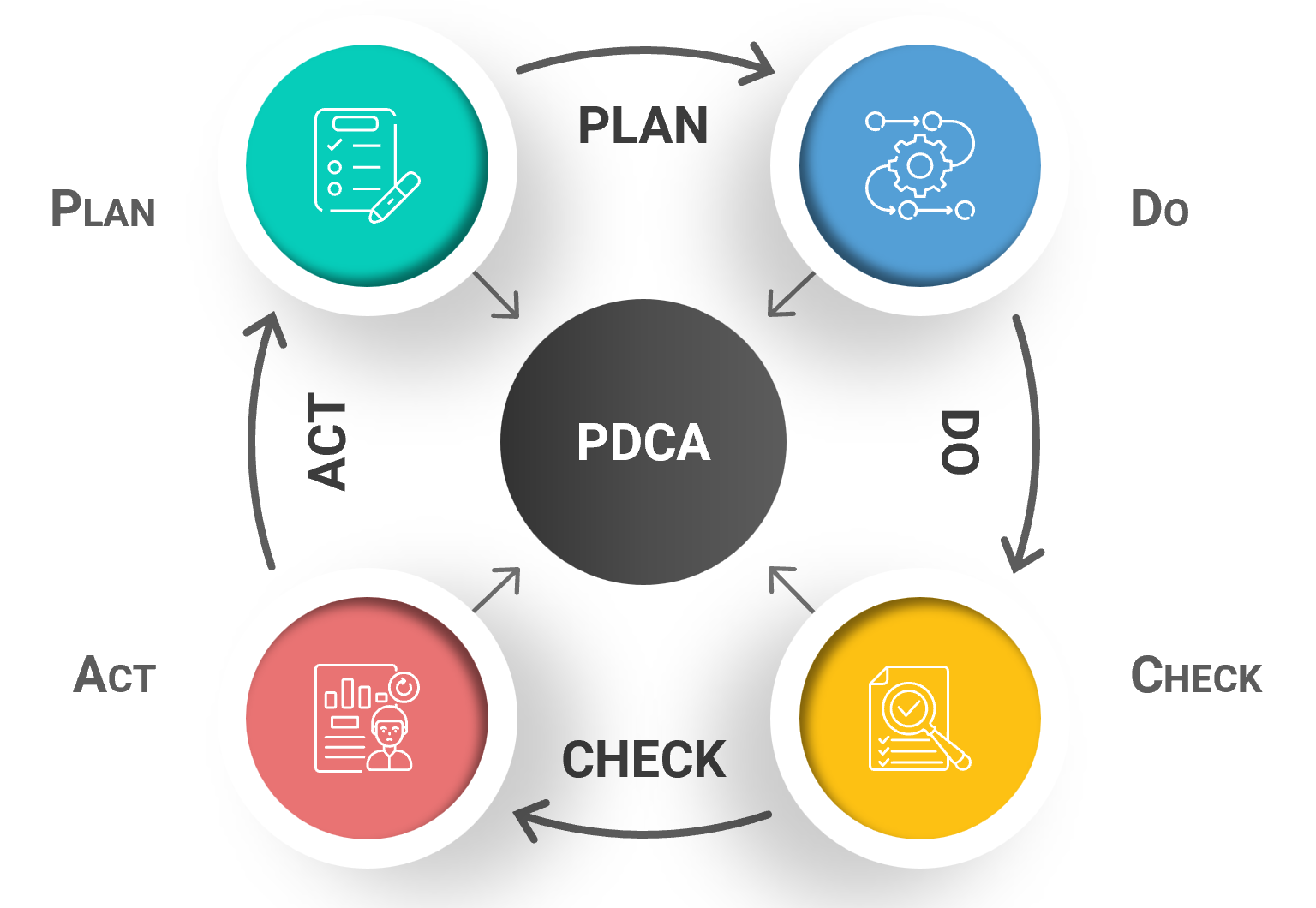
Total Quality Management starts from a single conviction: quality belongs to the entire organization, not to a department at the end of the line. Every person in the process owns a piece of the result. The mechanism for making that real is the Plan-Do-Check-Act cycle, the Deming cycle, which turns continuous improvement from an aspiration into a permanent operating rhythm. Plan a change. Run it on a small scale. Check what the results actually show, not what you hoped they would show. Act on what you learned and cycle back. The loop does not end at project close. It is how organizations that take quality seriously build it into the way they work, not just into individual deliverables.
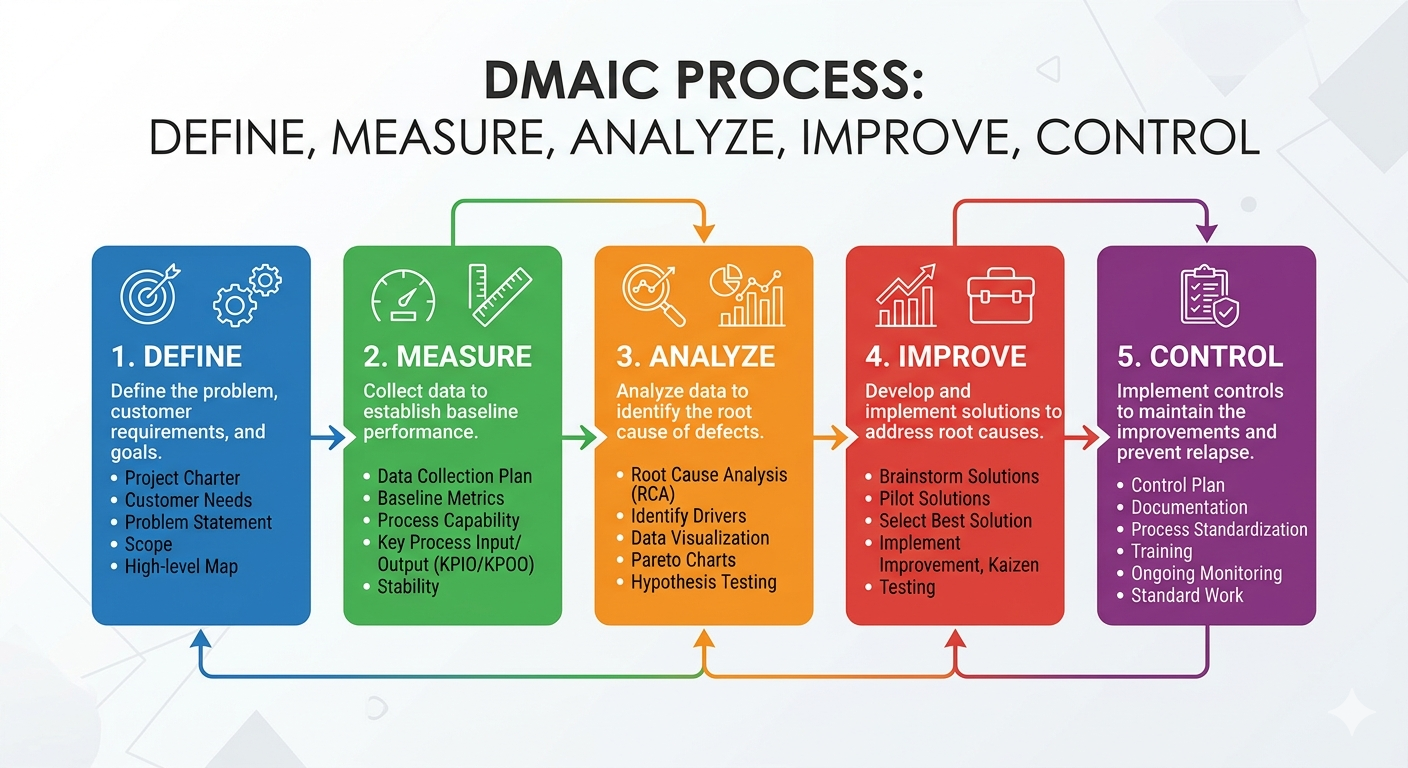
Lean Six Sigma combines two disciplines that attack quality problems from different angles. Lean targets waste: anything in a process that consumes resources without adding value. Six Sigma targets defects: measuring variation from a defined standard and driving it toward zero. The combined framework uses a five-step improvement cycle called DMAIC: Define the problem, Measure current performance, Analyze the root cause, Improve the process, and Control the result to hold the gain. Practitioner certification is not a prerequisite for applying this thinking. The cycle works at any scale, on any project where quality needs to be improved and the improvement needs to stick.
Benchmarking tends to get less attention than the other quality tools, but the logic is straightforward and worth using. Rather than defining quality metrics from scratch and hoping they reflect what good performance actually looks like, start with a comparable project that delivered well. Inside your organization or externally, if that data is available. If a similar project tracked first-pass review rates, defect counts per unit, and test-case pass rates, that data is your starting point. You are not guessing what good quality looks like. You are borrowing a definition from somewhere it has already been demonstrated, then adapting it to your context.
The frameworks in this chapter are not interchangeable, and the quality plan should specify which apply to which deliverables and why. Use PDCA when the project must stabilize an operating process during or after transition: run a cycle, check what the metrics actually show, adjust, and repeat until performance holds. Use DMAIC when there is a measurable defect or variation problem with enough data to diagnose the root cause before implementing a fix. Use checklists and test cases for conformance verification: when a deliverable simply needs to be compared against a defined standard, a structured checklist is faster and more reliable than an open-ended review. Use benchmarking when realistic quality targets are not obvious, so the team starts from demonstrated performance rather than guessing. Not every project needs all of these. The right choice depends on the type of work, the nature of the quality risk, and whether the goal is process improvement or output verification.
Quality looks different on an office relocation than it does on a software release, but the same principles apply. Thesis Yu and the RtR team open quality planning by agreeing on three objectives: build quality in early to find issues before the move rather than after; complete the physical move without loss of materials or assets; and set up the new location so that logistics, security, and technology operate at the same standard as the current site from day one. The objectives are specific enough to plan against.
Quality by design means establishing a baseline before anything changes. The team inventories all materials, equipment, and assets ahead of the move, so anything that goes missing in transit is immediately visible at delivery. Current state metrics are documented for the service bay, warehouse operations, and service call volume. Current state challenges are captured across the warehouse, service bay, technology room, building security, and office space. Delivery vehicles are confirmed for Air-Ride compliance before the moving contract is awarded: Air-ride suspension reduces vibration during transport, which matters for sensitive technology equipment, and discovering a non-compliant vehicle on moving day is not a problem that contingency reserve can solve. An organizational security training initiative is built into the plan from the start, not added as an afterthought at the new location.
The quality assessment approach runs alongside the work, not after it. Post-delivery, the warehouse inventory is compared against what was packed before the move, so any discrepancy is caught before items are placed permanently. Warehouse logistics are prototyped at the new location and metrics compared against the pre-move baseline, with a Plan-Do-Check-Act cycle built in to close any gaps. The technology room cabling and security system installation each go through a checklist-based test case before handover. CCTV and building security equipment are tested separately with their own test cases. Service call metrics are monitored during the interim period between move-in and full operations, with a Plan-Do-Check-Act cycle ready to shore up client support if metrics slip. The team also initiates a staff security challenge to encourage forward thinking about building and organizational security at the new site. The team is not waiting for the transition to be declared complete before finding out whether the new setup actually works.
| Area | Quality Standard | Metric or Check | Verification Method | Timing |
|---|---|---|---|---|
| Technology equipment | Arrives undamaged and fully operational | Zero transport damage; devices pass startup test | Air-ride vehicle confirmed before contract award; post-move device checklist | Before vendor award and after delivery |
| Warehouse inventory | No material or asset loss in transit | Pre-move count matches post-move count | Inventory checklist reconciliation at pack-out and receiving | Pack-out and receiving |
| Service call continuity | Client support does not degrade during transition | Wait queue stays within 10% of pre-move baseline | Call metrics tracked before, during, and after move; PDCA cycle if metrics slip | Transition window through stabilization |
| Building security | New site security operates as designed from day one | CCTV and access points pass defined test cases | Security system test case checklist; separate CCTV test cases | Before handoff |
| Warehouse logistics | New site operates at or above pre-move performance | Logistics metrics compared against documented baseline | Operations prototyped at new location; PDCA cycle to close gaps | Post move-in through stabilization |
The one-ten-one-hundred ratio is not a cautionary statistic. It is the organizing principle of every quality decision made during planning. The more quality is built into early design choices, into acceptance criteria, into prevention protocols, and into defined metrics, the less it costs over the life of the project. Catching problems late is expensive. Catching them early is smart. Not catching them because quality was designed in from the beginning is the goal. A quality management plan is not a checklist that gets checked at the end of execution. It is a design intention established at the start, before there is anything to inspect.
With quality planning complete, planning moves into territory that makes most teams uncomfortable: risk. Risk planning does not start with mitigation strategies. It starts with identification: building a shared picture of what could go wrong, what could go better than expected, and what the project does not yet know. Risk Foundations and Identification is the next chapter.
Lead with clarity, confidence, and real impact. This Leadership for Project Managers course turns day-to-day challenges—unclear priorities, tough stakeholders, and cross-functional friction—into opportunities to guide teams and deliver outcomes that matter.
You’ll learn practical leadership skills tailored to project realities: setting direction without overcontrol, creating alignment across functions, and building commitment even when authority is limited. We go beyond theory with tools you can use immediately—one-sentence visioning, stakeholder influence maps, decision framing, and feedback scripts that actually land.
Expect hands-on frameworks, real-world examples, and guided practice to prepare for tough moments—executive readouts, resistance from stakeholders, and high-stakes negotiations. Downloadable templates and checklists keep everything actionable when the pace gets intense.
Learn alongside professionals around the world working in project leadership and delivery.
Explore the CourseHK School of Management helps you go beyond status reports and gut feelings. In this advanced course, you will learn Earned Value Management (EVM) to measure progress, forecast outcomes, and take corrective action. Learn how WBS quality drives performance, how control accounts work, and how to use EAC, TCPI, and variance analysis. Practical skills, tools, and guidance you can apply right away. Covered by Udemy's 30-day refund policy.
Learn MoreUnlimited redemptions
Available until September 19, 2026 6:21 PM PDT
2A2133BF88C8DF36C1AA