
Limited-time Udemy offer
$9.99
Project Management From Initiation To Closing With AI
Unlimited redemptions
Available until September 19, 2026 6:21 PM PDT
2A2133BF88C8DF36C1AA
There is a moment most project managers experience at some point: a team member who was sharp in the interview is now delivering work that is just adequate. The basics are there; the energy is not. The natural impulse is to think about incentives — a bonus, recognition in a meeting, a promise of a better assignment on the next project. Some of those things will help. But before any of them can work, something more foundational has to be in place. Understanding what that foundation is, and what sits on top of it, is what motivation theory gives you.
Frederick Herzberg spent years studying job satisfaction and dissatisfaction, and his central finding still surprises people when they hear it clearly stated: pay is rarely enough to create sustained motivation on its own. When pay is perceived as unfair or inadequate, it becomes a powerful demotivator that will undermine everything else. But once it is fair enough, raising it further produces very little additional motivation. What it produces is the absence of a complaint, not the presence of energy. Once pay is fair enough, deeper motivators matter more: meaningful work, recognition, achievement, responsibility, and growth.
Herzberg divided work factors into two categories. Hygiene factors (salary, working conditions, quality of supervision, and workplace policies) are the floor. They do not produce motivation when they are adequate, but they produce dissatisfaction when they are not. Satisfiers (meaningful work, recognition, achievement, responsibility, and advancement opportunity) are what actually motivate when they are present. The practical sequence for a PM is direct: fix the hygiene factors first. If someone is worried about their workload, their relationship with their functional manager, or whether they will still have a role after the project closes, no amount of meaningful work will reach them. Get the floor right, then build upward.
Abraham Maslow proposed that human needs are organized in a hierarchy. Physiological needs sit at the base: food, water, shelter, the fundamentals of physical survival. Above that, safety and security. Then belonging and social connection. Then esteem — the need to feel valued and capable. At the top, self-actualization: the drive toward growth, purpose, and full expression of potential. What matters for a PM is not the hierarchy itself but the sequencing insight embedded in it. Lower-level concerns do not erase higher-level needs, but they can dominate attention enough that recognition, purpose, or growth opportunities do not land the way the PM expects. Anxiety about job security, a hostile team environment, or a feeling of exclusion from the group lives near the base. A team member carrying that kind of unresolved concern is not in a position where inspiration will reach them.
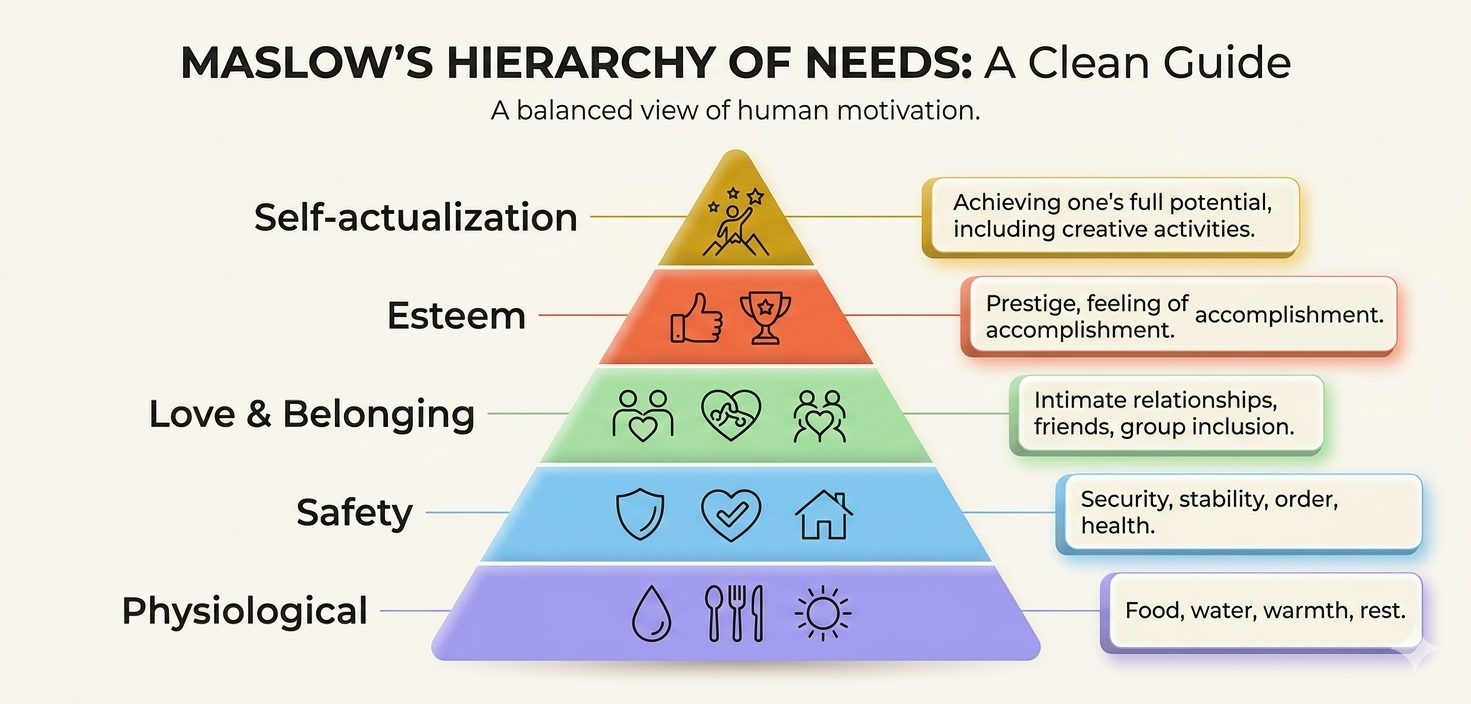
The practical application is this: before you try to motivate your team with a meaningful challenge or an opportunity for growth, look at whether the conditions beneath those things are actually secure. A team member who is uncertain whether their functional manager will reassign them mid-project, or who feels like an outsider in a tight group, is not operating from a foundation where growth-oriented motivation will take hold.
David McClelland identified three drives that explain much of what motivates people at work, expressed in different proportions in different individuals. The Achievement drive is the need to set challenging goals, pursue them with effort, and be recognized for the results. People with a strong Achievement orientation want stretch assignments. They want to know where the bar is and have the chance to clear it. They respond well to clear performance standards and find work without meaningful challenge genuinely draining.
The Affiliation drive is the need to belong, to collaborate, to be liked rather than to compete. People with a strong Affiliation orientation work best in cohesive teams with good relationships. They are often excellent at coordination and communication, and they tend to smooth over interpersonal friction naturally. What drains them is isolation, competition, or an environment where conflict goes unresolved and relationships feel transactional.
The Power drive is the desire to influence, to lead, and to be recognized as effective and capable. People with a strong Power orientation are often your most decisive team members. They want responsibility and the authority that goes with it. They are natural advocates for a position and can be excellent at moving a group to a decision. The PM's job is to give them a lane where that energy works for the project rather than against it.
McClelland's model is most useful when you apply it at the individual level rather than treating it as a personality sorting exercise. The same deliverable can motivate an Achievement-oriented person because it is technically demanding, an Affiliation-oriented person because it requires deep collaboration, and a Power-oriented person because it is high-visibility and consequential. The goal is the same. The reasons for caring about it are not, and structuring recognition and responsibility to match each person's actual drives is one of the most direct ways to get consistent performance from a diverse team.
Douglas McGregor proposed two contrasting assumptions about what motivates people to work. Theory X assumes that people fundamentally dislike work and require close supervision, control, and direction to be productive. Theory Y assumes that people naturally find meaning in work and, given the right conditions, will take responsibility, exercise judgment, and apply their abilities without needing constant oversight. These are not two types of people. They are two management philosophies, and the one a PM adopts shapes how they structure their entire relationship with the team: how much autonomy they extend, how closely they monitor, and how much trust they offer before it has been demonstrated. A Theory X approach on a team of skilled professionals tends to produce exactly the compliance it assumes, and nothing more. A Theory Y approach on a team that needs clear structure and accountability can leave people without the direction they need. The right philosophy is calibrated to the team and the situation, not applied uniformly out of habit.
| Framework | Core Insight | PM Application |
|---|---|---|
| Herzberg | Hygiene factors (pay, conditions, supervision) prevent dissatisfaction but do not create motivation. Satisfiers (meaningful work, recognition, growth) are what actually motivate. | Fix the floor first. If a hygiene concern is unresolved, no amount of meaningful work or recognition will reach the person. |
| Maslow | Needs are organized in a hierarchy. Lower-level concerns (security, belonging) dominate attention until they are resolved, blocking higher-level motivators. | Before offering growth opportunities or meaningful challenge, confirm that safety, belonging, and esteem needs are not actively unmet. |
| McClelland | People are driven by Achievement, Affiliation, or Power in different proportions. The same work can motivate different people for entirely different reasons. | Match recognition and responsibility to the individual's actual drive, not to what the role requires or what motivates you. |
| Theory X / Theory Y | Management style reflects assumptions about human nature. Theory X assumes people need control and oversight. Theory Y assumes people find meaning in work and will self-direct given the right conditions. | Calibrate autonomy and oversight to the actual team and situation. Applying Theory X assumptions to capable professionals tends to produce the compliance you assumed. |
Understanding what drives individuals is one part of the picture. The other part is recognizing that any group of individuals goes through predictable stages as it forms into a team — and that the PM's role changes meaningfully at each stage. Bruce Tuckman mapped those stages in a model that has held up precisely because it names what you are already looking at when it happens.
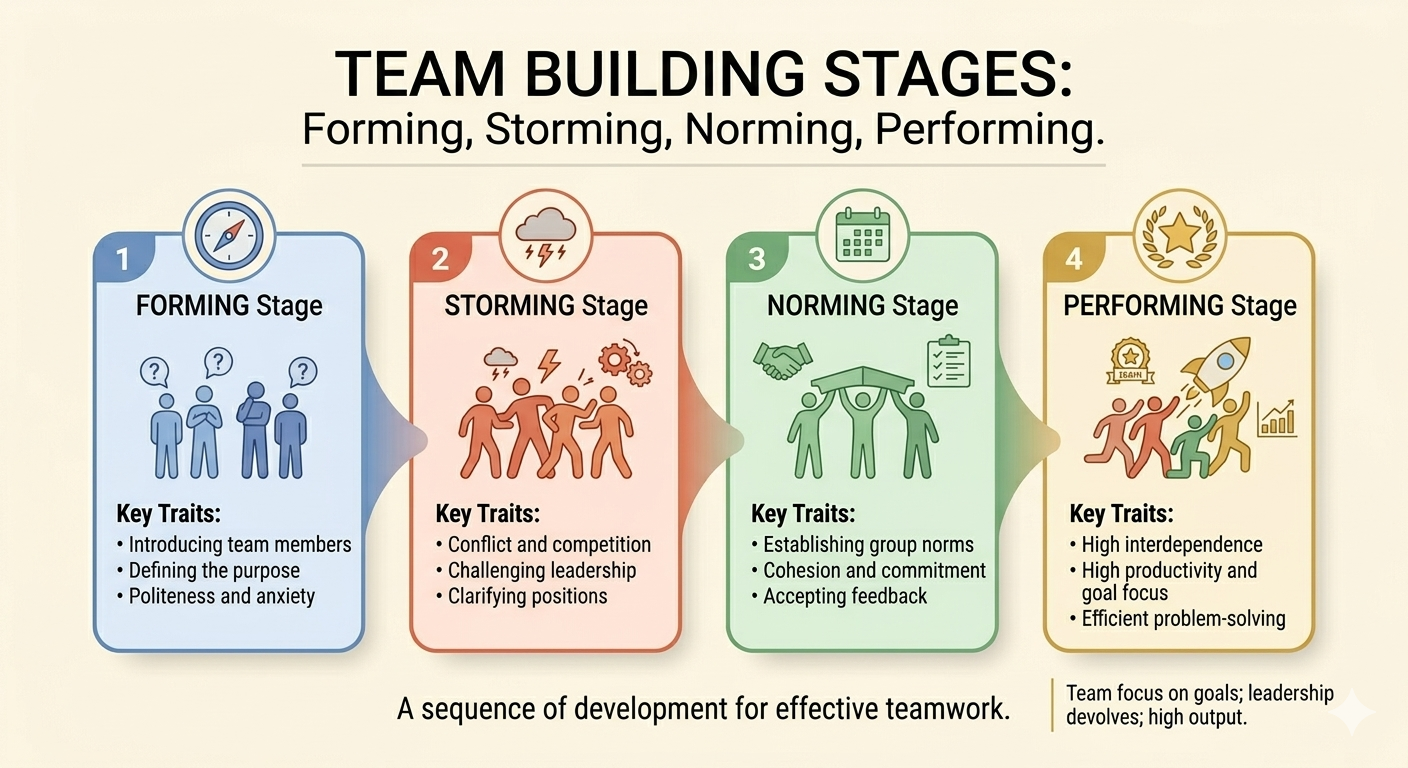
When a team comes together for the first time, everyone is on their best behavior. There is often genuine excitement alongside genuine uncertainty. Roles are not fully clear. Relationships have not been tested. People are reading the environment and calibrating their expectations. The PM's job in forming is to provide the structure that gives people something to orient around: clear expectations, the team charter (see Chapter 22), and enough direction that people know what they are doing and why their work connects to the project's goal. The team is looking to you for that framework. Give it clearly, because forming is the stage where ambiguity is most expensive.
Storming is where conflict surfaces. Differences of opinion on how the work should be done. Personality friction. Disagreements that did not exist in week one because nobody had been tested yet. Some teams storm loudly: raised voices, tense meetings, visible friction. Others storm quietly: passive resistance, parallel competing approaches, disagreements that get swallowed rather than surfaced. Both are storming, and both need the same response from the PM.
The instinct to shut conflict down as quickly as possible is natural and almost always counterproductive. A team that storms and manages through it builds real trust, the kind that comes from having navigated difficulty together and come out the other side. A team that suppresses its storming does not skip the stage. The conflict goes underground, waits for a worse moment, and surfaces later when there is less time and more at stake. Your job in storming is not to eliminate the conflict. It is to keep it productive: focused on the work, not the person; resolved at the lowest level possible; visible enough that you can see it and intervene when it turns personal.
In norming, the team finds its rhythm. The conflicts from storming have been worked through, trust has accumulated, and people begin to collaborate rather than compete. Norms emerge: how the team communicates, how decisions get made, what counts as acceptable and what does not. Performing is the goal state, where the team functions at a high level — making decisions efficiently, solving problems as a unit, covering for each other when someone is stretched, and producing results without requiring constant PM coordination to make it happen. Not every team reaches performing on every project. But every investment made in forming well and managing through storming meaningfully increases the probability that they get there. Teams do not move through these stages once in a clean line. A new member, a significant change in scope, or a missed commitment can push a performing team back into storming. When that happens, the process is not broken. It needs the same PM attention it needed the first time.
When the project ends, the team disbands. Adjourning is the final Tuckman stage, and it is the most consistently overlooked one. A team that has genuinely performed together has built something real, and it does not simply dissolve without effect when the project closes. There is often a sense of loss alongside the sense of accomplishment, and acknowledging that is not soft management. People who feel that the end of a project was handled with care bring more to the next one. The practical actions here are simple: celebrate what the team achieved, recognize specific contributions publicly and specifically, and close it properly rather than just letting it trail off. How a project ends is one of the things people remember most vividly, and it shapes whether they want to work with you again.
Managing team performance is not watching over shoulders. It is staying close enough to the work that you know where it stands, where it is struggling, and where it is moving faster than planned. The tools are not complicated. Status meetings provide formal structured visibility when they are done well — agenda focused on deliverables and decisions, not activity lists. Done poorly, they become a performance where everyone reports how busy they are without revealing anything actionable. One-on-one conversations are the most underused instrument in this toolkit. A direct conversation with a team member, alone, surfaces information that will not appear in a group setting. Pair a review of what you are tracking with an open question about what they are actually dealing with. Casual conversation — between meetings, at the end of a day — is low-cost intelligence that a PM who is paying attention learns to treat as signal rather than noise. People say things informally that they will not say in front of the group.
| What You Observe | Likely Cause | Where to Look First |
|---|---|---|
| Previously motivated person suddenly disengaged | A hygiene factor has turned into an active problem | Herzberg — check pay, workload, job security, or relationship with functional manager |
| Recognition and growth opportunities not landing | A lower-level need is unmet and dominating attention | Maslow — check whether security, belonging, or esteem are actively in question |
| Inconsistent motivation across the team despite similar conditions | Individual drives differ; same work does not appeal for the same reasons | McClelland — identify whether each person's assignments match their Achievement, Affiliation, or Power orientation |
| Capable person resisting autonomy or over-relying on direction | Management style is misaligned with what this person needs | Theory X/Y — check whether your oversight level fits the individual and the situation |
| Team-wide friction, regression, or loss of rhythm after a change | A team-stage shift back toward storming, not an individual problem | Tuckman — address the team dynamic rather than treating it as isolated individual performance |
| Persistent missed commitments despite direct feedback | Pattern that has moved beyond coaching | Document the conversations, the expectations stated, and the outcomes observed — then follow organizational HR process |
Issues entered in your RAID log are worth reading twice. Something recorded as a project problem is sometimes a performance concern in disguise. An issue entered passively, without a clear owner, or in unusually vague language is often a team member surfacing a conflict they did not feel comfortable raising directly. The issue log is a tracking tool, but it is also a diagnostic one. A PM who reads it looking for patterns — same person, same type of delay, same vague descriptions, will often see a performance or interpersonal situation before it is surfaced through other channels. Address what you find early, in private, and directly.
A feedback conversation that only happens when something has gone wrong trains people to associate the PM's attention with bad news. Make feedback regular and make it specific in both directions. When a team member handles something well, name it precisely: not "great job this week" but "the way you pushed back on that vendor's revised estimate and held the line on the spec saved us a scope conversation with the sponsor." When there is a genuine concern, address it early, privately, and with clarity about what was expected versus what was observed. Vague concern delivered late produces defensiveness. Specific, early feedback delivered with respect produces the conversation where the problem actually gets solved.
If a team member's performance is not meeting the project's needs, and you have had direct documented conversations about it, the situation has moved past coaching. Depending on the organization and the seriousness of the issue, the next step may involve HR, the functional manager, the vendor manager, or another formal authority. Do not improvise the process. Follow organizational policy. The PM's job is to understand what the HR process looks like, what responsibilities can be redistributed in the meantime, and what alternative resources are available to the project. The project still needs to deliver. Handling the people situation professionally, with documentation and support from the right parties, is how you meet both obligations at the same time.
The next chapter, Managing Conflict and Communications in Execution, goes deeper into the conflict types that surface during the project's active work: how to distinguish productive task disagreement from personal conflict, how to manage teams across organizational boundaries, and how to own the communication function so that the team's work is understood by the people who need to understand it.
Become an AI-first leader and transform your agile practice by leveraging artificial intelligence as your most powerful co-pilot. This course is designed to help you drive efficiency, insight, and innovation, ensuring you stay at the forefront of a rapidly evolving project management landscape.
This isn't about replacing human intuition—it's about augmenting it. You'll master prompt engineering to automate mundane tasks, freeing up your time for high-impact strategic leadership and creative problem-solving. Learn to refine backlogs, create strategic roadmaps, and integrate AI seamlessly into your agile ceremonies.
Gain predictive power by using AI-driven insights to anticipate project risks and seize new opportunities for more reliable outcomes. We deliver practical, prompt-based workflows and proven strategies built around real-world agile challenges that you can implement immediately within your framework.
Master foundational AI concepts specifically relevant to Scrum environments while developing advanced skills to handle diverse agile scenarios. You will learn to champion an AI-enabled culture within your organization, fostering a dynamic environment of continuous improvement and superior team delivery.
Learn alongside professionals around the world working in project leadership and delivery.
Explore the CourseHK School of Management helps you go beyond status reports and gut feelings. In this advanced course, you will learn Earned Value Management (EVM) to measure progress, forecast outcomes, and take corrective action. Learn how WBS quality drives performance, how control accounts work, and how to use EAC, TCPI, and variance analysis. Practical skills, tools, and guidance you can apply right away. Covered by Udemy's 30-day refund policy.
Learn MoreUnlimited redemptions
Available until September 19, 2026 6:21 PM PDT
2A2133BF88C8DF36C1AA