Role of the Project Manager
Not Doing the Work — Managing It
The project manager's job is not to build the thing. It is to make sure the thing gets built. That distinction is easy to state and genuinely difficult to live, especially for people who came to project management from a technical background, where the natural instinct is to solve problems personally rather than coordinate others to solve them. A project manager plans, coordinates, communicates, and navigates uncertainty while the technical work is done by the team. The competencies required for that are different from the competencies that make someone a great engineer, analyst, or designer. They are not better or worse. They are different, and treating them as an extension of technical skill is the first mistake many new project managers make.
Here is what makes the transition workable: project management competencies are skills, and skills can be learned, practiced, and developed over time. Personality helps. Prior experience helps. But the profession's experience is clear: effective project managers are developed over time, not born with the role fully formed. The question is not whether you have the right traits coming in. It is which skills you already have, which you are still building, and what you intend to do about the gaps. Every limitation you identify in yourself as a project manager can be followed by a single word that changes the meaning of the sentence entirely: yet. Not confident in financial analysis, yet. Not comfortable navigating conflict, yet. Not experienced with stakeholder management, yet. That shift from fixed statement to development plan is one of the most useful things you can carry through a project management career.
The Three Relationships That Define the Role
Every project manager operates within three defining relationships, and how well those relationships are managed determines more about project outcomes than any process or tool.
The sponsor holds the budget, owns the business case, and is ultimately accountable for the project's success in the organization. What the sponsor needs from you is clarity: on progress, on risks, and on decisions that require their input. Your job is to keep them informed without surprising them, and to arrive with options when something unexpected happens. A sponsor who receives consistent, honest communication can focus on removing obstacles and advocating for the project at the organizational level. A sponsor kept in the dark tends to micromanage at exactly the moments when the PM needs space to work, because their instinct is to protect an investment they cannot see clearly. The PM who brings a problem with three possible solutions is doing the job well. The PM who brings only the problem is outsourcing the thinking to the wrong person, and that pattern erodes the sponsor's confidence faster than almost any other behavior. Not every project answers to a single individual. A steering committee performs the same sponsor function: it owns the business case, sets strategic direction, and holds final authority over decisions that fall outside the PM's mandate. The dynamics differ from a one-on-one relationship. Decisions take longer, and communication needs to be more consistently structured and formally documented. But the core obligation is unchanged: keep the right people informed, bring decisions to them before they become crises, and use their authority for decisions that genuinely warrant it rather than as a mechanism to resolve disagreements that belong at the working level.
The project team does the work, and the PM's role is to enable them: to remove obstacles, clarify direction, and create conditions where the team can focus and deliver. This is not a passive role. It requires active coordination, real investment in the people involved, and a willingness to step back from the work itself so that capable people have room to perform. The team relationship is explored in depth in the execution chapter; the starting point here is recognizing that the team is the engine. The project manager is not.
Beyond the sponsor and team, every project has a wider circle of stakeholders: functional managers, end users, regulators, clients, and anyone else with an interest in the outcome. To these stakeholders, you are the project's representative. Surfacing their needs, addressing their concerns, and keeping them appropriately engaged is not a courtesy. It is operational management. In functional organizations especially, many stakeholders also control resources the project depends on. The relationship matters for practical reasons as much as relational ones. Stakeholder management gets its own detailed treatment later in this book; what matters here is recognizing it as a primary responsibility of the role, not an administrative add-on that gets attended to when everything else is done.
Other Roles in the PM Family
On larger or more complex projects, you will often work alongside other roles that support the project management function. A project coordinator assists the PM with administrative and coordination tasks but holds less formal authority and generally does not make scope, schedule, or budget decisions independently. A project expediter acts as a liaison between the project and a specific department, particularly in functional organizations, helping align resources and scheduling within that unit without formal authority over the work itself. Neither role replaces the project manager. They extend the PM function on projects too large or complex for one person to manage without deliberate delegation of coordination responsibilities. Understanding what these roles can absorb allows the PM to concentrate the project management function where it delivers the most value: at the decisions, the dependencies, and the points where things are most likely to go sideways.
What the Role Requires
Project manager competencies fall into three broad domains. Effective project managers are not one-dimensional: the role demands technical project management skill, business and strategic acumen, and what the profession calls power skills, the human capabilities that determine whether people want to work with you and whether they perform well when they do.
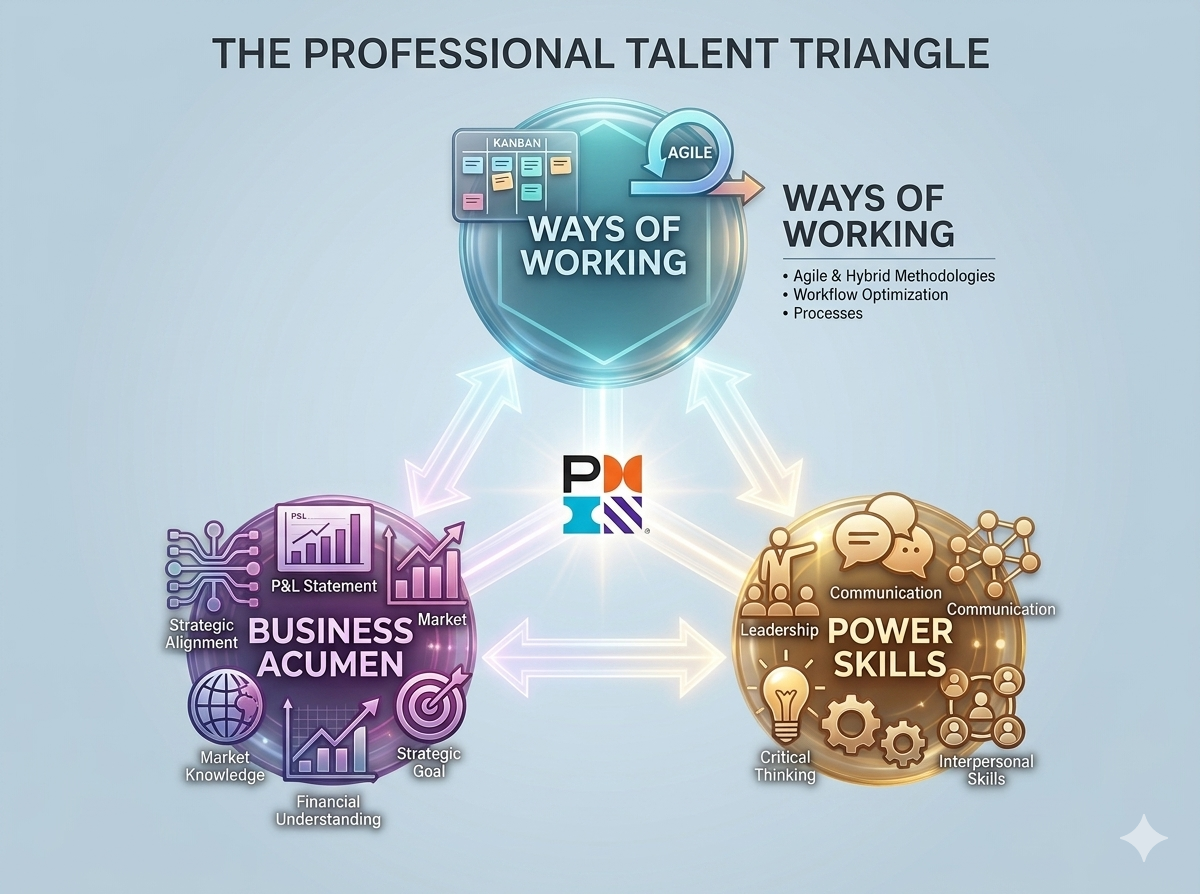
Ways of working covers the methods, frameworks, and processes of project management itself: planning, estimating, scheduling, risk management, change control, and the many other disciplines this book addresses. These are the mechanics of the role. They can be learned systematically and sharpened with experience, and this book focuses on the predictive, structured approach while acknowledging that adaptive and hybrid approaches are a real and increasingly important part of practice. Business acumen means understanding how organizations work, how decisions get made, and how the financial and strategic context shapes what a project needs to deliver. A PM with genuine business acumen can read a business case and understand what the sponsor is actually trying to achieve, not just what the document says. It includes financial literacy, organizational awareness, and the ability to navigate political dynamics without being naive about them. Power skills, sometimes called soft skills though that label understates them badly, are the human capabilities that determine how effectively you lead, communicate, and build trust under pressure. Listening, negotiation, conflict management, empathy, and the ability to stay clear-headed when a project is struggling are all power skills. They are consistently underestimated at the start of a PM career and cited repeatedly as the most valuable by experienced practitioners later in that same career. The reason is not complicated: you can execute a project management process with adequate technical and business knowledge. But the moments that determine whether a project survives difficulty are almost always human moments, and technical knowledge is rarely what decides them. People follow people. Process follows from that. PMI's Talent Triangle formalizes a similar grouping under the same three headings; the practical insight holds regardless of what framework a PM operates within.
Emotional intelligence is the foundation that power skills rest on. It describes the capacity to recognize and regulate your own emotional reactions under pressure, and to accurately read the emotional state and motivations of the people around you. For project managers, emotional intelligence shows up in concrete moments: staying composed when a sponsor questions a decision in front of the team, hearing frustration in a team member's tone before it becomes a formal issue, calibrating how much difficult information a stakeholder can act on in a single conversation. Self-awareness, self-regulation, empathy, and relationship management are its four components, and each one becomes a professional competency in practice, not just a personality trait.
AI can absorb more of the mechanical workload in this picture: drafting status updates, summarizing meeting notes, cataloguing risks, comparing schedule options, and surfacing conflicts between plans. These are genuine time savings. What AI cannot do is own a relationship, make a judgment call under pressure, earn the trust of a team, or hold accountability for an outcome. The competencies that define a strong project manager, especially the human ones, matter more as AI takes on administrative weight, not less. The role is shifting toward higher-order work. The fundamentals that enable it are staying exactly where they are.
The System Your Project Lives In
A project does not exist in isolation. It lives inside a larger system, a chain of connected decisions and investments that begins with organizational strategy and ends with value delivered to the people the organization exists to serve. Understanding that chain is practical knowledge, not abstract theory. It shapes what you pay attention to, what you tell your sponsor, and whether a decision that appears good for the project is actually good for the organization it belongs to.
Most organizations manage their project investments through a hierarchy. At the top sits strategy: the direction the organization is trying to move. Portfolios group the programs and projects that serve that strategy, balancing investment across competing priorities. Programs coordinate multiple related projects to deliver benefits that no individual project could achieve alone. Individual projects produce specific outputs within that structure. Operations run in parallel, keeping the organization functioning while projects work to change or improve it. Each layer connects to the others. A project that is well managed but disconnected from the portfolio priority it was created to serve can still represent a misuse of resources. Understanding where your project fits in that system is what allows you to make decisions that serve the organization, not just the plan in front of you.
Governance sets the authority structure above the day-to-day work, and it is not the same as management. Management handles scheduling, tracking, and directing the team. Governance determines who approves the business case, who authorizes spending beyond a threshold, and who holds final accountability when something significant changes. Every layer of the portfolio, program, and project hierarchy has a governance function. Understanding where the decision rights sit in your organization is part of operating effectively within it. Respecting those rights builds the organizational trust that makes future projects easier to navigate.
Projects produce deliverables: a system, a building, a trained team, a completed process. Deliverables enable outcomes, which is what changes as a result: faster service, reduced risk, improved capability. Outcomes produce benefits: cost savings, new revenue, stronger market position. Benefits aggregate into value. The distinction matters because projects can succeed technically while failing organizationally. A system goes live on time and within budget, and no one uses it. A building is completed to specification, but the team that was supposed to occupy it has been reorganized. These are projects that delivered their outputs and missed their outcomes. The cause almost always traces to the same place: at some point the PM and team stopped asking whether the work was still connected to the value the project was funded to create. Managing to the deliverable is part of the job. Keeping the connection from deliverable to outcome to value visible throughout delivery is the rest of it, and it is what separates project completion from project success.
The Principles That Guide Good PM Judgment
Every profession has rules: specific instructions for specific situations. Project management has many of them, and this book covers the most important ones. But rules only take you so far. When the situation is ambiguous, when two guidelines conflict, when you face something no process document anticipated, that is when principles matter. Principles are not rules. They are beliefs about what good project management looks like regardless of context, methodology, or industry. They guide judgment where rules run out.
The ten principles covered here fall into three clusters: how you think, how you lead, and how you engage with the world around the project.
- How you think: Holistic systems view. Value focus. Quality embedded from the start.
- How you lead: Accountable leadership. Team empowerment. Long-term sustainability.
- How you engage: Genuine stakeholder engagement. Tailored approach. Uncertainty made visible. Real collaboration.
The first cluster of principles concerns how a project manager thinks. Adopting a holistic view means recognizing that a project is a system of interconnected people, processes, decisions, and dependencies, not a list of tasks. A change to scope does not just affect scope. It ripples into cost, schedule, team capacity, and stakeholder expectations. PMs who think systemically can see these ripple effects before they become problems. Those who focus only on what is directly in front of them are regularly surprised by consequences they should have seen coming. Focusing on value means asking, for every scope decision, trade-off, or change request, whether it moves the project closer to or further from the outcome it was created to deliver. That question sounds obvious. It is also the one most easily lost under daily execution pressure. Embedding quality from the start is the third thinking discipline: treating quality as a habit throughout rather than a review at the end. Defects that accumulate silently through execution become expensive and visible at the worst moment, late in delivery, when attention and scrutiny are highest.
The second cluster concerns how a project manager leads. Accountable leadership means taking responsibility for outcomes rather than waiting for authority to match the accountability. An accountable leader does not deflect when things go wrong or disappear when decisions are hard. They maintain transparency with stakeholders, own their commitments, and model the same standard they expect from the team. This kind of leadership creates trust, and trust is what allows a team to perform under pressure without falling apart. Building an empowered culture extends that accountability outward: teams that are trusted, informed, and given real authority within their domain outperform teams that wait to be told what to do. Empowerment is not the absence of structure. It is the presence of clarity. And integrating sustainability into project decisions means thinking past the delivery date: can what we are building actually be maintained? Have we built capability or just dependency? Have we considered longer-term impacts in the choices we made during execution?
The third cluster addresses how a project manager engages with the people and conditions surrounding the project. Genuine stakeholder engagement is not broadcasting status updates. It is understanding what each stakeholder actually needs from the project, surfacing their concerns before they become blockers, and getting the right information to the right people before decisions need to be made. A stakeholder who feels heard and involved becomes an advocate. One who only receives updates tends to become a critic, usually at the worst possible moment. Tailoring the approach means selecting the methods and level of documentation that fit the actual complexity, risk, and context of the work, not applying a standard template because it is familiar. Uncertainty is the default starting condition on any project, not an exception to manage around before work can begin. The discipline is to make assumptions visible, build appropriate contingency, and adjust as reality reveals itself rather than waiting for certainty that will not arrive. Genuine collaboration rounds out the cluster: creating conditions where people with different expertise actively share what they know, where a concern raised by one team member actually changes how another approaches their work. High-performing teams are not collections of high performers working independently. They are groups whose knowledge flows between them, and the project manager's job is to build that environment.
Leadership Styles and When to Use Them
There is a trap that project managers fall into, especially those new to the role: stepping in and doing the work themselves when the team struggles. It feels productive. It solves the immediate problem. But every time you take a task back from a team member who is working through something difficult, you send a quiet message: I do not trust you to figure this out. In the short run you get a faster result. In the long run you get a team that stops trying, then stops caring. The hardest skill in project leadership is knowing when to coach, when to support, and when to step out of the way and let capable people work through what they are working through.
Every project manager has a default leadership style, the way they naturally show up when not consciously thinking about it. That default matters, but effective project leadership requires range. The same project will need different styles at different moments, and applying the wrong one to the wrong situation is one of the most consistent sources of avoidable friction in project teams. Understanding the full range of styles is what makes deliberate choice possible.
Directive and autocratic styles sit at one end of the spectrum: the PM makes the decisions, sets the direction, and expects the team to execute. These styles produce results when tasks are clear and urgent, or when team members are genuinely inexperienced and need explicit instruction. Applied too broadly or held too long, they create a culture of compliance where people do exactly what is asked and nothing more, and initiative quietly disappears. Democratic leadership operates differently: it solicits input, builds consensus, and creates genuine buy-in before decisions are made. In practice, people tend to be more committed to decisions they helped shape. Laissez-faire leadership, genuinely delegating authority to capable people with a clear mandate and staying out of their way, operates in the same space. Both require trust in the team and clarity about objectives. They are not about the PM abdicating responsibility. They are about exercising responsibility through people rather than over them, and that difference takes time to fully internalize.
Transactional leadership operates on systems of reward and consequence: perform as expected and be recognized; fall short and face a response. This style can motivate compliance on short-term work or within highly structured environments where outcomes are tightly defined and the work is repetitive. Its limitation shows on longer or more complex engagements: teams in transactional environments focus on what gets rewarded rather than what actually serves the project. On any engagement where judgment matters more than compliance, that tendency becomes a problem.
Servant leadership has become a leading model in effective project management for a simple reason: it builds the accountability and engagement that projects actually need. The servant leader's job is not to direct the team. It is to serve them. That means removing obstacles, providing what people need to do their best work, building trust through consistency, and protecting the team from distractions that pull them away from the work. It is a highly active role, but the energy goes toward enabling rather than controlling. Transformational leadership extends this further: it articulates a compelling vision of where the project is going and why it matters, connecting each person's contribution to a larger purpose. Where servant leadership removes obstacles so the team can do their current work well, transformational leadership raises ambition, challenging people to tackle problems they have not solved before and invest at a level they might not have thought possible. It is most powerful on projects where the work is genuinely novel and the stakes are high enough to warrant deep personal commitment.
Accountability on a project does not come from close supervision. It comes from ownership, and ownership comes from being trusted with real responsibility. When you ask the team what they need to solve a problem rather than solving it for them, you build trust. When you hold the space for the team to work through a difficulty rather than rescuing them, you build capability. In the short run it is slower. In the long run, you have a team that is engaged, invested in the outcome, and performing reliably above the floor that supervision alone can achieve.
No single style serves every person, every situation, or every phase of a project. The most effective project leaders are situationally aware: they read what a person or a moment needs and adjust deliberately. A team member tackling something unfamiliar needs different engagement than one doing something they have done many times. A project in crisis needs a different tempo than one in steady progress. The goal is not consistency of style. It is responsiveness. Know the full range. Know your team. Match the two deliberately, and keep adjusting as both evolve across the project's life.
| Style | When it fits | Watch out for |
|---|---|---|
| Directive | Clear tasks, urgent delivery, inexperienced team | Becomes a compliance culture if held too long; initiative disappears |
| Democratic | Buy-in matters, experienced team, no severe time pressure | Too slow when decisions are time-sensitive or the team is deeply split |
| Laissez-faire | Highly capable, autonomous team with a clear mandate | Fails without trust and defined objectives; does not resolve ambiguity |
| Transactional | Structured, repetitive work with tightly defined outcomes | People optimize for what gets rewarded, not what serves the project |
| Servant | Most PM situations, especially during execution | Requires discipline not to slip into rescuing or doing the work yourself |
| Transformational | Novel, high-stakes work requiring deep personal investment | Rings hollow when applied without a genuine and compelling vision |
Integration — The PM's Core Function
Of all the responsibilities the project manager carries, integration is the most distinctive. Every project runs on several disciplines simultaneously: scope, schedule, cost, risk, quality, and stakeholder management, among others. Each discipline is essential, and none of them work well when managed in isolation. Integration is the continuous, active work of connecting them, ensuring that decisions in one area reflect the reality in all the others. When a scope change affects cost, someone tracks that connection. When a schedule slip creates a new risk, someone flags it. When a change that looks minor in one dimension turns out to be significant in another, someone catches it before a decision is made rather than after. That someone is the project manager.
Integration begins at the start of the project with the project charter: the formal document that authorizes the project, names the project manager, and establishes the project's purpose, objectives, and high-level parameters. Without that authorization, the PM's ability to direct resources and make decisions is ambiguous at best. From the charter, integration moves into planning: building a coherent framework that connects scope, schedule, cost, risk, quality, communications, and stakeholder management so that everyone is working from the same plan. Once execution begins, integration becomes the work of directing the project through its actual conditions: managing the gap between what was planned and what is unfolding, and evaluating every proposed change for its impact across all dimensions before approving or rejecting it. A disciplined change process keeps those interdependencies visible before decisions are made. A change that looks minor in scope may be significant in cost or schedule. The PM is the one who catches that before a decision is locked in.
The most common failure of integration is not deliberate. It is tunnel vision. Each discipline specialist focuses on their domain without enough visibility into how it connects to the others. The schedule manager sees the schedule. The cost analyst sees the budget. Each is doing good work in isolation, but no one is actively tracking the dependencies between them. The project manager is the only role with a mandate to see all of it at once. When that function is not being actively exercised, when the PM is buried in one area at the expense of the others, the project fragments. Decisions get made in silos, surprises multiply, and the team ends up doing good work on the wrong things. That fragmentation is avoidable. It is the integration function's job to prevent it.
Integration also governs how a project ends. Closing is not simply stopping the work. It is formally confirming that deliverables have been accepted, contracts have been fulfilled, documentation has been archived, and lessons have been recorded for whoever runs a similar project next. A project that ends without proper close-out leaves loose ends: unresolved contracts, unrecorded knowledge, teams that move on before anyone captures what was learned. The project manager's integrating role does not end when the last deliverable ships. It ends when the organization has received what it invested in and the knowledge from the project is preserved for what comes next.
A project manager is assigned to implement a new quality management system that will eliminate a costly recurring defect problem on the production floor. The sponsor is the operations director, the same person whose team produces the defect. Week one goes well: the sponsor is enthusiastic, briefed on the business case, and clearly wants this to succeed. Then the planning sessions begin. Three of the four key team members are on the production floor. The defect problem has gotten worse, and the operational crisis is consuming them full-time. By week two, only one partial planning session has been held. By week three, the sponsor is frustrated with the project's lack of progress. The team is not unavailable because they are disengaged. They are unavailable because the same situation the project was funded to fix is pulling them in the opposite direction.
The instinct is to defend the timeline, to explain that the delay is not the PM's fault. That instinct is worth resisting. The sponsor's frustration is real, and meeting it with justification closes off the conversation before it starts. The better move is to lead with shared purpose: both the PM and the sponsor want the same outcome, and both are facing the same constraint. Request a dedicated session with the sponsor and the core team together, not to assign blame, but to find a realistic path forward. What is the minimum team availability that keeps the project on a credible timeline? Can any scope be phased to allow parallel progress? Can temporary operational cover be arranged? These are questions a project manager facilitates, not answers they deliver unilaterally. The most powerful tool in the conversation is the business case: every week the project stalls is another week the defect costs the organization money. Reconnecting the sponsor to that logic reframes the situation from project versus operations to a shared need to invest now to stop the bleeding, which is exactly what the business case already established.
What's Next
The next chapter begins the project itself, moving from the role that manages it to the work of initiation: the project charter that formally authorizes the project, the stakeholder landscape that will shape every decision throughout delivery, and the risk identification that establishes what the project needs to plan for before execution begins.
Reflect
- Think about a project manager you have worked with. Which of the three competency domains (ways of working, business acumen, power skills) was their strongest, and which created the most friction? What did that reveal about the balance the role requires?
- The distinction between deliverable, outcome, and value is easier to understand than it is to maintain under execution pressure. Think of a project you have seen succeed on paper but fall short on actual value. What broke the connection?
- Of the ten principles covered in this chapter, which one is most consistently underweighted in the project environments you have experienced? What would be different if it were taken more seriously?
- Situational leadership requires reading what a person or a moment needs and adjusting deliberately. What is your natural default style, and in what situations does that default create friction rather than results?
Advanced Project Management — Measuring Project Performance
Move beyond guesswork and status reporting. This course helps you measure real progress, spot problems early, and make confident decisions using proven project performance techniques. If you manage complex projects and want clearer visibility and control, this course is built for you.
This is not abstract theory. You’ll work step by step through Earned Value Management (EVM), learning how cost, schedule, and scope come together to show true performance. You’ll build a solid foundation in EVM concepts, understand why formulas work, and learn how performance data actually supports leadership decisions.
You’ll master Work Breakdown Structures (WBS), control accounts, and budget baselines, then apply core EVM metrics like EAC, TCPI, and variance analysis. Through a detailed real-world example, you’ll forecast outcomes, analyze trends, and understand contingencies and management reserves with confidence.
Learn how experienced project managers monitor performance, communicate results clearly, and take corrective action before projects slip. With practical exercises and hands-on analysis, you’ll be ready to apply EVM immediately. Enroll now and start managing performance with clarity and control.
Explore the Course
Stop Managing Admin. Start Leading the Future!
HK School of Management helps you learn AI prompt engineering for project work. Move beyond status reports and risk logs with practical prompt frameworks for everyday tasks. Practical skills, tools, and guidance you can apply right away. Covered by Udemy's 30-day refund policy.
Enroll Now