
Limited-time Udemy offer
$9.99
Leadership For Project Managers Leading People And Projects
Unlimited redemptions
Available until September 18, 2026 5:09 PM PDT
66D6FD5906E09C4284FE
Scrum does not ask teams to run four separate meetings and hope they connect. The Scrum Guide formally calls these events; many teams and workplaces call them ceremonies, and this chapter uses both terms. Either way, the four events form a single feedback loop, and each one has a specific job inside that loop. Sprint planning commits the team to a direction at the start of the sprint. Daily standups keep the team synchronized throughout the sprint, catching misalignment before it becomes lost days. At the sprint's end, the review brings stakeholders into contact with the actual work, generating real feedback that tells the team whether they built the right thing. Last, the retrospective turns that cycle of delivery and learning inward, asking how the team's own process can improve before the next sprint begins. Remove any one of these events, and you have not saved time: you have opened a gap in the feedback loop. The team may keep moving, but without the missing event, it moves with one less source of information, one less correction mechanism, one less chance to catch a problem while it is still small.
Here is what happens in most organizations when a project hits a rough patch: the team gets busier, and the ceremonies start to disappear. Standups get cancelled because everyone is heads-down on critical tasks. The sprint review is compressed to a five-minute walkthrough that nobody acts on. The retrospective is postponed until after the release, then postponed again, then never held. It feels rational. The team is under pressure, and ceremonies look like overhead. But consider what each skipped event actually costs. The cancelled standups mean that the blocker one developer hit on Tuesday afternoon does not surface until Thursday, costing two days the team will never recover. The shortened review means that a feature direction that felt right in the backlog turns out to be wrong in the actual product, and no stakeholder saw it in time to say so. The skipped retrospective means the team enters the next sprint carrying the same process friction that slowed this one, and the sprint after that, compounding the cost with each cycle. The ceremonies that feel like overhead when the project is under stress are precisely the mechanisms that would reduce the stress if they ran consistently. Skipping them is the equivalent of pulling over to push the car rather than stopping to refuel.
Sprint planning begins with two inputs that must be ready before the meeting starts. The product owner brings a refined backlog: the top items are clearly described, estimated, and carry acceptance criteria agreed in advance. "Clearly described" is not the same as "written down." A backlog item is refined when a developer can read it, understand what done looks like, and estimate the effort required without a twenty-minute discussion to establish basic context. When sprint planning opens and the team spends the first hour figuring out what a backlog item even means, the planning event has failed before the team selects a single item. The team brings its own input: a capacity estimate based on the sprint length and known constraints, accounting for vacation, on-call rotation, and any recurring obligations that pull developers away from sprint work. These two inputs define the container. Sprint planning is where the team fills the container by selecting which backlog items it will deliver.
The mechanism for selecting those items is a pull system, and the distinction matters more than most teams realize. The team pulls work it believes it can complete. The product owner does not assign items to the team. The Scrum Master does not negotiate the total on behalf of stakeholders. Individual team members select the items they can own, based on their own read of the complexity and their own understanding of what the sprint's calendar actually allows. This is not a formality or a process courtesy: it is the reason the team's commitment is meaningful. When a team is handed a list of tasks by someone else, the commitment belongs to the person who made the list. When the team selects the work themselves, the commitment belongs to the team. That shift in ownership changes behavior across the entire sprint. A team that committed to its own sprint backlog will actively problem-solve when something goes sideways, because the sprint is theirs to protect. A team that was assigned its backlog waits for direction, because the responsibility was never theirs to begin with.
Sprint planning also produces a sprint goal, and this is where many teams stop short. The sprint goal is not a summary of the backlog items selected. It is the reason those items were selected together, the outcome the team is trying to create for the user or the business by the end of the sprint. Any backlog item that does not serve that outcome probably does not belong in this sprint. A team that completes a sprint with eight items done but no coherent result to show has technically executed. It has not demonstrated progress toward anything a stakeholder would recognize as meaningful. The sprint review at the end has no throughline. The product owner has difficulty explaining what changed for the user. Sprint goals solve this by giving the team a shared answer to the question every sprint should be able to answer: what is different because of this sprint? Effective sprint planning is timeboxed, focused on selection rather than extended negotiation, and ends with a goal the whole team can articulate without looking at their notes.
The daily standup runs every working day of the sprint, for fifteen minutes. The development team attends. The Developers own the event and choose how to structure it; the Scrum Master ensures it happens and stays within the fifteen-minute timebox, but does not have to run it. The product owner may observe but typically does not participate unless there is a specific backlog-related impediment that requires their input. Each team member answers three questions: what did I complete since the last standup? What will I complete today? What is blocking me? The order of those questions is deliberate. Starting with what is done gives the team a shared picture of where the sprint stands before anyone claims new commitments. Next comes the current-day commitment, setting a specific target the team can hold each other to by the following morning. The blocker question comes last, because it calls for a different kind of answer: not "what are you doing?" but "what is in the way, and does the team need to know about it?" The standup is a diagnostic event before it is anything else.
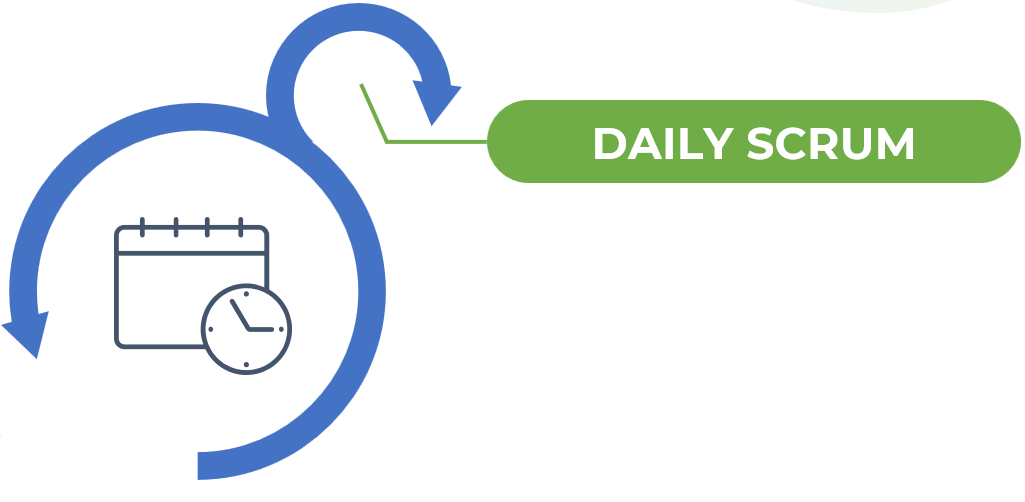
The most important thing to understand about those three questions is who the answers are for. They are for the team, not for the Scrum Master, not for any manager observing from the back of the room, and not for the product owner. This is the distinction that separates a standup from a status meeting, and it is violated constantly in organizations that adopt Scrum without understanding the intent behind the structure. In a status meeting, each team member reports to the Scrum Master. The Scrum Master asks follow-up questions about tasks, timelines, and estimates. The event runs forty-five minutes and ends with the Scrum Master holding all the information while the rest of the team holds nothing new. In a standup done correctly, team members talk to each other. One developer hears that another is working on the same API endpoint and realizes they are about to create a merge conflict. They plan to sync for five minutes immediately after the standup. A tester hears that a feature is complete and shifts her day to prioritize verification before the sprint ends. This lateral coordination, team member to team member rather than team member to leader, is the entire value of the event. The Scrum Master notes blockers surfaced during the standup and owns them until they are resolved. Those blockers do not get solved during the standup itself. Problem-solving during the standup pulls the full team into a discussion that is relevant to one person, extends the event well past fifteen minutes, and defeats the efficiency the standup exists to create.
The sprint review happens at the end of the sprint, and its purpose is frequently misread. Teams treat it as a performance: the work is polished, the walkthrough is rehearsed, and the implicit goal is to leave stakeholders impressed. That framing produces the wrong event entirely. The sprint review is a conversation, not a performance. The team demonstrates the working increment, meaning the actual product running in a state that is complete by the team's definition of done, and the product owner and stakeholders engage with what they see. They try the feature, share reactions, and surface the mismatch between what they imagined when they read the backlog item and what they see running in front of them. That mismatch is the most valuable output of the review. The team updates the backlog based on what they learned. Sprint planning for the next sprint begins with a clearer picture of what the product should become, shaped by real contact with the work rather than continued assumption.
The contrast between a demo and a review is worth being specific about, because the difference is not stylistic. A demo exists to show capability. A review exists to generate information. A team running a demo selects the features most likely to produce approval, sequences them to build toward a satisfying conclusion, and manages the room's reaction. A team running a review shows what was committed and what was built, invites honest evaluation, and treats critical feedback as the most useful input the session can produce. The better a team becomes at running reviews, the more uncomfortable the reviews become, because comfortable reviews produce little new information. Stakeholders who leave a review with no questions about the product either saw exactly what they expected or were not engaged enough to push back. Neither outcome helps the next sprint. There are also two common misunderstandings worth clearing up: the sprint review is not an acceptance ceremony, and it is not a gate that the product owner opens or closes. Acceptance happens continuously throughout the sprint at the item level, when a developer completes a story and the product owner verifies it meets the acceptance criteria. The review is about learning, not formal sign-off. Conflating the two turns the review into bureaucracy and strips out its actual value.
The retrospective is the fourth ceremony, and it is the only one focused entirely on the team's process rather than its output. The sprint review asks what the team built and whether it served the user. The retrospective asks how the team built it and whether there is a better way to build the next thing. Three questions drive the event: what worked well and should be repeated? What did not work and should change? What should we try that we have not tried yet? Those questions sound simple, and structurally they are, but the quality of the answers depends entirely on what the team is willing to say out loud and whether the conversation that follows is specific enough to produce an actual commitment. A team that runs a retrospective in twenty minutes and leaves with two statements like "communication could be better" and "sprint planning ran too long" has held a retrospective in name only. A team that surfaces the specific Wednesday afternoon blocker that recurred in three consecutive sprints, traces it to a single external dependency with no clear owner, and assigns one person to resolve the ownership question before the next sprint opens has completed a retrospective that will measurably change the next sprint.
Three conditions determine whether a retrospective produces real improvement or simply produces attendance. The first is psychological safety: team members must be able to say what is not working without fear that the observation will surface in a performance review or shift how their manager sees them. When team members do not feel safe, retrospectives produce agreement rather than honesty, and agreement with a failing process is not improvement. The second condition is specificity. "Deployments were slow" is an observation that cannot be acted on. "The staging environment was unavailable for four hours on Wednesday and blocked three developers from testing" is a fact with a root cause that can be investigated and a pattern that can be addressed. The third condition is accountability. Every retrospective should end with one or two concrete commitments, owned by named individuals, that will be visible during the next sprint. If those commitments are not tracked, the retrospective becomes a recurring complaint session. Teams that track their retrospective commitments demonstrate something important: improvement is not an aspiration for them, it is a deliverable with an owner.
The retrospective is also the most transferable of the four ceremonies, and this matters beyond Scrum teams. You do not need sprints or a product backlog to hold a retrospective. A team nine weeks into a six-month predictive project can hold a monthly retrospective and surface communication gaps, process friction, and team dynamics problems before they compound into something that derails the schedule. Any project team in any delivery model improves faster by stopping at regular intervals to ask how the work is actually going. The reason retrospectives get cut first when a team is under pressure is that they feel indulgent: the project is behind, and a ninety-minute conversation about process seems like the opposite of what the situation requires. But a team that is behind, under pressure, and never examines why it is behind stays behind. The retrospective is the mechanism that would tell them what to change. Cutting it is cutting the one event most likely to relieve the pressure that drove the decision to cut it in the first place.
Eight days into a two-week sprint, a VP of Product stops by the team's workspace. A major client's contract renewal is three weeks away, and the client has asked to see a returns portal feature before signing. The sprint goal is the checkout flow, eight of fourteen sprint days are spent, and multiple items are in progress. The VP's request is reasonable on its surface: she is responsible for the client relationship, the renewal timeline is real, and she is not asking in bad faith. She simply wants the team to add the feature to the current sprint so the client sees momentum. The Scrum Master and product owner explain what that would actually mean. The team committed to a sprint goal eight days ago and built the sprint backlog around delivering it. The sprint goal does not change mid-sprint; adding the returns portal now means pursuing a second goal with capacity already committed to the first. Adding it produces one of two outcomes: the checkout flow does not finish, or the team is asked to deliver in six remaining days a feature that was never estimated for this sprint. The sprint review would have nothing coherent to show. The team would also learn that sprint commitments can be overridden by any sufficiently senior walk-in request, and future sprint planning would stop being taken seriously.
The product owner adds the returns portal to the top of the product backlog immediately. The current sprint ends in six days. Sprint planning opens the next morning, the returns portal becomes the sprint goal for the following sprint, and the two-week sprint begins. The client renewal meeting falls eight days after the current sprint ends, placing it two days into the sprint containing the portal work. The team shows early progress at the renewal meeting, and the complete feature is ready well before the contract closes. The checkout flow ships in six days. The returns portal ships in two weeks. Neither is half-done. The sprint structure did not block the business need: it gave the product owner the language and the mechanism to respond to real pressure with a credible, specific, professional answer rather than a reactive yes that would have broken both commitments at once.
The next chapter covers Scrum artifacts: the product backlog, sprint backlog, user stories, epics, minimum viable product, and the definition of done that ties every sprint commitment to a concrete standard of completion.
Move beyond guesswork and status reporting. This course helps you measure real progress, spot problems early, and make confident decisions using proven project performance techniques. If you manage complex projects and want clearer visibility and control, this course is built for you.
This is not abstract theory. You’ll work step by step through Earned Value Management (EVM), learning how cost, schedule, and scope come together to show true performance. You’ll build a solid foundation in EVM concepts, understand why formulas work, and learn how performance data actually supports leadership decisions.
You’ll master Work Breakdown Structures (WBS), control accounts, and budget baselines, then apply core EVM metrics like EAC, TCPI, and variance analysis. Through a detailed real-world example, you’ll forecast outcomes, analyze trends, and understand contingencies and management reserves with confidence.
Learn how experienced project managers monitor performance, communicate results clearly, and take corrective action before projects slip. With practical exercises and hands-on analysis, you’ll be ready to apply EVM immediately. Enroll now and start managing performance with clarity and control.
Explore the CourseHK School of Management offers a practical Leadership for Project Managers course for real projects, tight deadlines, and cross-functional teams. Learn to set direction, align stakeholders, and drive commitment without relying on title. Practical skills, tools, and guidance you can apply right away. Covered by Udemy's 30-day refund policy.
Learn MoreUnlimited redemptions
Available until September 18, 2026 5:09 PM PDT
66D6FD5906E09C4284FE