
Limited-time Udemy offer
$9.99
Leadership For Project Managers Leading People And Projects
Unlimited redemptions
Available until September 18, 2026 5:09 PM PDT
66D6FD5906E09C4284FE
Traditional and agile project management are trying to accomplish the same thing: deliver something of value to the organization that funded it, meet the objectives that were set, and satisfy the people who asked for the work. The methodologies differ. The terminology differs. The daily rhythms of a sprint-based agile team and a Gantt-chart-driven traditional team look almost nothing alike. Strip those surface differences away, though, and the goal is identical. Value, delivered, on time enough to matter. The frameworks are vehicles. The destination is always the same.
Where these two models part ways is in how they think about uncertainty. Traditional project management treats uncertainty as a planning problem. The assumption is that if you gather requirements thoroughly enough, estimate carefully enough, and build a detailed enough schedule, you can resolve most of the unknown before the first task begins. The plan is the answer to the question: what will happen? It is designed to make the future legible before you enter it. Agile treats uncertainty differently. The assumption is not that uncertainty can be eliminated through better planning. The assumption is that uncertainty is the native condition of most projects, and the right response is to build a model that can absorb and respond to it continuously. You do not try to make the future legible before you start. You make short, fast loops that let you learn as you go, and you adjust after each one.
Neither approach is inherently more disciplined than the other, and confusing the two is one of the most persistent misreadings of agile adoption. A well-run agile project is not looser than a well-run traditional project; it is differently structured. The discipline in a traditional project lives in the upfront planning and the change control process. The discipline in an agile project lives in the sprint cadence, the backlog prioritization, and the definition of done. Both require rigor. They just locate that rigor at different points in the lifecycle. The PM's job is not to defend one model against the other. The PM's job is to recognize which project conditions call for which model, and then apply it with the full discipline that model requires. Most practitioners default to the approach they know. The better habit is to read the project's conditions first, then choose the approach that fits them.
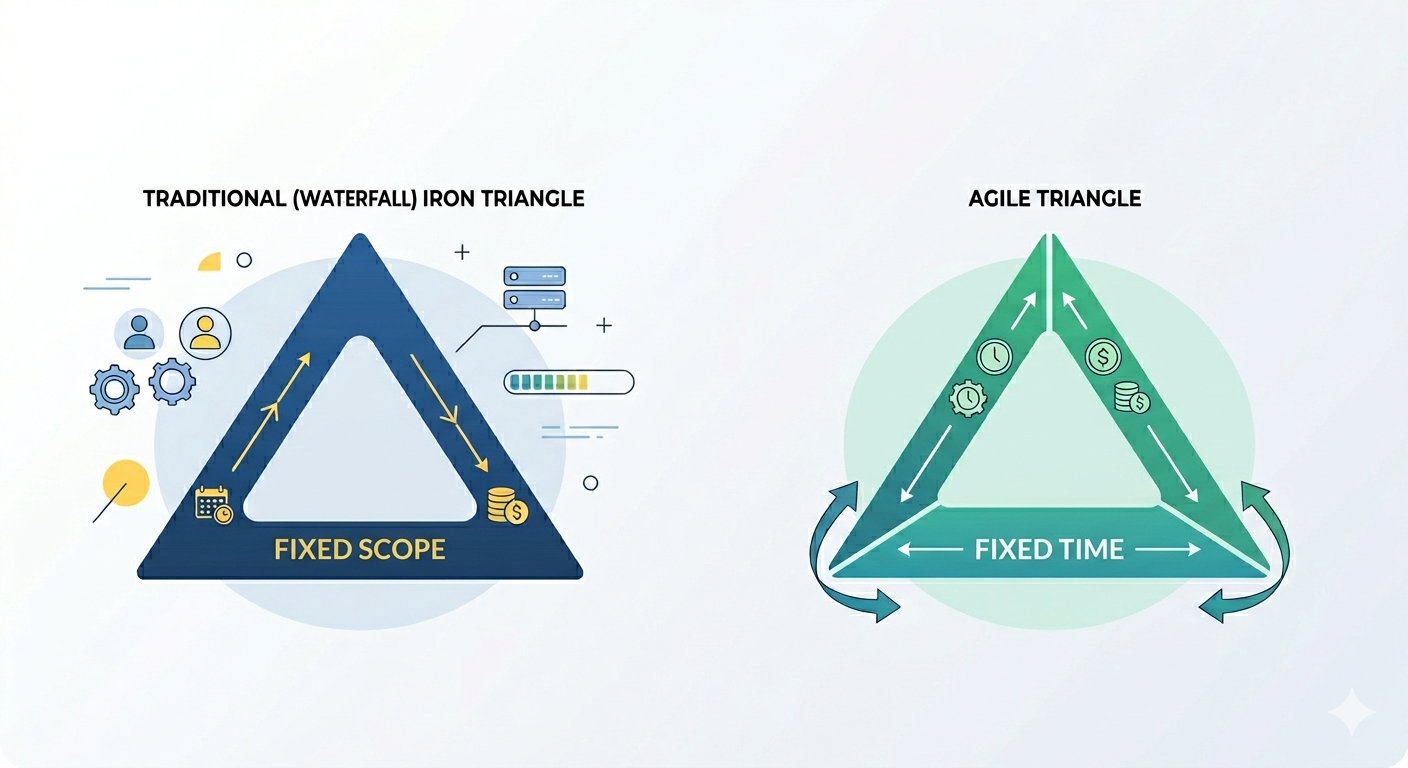
Every project manager learns the iron triangle early. Scope, time, and cost are the three constraints. When any one of them moves, the others feel the pressure. Change the scope and you change the budget or the deadline. Compress the deadline and you cut scope or spend more. Traditional project management is built around the assumption that scope is the fixed point. The customer defines what they want, the team defines how long it will take and what it will cost to deliver exactly that, and scope becomes the contract. When something goes wrong in a traditional project, or when a sponsor requests something new, the PM's first question is: what does this do to time and cost? Scope is the last thing to move. Moving scope is, in most traditional projects, a formal concession that triggers change control. That is not inefficiency. It is the right response to a model built around delivering a defined outcome to a defined specification.
Agile inverts the triangle. In an agile delivery model, time and cost are the fixed parameters. A sprint is two weeks long. The team is a known size and carries a known cost. Those things do not change sprint to sprint. What changes is scope. The team delivers whatever work they can complete within the fixed time and budget, starting with the highest-value items in the backlog. Scope is not abandoned or ignored; it is continuously negotiated and sequenced. Lower-value items wait. Higher-value items ship first. The mechanism for managing scope is prioritization, not reduction. This model handles uncertainty well because the cost of learning something new mid-project is low. If a customer changes their mind about a feature in week four, the response is to update the backlog and reprioritize. The sprint continues with the highest-value work. The new feature enters the queue where it belongs. The team never has to build something they were about to invalidate, because the delivery cycle is short enough that the learning happens before the work is locked in. This fixed-time, variable-scope model describes the most common agile planning pattern. Projects with variable funding, fixed regulatory scope, or committed release dates may need to anchor different constraints instead.
The conversation with sponsors changes in this model, and that shift deserves attention because it is where many PMs get tripped up during their first agile engagement. In traditional delivery, the success narrative is clear: we delivered everything in scope, on time, on budget. The sponsor evaluates the project against a fixed checklist. In agile delivery, the success narrative is different: we delivered the most important things within the time and cost envelope, and we sequenced lower-priority items for a future release. That framing is not a failure. It is the model working as designed. But sponsors accustomed to traditional delivery sometimes hear it as an excuse, and a PM who does not set the expectation clearly before the first sprint will spend the entire project defending a misunderstanding. The conversation with the sponsor should happen before any work begins: the team will deliver the highest-value items first, and if scope must be adjusted to fit the budget, the adjustment comes from the bottom of the priority list, not from the top. A sponsor who understands that framing from the beginning will not be surprised when scope adjustments happen. They will recognize them as the model functioning correctly.
A traditional project plan is a blueprint. The work breakdown structure breaks the full scope into deliverables and tasks. The schedule sequences those tasks, assigns dependencies, and maps them across time. The budget baseline estimates the cost of every work package. By the time a traditional project kicks off, the PM has a detailed picture of what the team will build, in what order, by what date, at what cost. The plan is not aspirational. It is a commitment. The team is accountable to it, and deviations from it require documentation, explanation, and often formal approval. This model works when the assumptions behind the plan are stable. If the requirements are well understood, if the technology is known, if the stakeholders agree on what done looks like, a detailed upfront plan is the right tool. It gives everyone a shared reference point. It makes dependencies visible before they become conflicts. It enables cost and resource forecasting that would be impossible without a defined scope. The discipline required to build a good traditional plan is real, and the plan itself has genuine value when conditions support it.
Agile planning produces a different starting artifact: the product backlog. The backlog is a prioritized list of the desired outcomes, features, or user stories the product should eventually deliver. It is ordered by value, not by sequence. Items at the top are the most important; items at the bottom may never be built if budget or time runs out. The backlog is expected to evolve. New items are added when new information arrives. Existing items are reprioritized when the team or the business learns something that changes the relative value of features. Planning horizons shift based on how much is actually known at any given point. The next two-week sprint is planned in detail: specific stories are committed, tasks are broken down, estimates are agreed. The next quarter is mapped in rough shape, capturing which themes or capabilities the team is working toward. Anything beyond that is held loosely, because the information that would make it worth planning precisely does not yet exist. This is not vagueness. It is calibrated precision: you invest planning effort where the detail is stable enough to trust, and hold the rest at the level of intention until it becomes stable enough to plan.
One of the most common objections to agile planning is that it cannot answer the sponsor's fundamental question: when will this be done? That objection misunderstands how agile teams forecast. After a few sprints, an agile team has a measured velocity: the average number of story points or backlog items they complete per sprint. With that velocity and a known backlog size, the team can project a release date with a confidence range. It will not be as precise as a Gantt chart milestone, but it will be more honest, because it is based on observed performance rather than upfront estimates made before any work has occurred. A team that has delivered for four sprints knows roughly how much it can accomplish in a sprint. The PM or product owner can say: given our velocity and the size of the remaining backlog, we expect to complete the highest-priority features by a certain date, with a confidence range of plus or minus one or two sprints. That is a meaningful forecast, and it is updated every sprint as actual data replaces assumptions. The plan is not fixed upfront and then defended. It is continuously refined as the team learns.
In traditional project management, a scope change is a formal event. When a stakeholder requests new work or a modification to existing work, the PM initiates a change request. That request goes through a documented impact analysis: how much time will this add to the schedule, how much will it cost, what dependencies will it affect, what risks does it introduce? The change control board reviews the analysis and either approves the change, defers it to a future phase, or rejects it. If approved, the PM updates the plan, adjusts the budget, and revises the schedule. This process exists for good reason. Changes in the later phases of a traditional project are exponentially more expensive than changes in the earlier phases. A requirement missed in planning costs one unit of effort to fix in planning, ten units to fix in design, one hundred units to fix in construction, and one thousand units to fix after go-live. The change control process is the mechanism that makes those costs visible before they are committed. Protecting scope protects the budget, and protecting the budget protects the sponsor's investment. The formality is the discipline.
In agile delivery, a change request is a backlog item. When a stakeholder identifies new work or a modification, the product owner captures it as a story or feature in the backlog. The PO then evaluates it against everything already in the backlog, weighing its value relative to existing items, and places it in the sequence where it belongs. If the new item is more valuable than what is currently at the top of the backlog, it moves up and enters the next sprint. If it is less valuable, it waits. The team never builds it out of turn. The control mechanism is prioritization rather than a formal approval gate. The backlog is always a ranked list, and every new item has to earn its place in that ranking. A sponsor cannot simply add a new feature without the PO assessing what it displaces. Adding a high-priority item at the top of the backlog means the lowest-priority item at the bottom gets pushed out if the budget or timeline is fixed. The sponsor gets the new feature, but they understand the tradeoff explicitly. That is control. It looks different than a change control board, but the accountability is real.
Many real-world projects need both mechanisms simultaneously, and recognizing when to apply each is a mark of an experienced PM. Consider a project where the team uses agile delivery sprints but operates under a fixed-price contract. The contract defines a scope boundary. Work inside that boundary can be adjusted sprint by sprint through backlog prioritization without formal change control. Work that extends beyond the contract boundary, adding something that falls outside the agreed scope envelope, requires formal change control because it affects the contract itself. The sprint team has daily flexibility within the boundary. The PM protects the boundary through the formal process. Drawing that line clearly at the beginning of the project saves a significant amount of friction when changes arrive, and they always arrive. Delivery-level decisions, how a feature is implemented, which user stories are picked up in a given sprint, whether a technical approach changes, live inside the team's authority. Scope decisions that affect cost ceilings or contractual commitments move through the formal process. Both mechanisms serve the same underlying goal: ensuring that changes are made intentionally, with the relevant people informed and accountable.
In a traditional project structure, the project manager is the coordination point. The PM assigns the work. The PM knows who is working on what task, when it is expected to be complete, and how it connects to the tasks around it. Against that plan, the PM tracks progress, and if a team member falls behind, the PM identifies the variance, assesses the impact on the critical path, and takes action: reassigning resources, adjusting the schedule, escalating to the sponsor if needed. The PM is responsible for knowing the state of the project at all times, because the PM is the one building and maintaining the map. This structure has genuine advantages. A skilled PM who owns the schedule can spot problems before they become crises. Dependencies between team members are managed centrally, which reduces the chance that two people are working at cross-purposes without anyone noticing. For projects with complex sequences of dependent tasks, or for teams where technical specialization means only certain people can do certain work, a directed structure is often the most efficient way to coordinate.
Agile teams operate on a different premise. Self-organizing means that the team collectively decides how to accomplish the sprint goal. At the start of each sprint, the team reviews the prioritized backlog, pulls items into the sprint based on their capacity, and distributes work among themselves. They coordinate through daily standups, direct conversation, and shared tools. Nobody tells them exactly how to do the work. The Scrum Master facilitates the sprint process and removes organizational obstacles. A product owner sets the direction: what to build and why. The team decides how. This structure reflects a deliberate assumption: the people closest to the work are better positioned to decide how to do it than the person managing the schedule. A developer who encounters an unexpected technical problem mid-sprint should not have to escalate to the PM before changing their approach. They discuss it with the team, agree on a path, and move. The sprint is short enough that if the approach turns out to be wrong, the retrospective catches it and the next sprint corrects it. Speed of learning is the advantage self-organizing teams are designed to produce.
For a PM transitioning from traditional to agile delivery, this shift is often the hardest adjustment. The instinct to own the schedule, to know where every task stands, to be the person with the answer when a stakeholder asks "where are we?" is deeply embedded in traditional PM practice. In an agile context, that instinct can actually slow the team down. A PM who micromanages task assignments on a self-organizing team undercuts the team's ownership and creates a bottleneck at the exact point where the model is designed to be fluid. The PM's role in an agile context is not abdication. It is a deliberate shift in where the PM's attention goes. You define the objective clearly. Removing organizational obstacles is your core function: budget approvals that are stuck, stakeholders who are not providing timely feedback, infrastructure that has not been provisioned. You ensure the team has what it needs to operate effectively. Managing the boundary between the team and the outside world is where your attention belongs. The team manages the inside. This is not easier than owning the schedule; it requires a different set of skills, a higher tolerance for ambiguity, and a genuine willingness to trust the team's judgment on how to reach the goal you have set together.
A concrete scenario makes the difference tangible. A sponsor calls you three months into a twelve-week project. A competitor released a product last week, and the feature set has shifted what your client's customers are expecting. The sponsor wants to add a new capability that was not in the original scope. Not a small tweak. A meaningful new feature that would take approximately two weeks of development effort if added now. How you respond depends entirely on which model you are operating in. This is not a hypothetical situation. A team midway through a fixed-scope project faces this kind of request regularly. Technologies shift. Markets move. A business assumption made during the planning phase turns out to be wrong by month three. The question is not whether change will arrive. The question is what your system for handling it looks like, and whether your sponsor understands that system well enough to work within it when the moment comes.
In a traditional delivery model, the new feature triggers the change control process. The PM captures the request formally and conducts an impact analysis. Adding two weeks of development effort to a twelve-week project does not simply extend the end date by two weeks; it ripples through the schedule, affecting downstream testing, integration, and deployment tasks. The analysis might determine that the true schedule impact is three weeks, not two, once you account for the dependencies. The cost analysis adds the development and testing effort, plus any resource overtime required to absorb the work without extending the timeline. The PM brings that analysis to the sponsor with options: add the feature and accept the schedule and cost impact, defer the feature to a post-launch release, or deprioritize a lower-priority in-scope item to free up time for the new feature without extending the timeline. The sponsor makes an informed decision based on real numbers. The PM updates the plan to reflect that decision, and the team executes against it. The process is deliberate. It is designed to make the cost of the change visible before committing to it, which protects the project from decisions made without full information about their consequences.
In an agile delivery model, the response is structurally different but equally accountable. The product owner captures the new feature as a backlog item and evaluates its priority relative to everything else currently in the backlog. If the feature is high enough value to displace what was planned for the next sprint, it moves to the top of the backlog and enters the next sprint when it starts. If existing sprint work has already begun, the team finishes the current sprint and the new feature enters the following one. The timeline and budget do not automatically change, because those are fixed in the agile model. What changes is the sequence and, potentially, what gets built at all. The sponsor needs to understand the tradeoff before agreeing to the addition: adding a high-priority item at the top of the backlog means the lowest-priority item at the bottom will not be built if the budget runs out. The product owner facilitates that conversation explicitly, so the sponsor is never surprised by what did not ship when the project closes.
A software team building an internal reporting tool was midway through a six-sprint project when the finance director identified a new regulatory requirement. Under a traditional model, the PM submitted a change request and the analysis showed a four-week schedule extension at a cost of $28,000. The sponsor deferred two lower-priority reports to a future release and absorbed a two-week extension instead. Under an agile model, the PO would have added the regulatory feature to the top of the backlog and removed the two lowest-priority reports from the plan entirely, hitting the same budget without extending the timeline. Both responses were defensible. The key was that the sponsor made the call with full information about what the change cost.
Both models handled the change. One protected the plan through formal control and explicit cost accounting. The other updated the plan through prioritization and a transparent tradeoff conversation. The feature gets built in both cases, or a deliberate decision gets made about whether to build it. The difference is in the mechanism and the conversations it generates. Neither mechanism is inherently better. A team building a safety-critical medical device under a regulatory contract needs the formal change control process, both for technical rigor and for legal compliance. A team building a consumer-facing web product in a fast-moving market needs the agile mechanism, because the four-week delay that formal change control introduces may be longer than the window in which the feature is commercially relevant. The model you choose should match the conditions you are actually operating in, not the conditions you are most familiar with.
The next chapter introduces the delivery spectrum and the three-category framework for choosing your approach, walking through a scenario where a traditional PM evaluates a new project and makes the call.
Solve complex problems, reduce variation, and improve performance with confidence. This course is designed for professionals who already know the basics and want to apply advanced Lean Six Sigma tools to real business challenges.
This is not abstract statistics or theory-heavy training. You’ll use Excel to perform real analysis, interpret results correctly, and apply tools like DMAIC, SIPOC, MSA, hypothesis testing, and regression without memorizing formulas or relying on expensive software.
You’ll learn how to measure baseline performance, analyze process capability, use control charts to maintain stability, and validate improvements using statistical evidence. Templates, worked examples, and structured walkthroughs help you apply each concept immediately.
Learn through a complete, real-world Lean Six Sigma project and develop the skills to lead data-driven improvements with credibility. If you’re ready to move beyond basics and make decisions backed by data, enroll now and take your Lean Six Sigma expertise to the next level.
Explore the CourseStandard IT controls can disrupt the industrial systems they are meant to protect. Learn how to assess OT risk, design zones and conduits, apply IEC 62443 security levels, use MITRE ATT&CK for ICS, and establish passive asset visibility without risking production. Eight reconstructed incidents connect attacker techniques to the controls that failed, giving you the vocabulary and judgment to make credible security decisions from day one.
Explore the CourseUnlimited redemptions
Available until September 18, 2026 5:09 PM PDT
66D6FD5906E09C4284FE