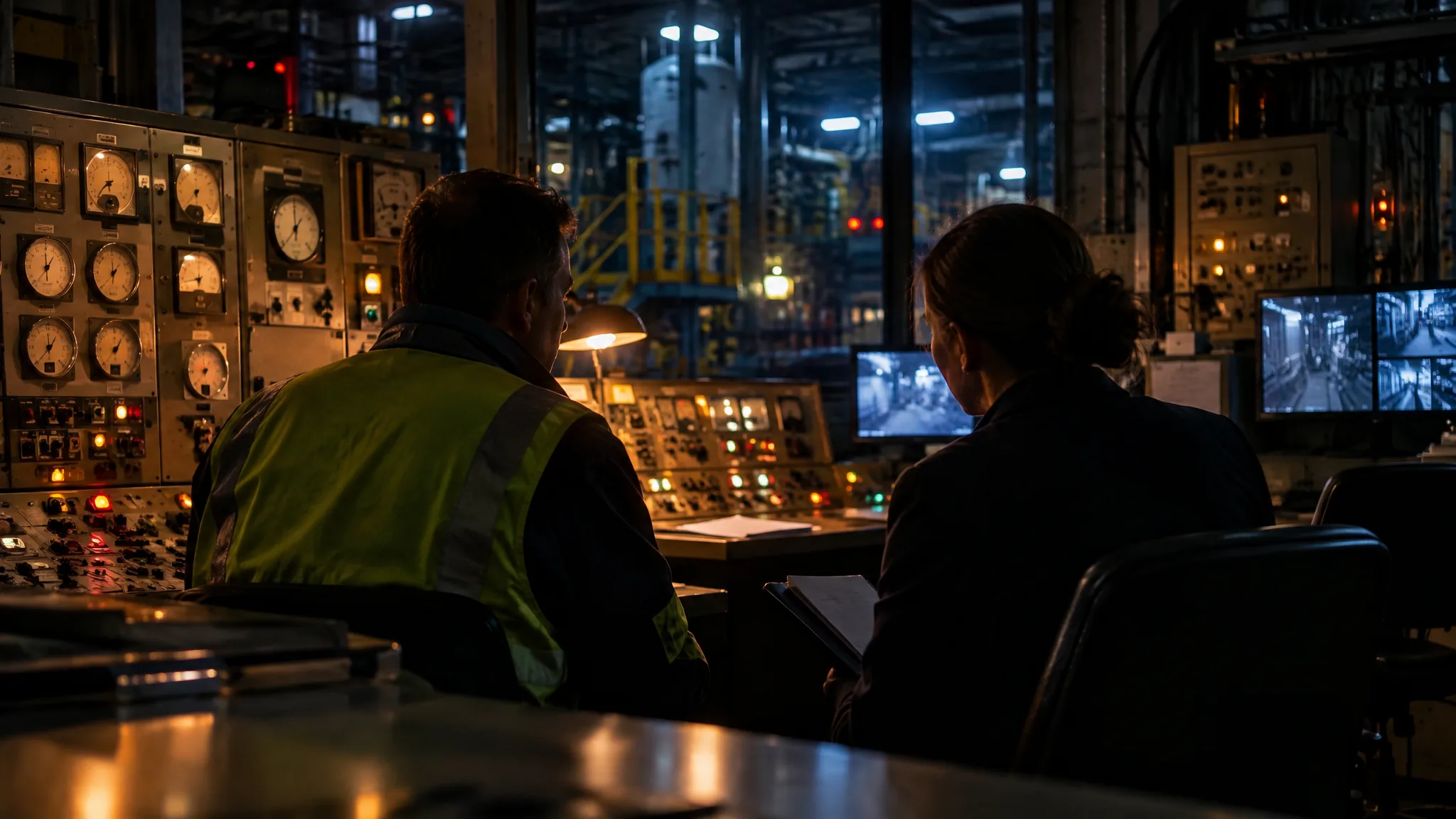
"Who can tell you to stop the plant for a cyber reason?" The day-shift supervisor answers without a pause: "The plant manager." Walk across to the night-shift supervisor, ask the same question, and you get: "Nobody. I'd just do it."
That exchange is illustrative, from a teaching plant rather than a real one. Ask the question at your own site before deciding it could not happen there. Neither answer is wrong for the person giving it. Neither is written down anywhere. And the incident response plan you are about to write will contradict at least one of them, unless you find out first.
This is for whoever has been asked to write, or rewrite, the incident response plan for an industrial site and has not started drafting yet. If you already have a plan, keep reading anyway: the same interview finds what the existing plan gets wrong.
There is a number that points the same way. The SANS 2025 survey, as reported by Industrial Cyber, found that 57% of respondents have a dedicated ICS/OT incident response plan, and added this:
"Organizations that involved frontline technicians in exercises were nearly 1.7 times more likely to report strong readiness."
Read that carefully. It is about exercises, not planning interviews, and it is a correlation, not proof of cause. What it supports is narrower and still useful: the people closest to the equipment change the result. A discovery interview brings them in before the first draft, instead of after the plan has been written around them.
Call, Dark, Stop: the interview script
Our interview guide carries seven core questions. Three of them do most of the work, and they fit in one sitting. We call them Call, Dark and Stop, after what each one is really asking about. Here is the whole script, including the parts most people skip.
The "why" follow-up is where the plan facts come from. A worked exchange from our teaching material:
"We'd call the integrator." Why? "Only they have the PLC passwords." Why? "The contract never handed them over."
Three answers in, a recovery dependency and a contract gap have surfaced that no drawing or inventory would have shown. That is the depth to aim for on every question.
How the answers become plan requirements
An answer in a notebook is a memory. An answer in a findings log is a requirement with an owner. Every entry gets one line in this shape:
- ID and date
- Source, by role rather than name where that is sensitive
- Type: fact, decision needed, gap, conflict or action
- The finding, in one sentence
- Plan chapter it belongs in
- Owner
- Sponsor decision needed, yes or no
- Status
Here is how one night-supervisor interview at Cedar Ridge Water Treatment Plant, the fictional plant we teach with, turns into five entries, one of each type. A fact: radio is the backup for reaching the remote pump stations. A gap: there is no paper copy of the integrator's number. A decision needed: who may stop chemical dosing. A conflict: the day and night supervisors disagree about who holds shutdown authority. And an action that follows from them.
Filter the log on "sponsor decision needed" and you have the list that must be settled before drafting closes. Does your current plan say who may stop chemical dosing, or its equivalent at your site? If it does, and both shifts agree with it, that entry is closed. If not, it just became the first item on your sponsor's list.
"I can write it from the documents."
We have the drawings, the procedures and an asset inventory. Why would I spend weeks interviewing people when the answers are already on paper?
Documents describe the official plant. Interviews describe the working plant: who really gets called at 2 a.m., which workarounds exist and who knows them, which systems the place cannot run without, and where people disagree. You need both, in that order. We call it read, ask, walk:
- Read first. Emergency shutdown procedures, loss-of-control procedures, power-failure procedures, alarm responses. The interview should confirm what you already know, not start from zero.
- Ask the three questions. Listen for the places where the answer and the document disagree. Those are your findings.
- Walk it. For anything physical, go to the panel and say "show me". Which local panel, which valve, which radio channel.
At Cedar Ridge, the radio backup for the remote pump stations is the kind of fact that lives in a supervisor's head. A plan written from documents would assume the telemetry is always there.
"Operators won't talk to someone from IT."
I'm the security person. The control room thinks I'm there to take their remote access away. And I've never run an interview in my life.
You do not need to be a skilled interviewer. You need a script, which you now have, and a few habits that signal respect for how the plant works:
- Go to them. Sit in the control room or the workshop, not a meeting room. Interview the night shift at their hours; do not ask them to come in on days.
- Pick the moment. Never during startup, shutdown or a turnaround.
- Say what it is for. The context minute exists because "this is not an audit" changes the answers you get.
- Close by asking who else to talk to. It hands the person some control over the process, and it is how you find the one technician who knows the old system.
There is a quieter benefit. The night supervisor who was asked is far more likely to use the plan, and to defend it when the approval rounds come.
"I'll never get time with the night shift."
Overtime has to be approved, the union has rules about call-outs, and there's a turnaround in six weeks. This will take forever.
It takes a few weeks if you plan it like a small project instead of a favour. Run it in four waves:
- The sponsor and the plant manager. Their interviews create visible support for the rest.
- Operations across every shift: one day-shift and one night-shift supervisor at least, plus a board operator.
- Engineering, process safety and maintenance, including the instrument and electrical lead.
- Outside parties and support functions: the integrator or vendor, the managed security provider, the insurer or broker, legal, HR and procurement.
For a mid-size plant we plan for 12 to 20 interviews over two to four weeks. That is our estimate, not a benchmark. Put the overtime in the plan's charter before the first interview, so it is approved once rather than argued shift by shift, and bring in the union representative where a collective agreement covers call-out.
Write from what the plant told you
Go back to the two supervisors. Before discovery, their answers were two private beliefs that would have met for the first time during an incident. After discovery, they are entry C-03 in the findings log: type conflict, chapter decision rights, sponsor decision needed, with a date by which it must be settled. The plan that follows says one thing, and both shifts know why.
That is the whole point of the interview. You do not write an incident response plan from documents and then hope the plant agrees. You write it from what the plant told you, with the disagreements settled first.
Sources: Industrial Cyber, reporting the SANS 2025 State of ICS/OT Cybersecurity survey