Three lines from a night-shift log at an illustrative water plant. 02:47: "Filter PLC 3, logic download from EWS-2, no work order." 02:51: "Chlorine analyser reading drifted, field check normal." 03:05: "Vendor remote session opened, not on the schedule." Every line has a time, an asset and an observation. Not one says what it is. The column that would have said event, incident or emergency was never in the log, because the plan never defined the words.
A night operator with no written definition rings everybody, or rings nobody. Both are reasonable guesses. Neither is a plan.
The reader in mind: the person now holding the job of writing the OT incident response plan, an IT severity scale open on the desk, wondering where the plant fits. If your plan already has a definitions page a shift lead uses without phoning you, jump to the regulator section and check its breadth.
You are not alone in the gap. In the SANS 2025 survey, as reported by Industrial Cyber, only 57% of respondents had a dedicated ICS/OT incident response plan. NIST SP 800-61r3 is blunt about why it matters: an incident is declared when adverse events meet the organisation's defined incident criteria. No written criteria, no declaration. Just a judgement call at 03:05.
Three words, two lines, one page
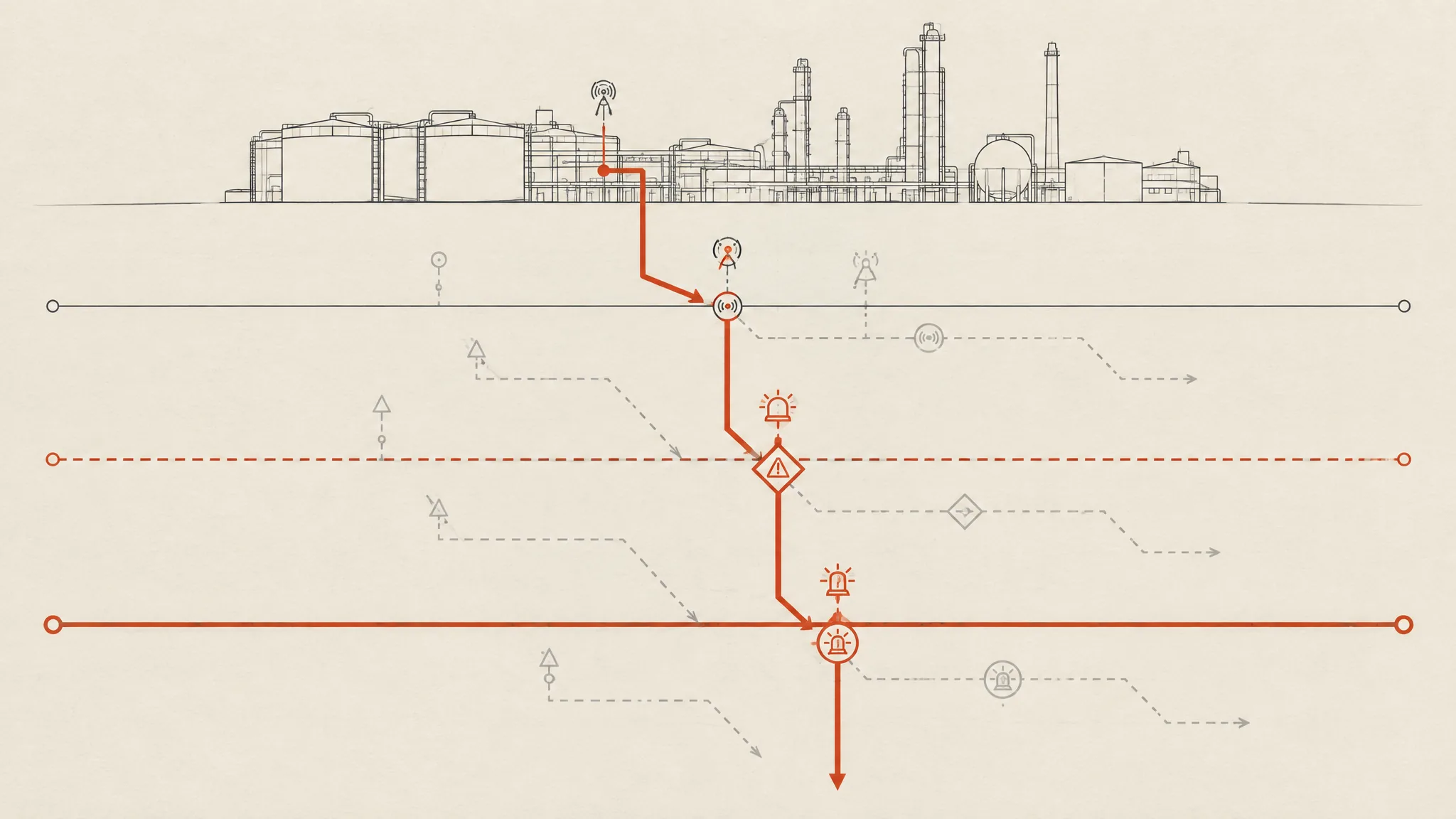
The fix is one page near the front of the plan: three words, and two lines between them. Here it is in full.
Each row below is something a shift could plausibly see. The columns are the answers a night operator should not have to invent.
| What the shift sees | The word | Who gets called | What it switches on |
|---|---|---|---|
| A CISA advisory names a product you run | Event | Nobody at night. OT lead, next working day | Vulnerability and patch process, not the incident plan |
| The same product, plus a connection from an address nobody recognises | Event over the investigation line | On-call OT lead | A check of logs and the asset; a timed note in the log |
| Logic or configuration download with no matching work order | Event over the investigation line; incident if no approved change explains it | On-call OT lead, then the declaring role | Comparison with management of change; declaration if unexplained |
| Confirmed or credibly suspected compromise of an in-scope system, or any activity on or near the safety system | Incident | Declaring role, or the first available alternate | Response team, incident record, regulator and contract checks |
| Pressure, level or release heading out of limits, cause unknown | Emergency | Shift supervisor acts; site emergency plan | Safe state now; the cyber question is asked afterwards |
| A vendor plugs their own USB stick into an engineering workstation; nothing found | Recorded, not declared | Nobody at night | A near-miss entry, trended and reviewed |
Look at the first row again, because it is current. On 15 October 2026 CISA published advisory ICSA-26-288-01 for Eclipse Milo, an open-source OPC UA stack, covering versions 0.6.0 through 1.1.4, with 1.1.5 as the fix. The advisory does not say the flaws are being exploited. If Milo sits inside something on your plant network, the advisory is an event. It becomes an incident only when something on your own network says so, and that is row two or row four, not row one.
Does that match how your site handled the last advisory? If someone was paged at night for it, your plan is treating news as an incident, and the people on call will learn to ignore the pager.
"We already have Sev 1 to Sev 4 from IT"
"Corporate gave us a four-level severity scale two years ago. Every ticket has one. I am not inventing a second vocabulary for the plant."
Keep the scale. Severity says how bad something is. The three words say whose plan owns it and who is allowed to decide. An IT Sev 2 on a historian server and a Sev 2 on a dosing PLC carry the same number and need different people out of bed, because one of them can hurt somebody.
The standard behind most OT programmes leaves the word to you. ANSI/ISA-62443-2-1:2024 defines a security incident as a compromise or failed attempt "of some significance to the asset owner" (clause 3.1.12). The standard is paywalled, so check a copy if you want the wording. The threshold is deliberately yours. An IT scale written for laptops and email is someone else's threshold.
So the definitions page sits above the severity scale, not instead of it. First the word, then the level.
"My operators are not security analysts"
"You want a night operator to tell an attack from a failing sensor at three in the morning? They can't. Half the time I can't."
They do not have to. None of the three questions in the operator test asks "is this an attack?" They ask about risk now, unapproved change and a written list, which operators already judge every shift.
The investigation line is written in plant terms for exactly this reason. Six triggers, written in plant language, are a workable start:
- an unplanned logic, firmware or configuration change, checked against management of change first;
- an HMI value the field disagrees with;
- a mode change nobody made;
- a vendor remote session nobody booked;
- an alert the security team forwards about an OT-connected asset;
- an IT incident on a system the plant depends on.
The bridge also runs the other way. 62443-2-1:2024 notes that the investigation of an ordinary facility event, a trip or a quality excursion, can find a security incident as its root cause (guidance to clause 12.2.8). Write one rule for it: when a process investigation finds no physical cause, or finds an unexplained change to logic or setpoints, it is referred across the investigation line, by a named role, to a named role.
Then name the declaring role. One role, with alternates appointed in advance and reachable around the clock: for a small plant, perhaps the plant superintendent, with the on-shift lead operator and the site IT security manager behind them. The free ICS4ICS escalation and declaration template uses the same pattern: one designated declarer, with a primary, secondary and tertiary.
"The regulator defines incident for us anyway"
"We are regulated. Whatever I write, the rule decides what counts. Why spend a week on my own definitions?"
Because the regulators disagree with each other, and several assume you have written your own.
- NERC CIP-008-6 has two tiers: a Cyber Security Incident, which includes attempts, and a Reportable one. It also requires the entity's own written criteria for what counts as an attempt (R1 Part 1.2.1). Your definition is what the auditor reads.
- TSA's Security Directive Pipeline-2021-01G counts an event still under investigation, before anyone knows whether it was malicious. Reportability can arrive before your own declaration.
- CIRCIA, as proposed, counts only substantial incidents with actual impact, and excludes attempts. It is a proposed rule and not in force; the final text may change.
One event at a multi-sector operator can meet one of these and miss another. So write one rule on the page: your internal declaration line is at least as broad as the broadest definition that applies to you. Then each regulator's test becomes a separate checklist, run at declaration and again whenever the incident is reclassified. Add contracts to the list. A cyber insurance policy can define a "cyber event" of its own and attach a notice duty to it.
Back to the blank column
Run the night log again with the page in place. 02:47, the logic download with no work order: over the investigation line, the on-call OT lead checks management of change and, finding no approved change, calls the declaring role. 02:51, the analyser drift with a normal field check: an event, logged. 03:05, the unbooked vendor session: over the investigation line, and together with 02:47 it probably meets a declaration criterion. Nobody had to guess.
The plan did not get longer. It got one page that settles, in advance, the argument a tired shift would otherwise have alone.
Sources: CISA, ICSA-26-288-01 Eclipse Milo | SANS 2025 survey, as reported by Industrial Cyber | NIST SP 800-61r3 | ANSI/ISA-62443-2-1:2024, clauses 3.1.12 and 12.2.8 (paywalled) | NERC CIP-008-6 | TSA SD Pipeline-2021-01G | CISA, CIRCIA proposed covered incident one-pager | ICS4ICS escalation and declaration template