
Here is the confession, and it is a common one among people handed the plant's incident response plan. The first draft was the IT plan, saved under a new name, with "the plant" typed in wherever it used to say "the network". It reads well. Three of its sections would do damage at 2 a.m.
That is no judgement on the IT plan. It was written to protect data, which can be copied, wiped and restored without anyone getting hurt. A plant protects a physical process that keeps moving while the response team talks, and the instructions that keep data safe can push it somewhere nobody chose.
This is for whoever has been handed the OT plan with an IT plan already on the shared drive: an OT security lead, a controls engineer, an IT analyst on loan to operations. The fix is smaller than it looks. Three sections, rewritten with people who already know the answers.
The US government's own guidance for OT says the core problem plainly. NIST SP 800-82 Revision 3, the Guide to Operational Technology Security, on choosing a response to an OT incident:
The response "can range from doing nothing to performing a full system shutdown", and the right choice depends on the incident and its effect on the physical process.
NIST SP 800-82r3, section 6.2.4.5, paraphrased around the quoted words
An IT template has one setting for that range: isolate it. On a plant floor that is one option among several, and sometimes the worst.
The three sections that need rewriting, side by side
To find them in your own plan, run a three-verb search. Search the document for isolate (and disconnect), reimage (and wipe, rebuild, power down), and declare (and close). Almost every hit lands in containment, evidence handling or recovery. Those are the three rows below.
The right-hand column contains no new technology. Every row is a decision about who acts, in what order, and what must be true first.
A quick check. Does your containment section already name who may order each move? If it does, that row is done and your rewrite starts at evidence.
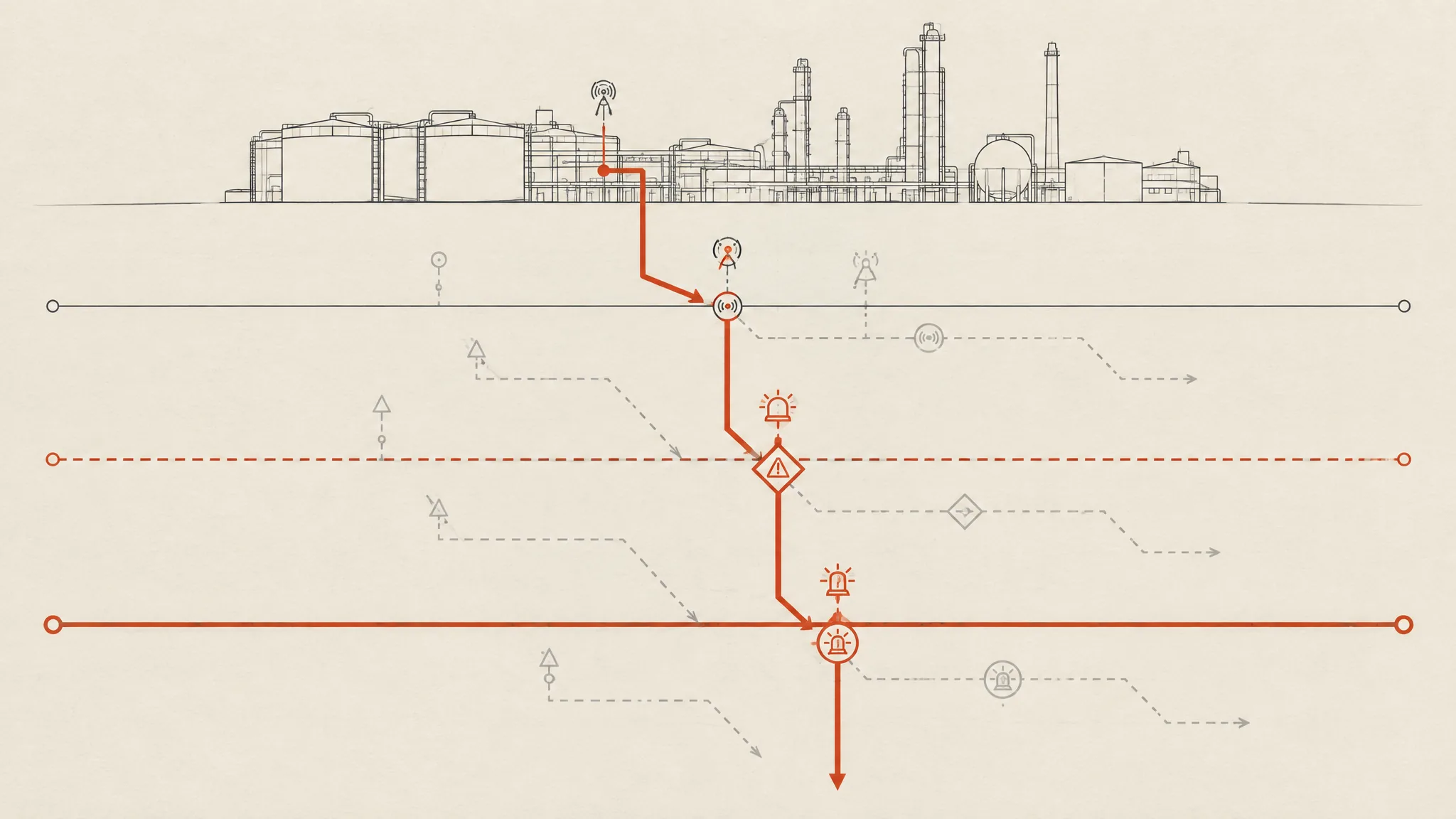
Here is the unconverted version on a realistic layout. Cedar Ridge Water Treatment Plant is a fictional plant we use for teaching. One SCADA system runs PLCs on the filters, chemical dosing and high-lift pumps, and polls four remote booster stations and two storage tanks over cellular telemetry. A managed security provider watches city IT only. The plant's sole incident response plan belongs to the city, and its containment step reads "disconnect affected systems from the network".
Follow that step with the SCADA server as the affected system. The control room loses sight of every booster station and both tanks at once, and nobody wrote down who drives out to read them. The step did exactly what it said. It said the wrong thing for this building.
"It's a good plan. It just needs an OT appendix."
Our IT plan was written by people who do incident response for a living. I'm not throwing it out. Add a page about the plant at the back and we're done.
Keep most of it. The trouble with an appendix is that the main body still gives the instruction, and on the night people follow the main body. "For OT assets, consult operations first" sits forty pages behind "isolate immediately".
Sort the IT plan instead. We call it keep, bend or replace, one afternoon with the document and a highlighter:
- Read each step and ask one question: if this ran on a control system at 2 a.m., could it change the physical process? Pulling a cable, rebooting a host, blocking a port and restoring a backup all can.
- If yes, replace it. It goes into one of the three rows in the table, and the rewritten version names the process consequence and who may order it.
- If it changes only who is told, or when, bend it. Detection sources, notification routes and escalation thresholds keep their purpose but need OT conditions added, such as the control room as a reporting source.
- Otherwise, keep it. The contact tree discipline, the incident log, legal hold and approval of outside statements usually carry over unchanged.
At Cedar Ridge, the sort leaves the city plan's communications and legal chapters nearly untouched and flags containment and recovery for replacement. The plant keeps the IT plan's good habits without its dangerous reflex.
"I'm from IT security. I can't write the right-hand column."
I know incident response. I don't know what happens to a chlorine dosing skid when the screen goes blank. You want me to write that?
Nobody should want you to invent it. Process engineers and operations define the safe state. The plan writer collects it, checks it and points to where it is written. That is a different job, and one you can do.
Collection runs on six questions, asked per process unit:
- What is the safe state for this unit?
- Who may command it, and who is the backup on nights?
- Can it be reached without the HMI or control system? How, exactly?
- How long can the unit run in manual, and with how many extra people?
- What forces a shutdown?
- Which existing procedure already covers this, by number?
Question three does the work. "We'd go to manual" is not an answer. Ask which local panel, which valve, which radio channel, then go and look with the operator. A safe state reachable only from the screen is a finding, not a fact.
Question six keeps the plan short. Plants already have loss-of-control and emergency shutdown procedures written for equipment failure, and their steps still apply to a cyber cause. The plan points to the procedure number and adds only the cyber trigger and who may invoke it. Copying the steps creates two versions of a safety procedure, and one will go stale.
Question four hides a staffing number. A unit that runs "indefinitely" in manual with two extra operators per shift, at a site with one spare operator, runs for one shift. Write down the hours and the people, then check the people against the call-out roster.
"Corporate owns incident response. They won't let a plant fork their template."
Our CISO's team owns the incident response plan for the whole company. If I turn up with a rewritten version for one plant, I'll be told to stop freelancing.
Then do not fork it. Write the seam. The corporate IT plan stays the plan for IT assets. The plant gets its own OT plan, one member of a family that already includes the emergency response and business continuity plans. What matters is the line between them:
- Leave the IT plan as it is for business systems.
- Record the IT plan in the OT plan's inventory of existing plans, with its owner, its last review date, the observable condition that starts it, and its 24/7 hand-off contact.
- Write the hand-off condition both ways. For example: when an IT incident touches the firewall between IT and the plant, the OT plan activates and operations joins the call before anyone changes that firewall.
- List the decisions only a sponsor can make. Who may cut the connection between IT and the plant is the usual first entry.
At Cedar Ridge, the inventory row for the city's IT plan shows a gap at once: the security provider watches city IT only, so nothing in that plan would notice trouble on the plant network. That becomes a finding for the plan's owner, with a date. The city keeps its template.
A good plan in the wrong building
The IT template is not careless. It is precise about a different building. Containment, evidence and recovery each carry an assumption that holds in an office and fails on a plant floor: cutting things off is safe, evidence survives a reboot, and security decides when it is over. Change those three and most of the IT plan is worth keeping.
So an appendix will not do, and starting from nothing is not needed. The work is three rewritten sections and answers that already exist in your plant, in procedures and in people's heads, waiting for someone to ask.
Sources: NIST SP 800-82r3, Guide to Operational Technology Security (2023) | CISA and INL, Recommended Practice: Creating Cyber Forensics Plans for Control Systems (2008) | CISA, Recommended Practice: Developing an ICS Cybersecurity Incident Response Capability (2009) | CISA, #StopRansomware Guide