

The FBI's warning about ARTEX runs to thirteen pages. Energy and manufacturing appear once, in a list of ten targeted sectors. After that, the document never mentions a PLC, an HMI, a historian or an industrial protocol. Every technique in its attack table belongs to office networks, cloud accounts and Windows domains.
That is the most useful thing about it for anyone who looks after a plant. The flash does not describe a new way to break a controller. It describes a faster way to reach everything around the controller, and it says the speed leaves defenders little time to respond. A two-person engineering team with no security operations centre was never going to win a race against software. The question is what to change so it does not have to run one.
What the FBI flash actually says
FLASH-20261113-001 was published on 13 November 2026 under TLP:CLEAR, so anyone may share it. It describes ARTEX as an open-source penetration testing platform driven by large language models. An operator types a goal in plain language. Specialised agents turn that goal into commands and run them, "requiring minimal human interaction beyond initial objective setting."
The tool was released for authorised security testing in July 2026. Since at least August, according to the FBI, "a variety of malicious cyber actors" have used it. Its developer pulled the repository on 8 October, but forks, archived copies and a commercial edition are still in circulation. Researchers counted more than 1,600 ARTEX consoles exposed on the internet in early November alone.
Three findings in the flash matter for a plant:
- Speed. "Some intrusions progressing from initial targeting to privileged access in under three hours."
- Scale for small groups. The agents do the slow work of enumeration and exploitation, so a small group can run several campaigns at once. The skill barrier drops with it.
- The edges. The FBI says ARTEX "excels" at systems that get less attention than the main application: supplier portals, legacy services, third-party integrations. Elsewhere it lists stolen VPN configurations as a way in.
The FBI also names the problem directly. ARTEX is noisy and "may trigger alerts," but "attack speed provides limited time for coordinated defender response." In other words, the alarm can sound and still be too late.
What it does not say, and where the confusion came from
Some aggregator coverage paired the flash with MITRE ATT&CK campaign C0066 and with claims about AI attacks on industrial equipment. Those are separate events. C0066 is the July 2026 campaign against more than 30 water utilities in Minnesota, part of activity the FBI and EPA reported in at least seven states. In it, internet-facing Allen-Bradley MicroLogix PLCs had their IP addresses and passwords changed and operators lost view and control. Neither MITRE's page nor the FBI and EPA notice of 30 July mentions AI. MITRE records attribution for the Minnesota intrusions as unconfirmed.
So the honest position, as of 19 November 2026, is this. There is a verified warning that an attack tool which runs itself is in wide use against IT and cloud systems, including at energy and manufacturing organisations. There is no public evidence in that warning of ARTEX operating inside an industrial control network.
That distinction is not a reason to relax. The water campaign showed how little it takes once a controller is reachable. According to the FBI and EPA, the attackers were "turning on and setting passwords." Some devices had no password at all. No AI was needed for that. A tool that finds reachable things faster and in greater numbers makes the same kind of door cheaper to find. (We covered that campaign in detail in our breakdown of the US water utility attacks.)
Where a plant meets a tool like this
Read the flash's list of initial access methods with a plant in mind and it stops being an IT document. Weak administrative credentials. Hardcoded passwords. Stolen VPN configurations and leaked logins. Compromised accounts belonging to a third-party vendor. Web interfaces with missing authentication.
Every one of those has an industrial equivalent most small sites will recognise. The integrator's remote support login that was set up for commissioning and never removed. The historian's web page, reachable from the office network. The cellular modem in a pump station or a remote substation. The shared engineering laptop with a saved VPN profile. The edges ARTEX looks for are the edges small plants tend to forget.
The second half of the flash matters even more. Once inside, the observed intrusions went for the Windows domain. In one case the tool enumerated more than 110,000 Active Directory objects. It read local administrator passwords and stole domain credentials. Suppose your engineering workstations and HMIs sit in the same domain as the office. Then a domain compromise can become an OT compromise wherever the network lets the attacker reach those machines. Nobody has to write a line of industrial code. They log in to the engineering workstation like an engineer would.
Why detection is the wrong race for a small team
The usual advice after a warning like this is to improve monitoring. For a large operator with a staffed security centre, that is reasonable. For a plant where cybersecurity is one of five jobs held by the controls engineer, it is not a plan.
Do the arithmetic. An intrusion can go from first contact to privileged access in under three hours. If your alerts land in an inbox someone reads the next morning, the race ended overnight. Buying a better alarm does not change who reads it at 2 a.m.
The better question for a small team is which steps can be made impossible, or slow, without anyone watching. Speed only helps an attacker when there is a path. A tool that reaches an exposed login in minutes gets nothing from a login that is not exposed. The flash records one example. In an observed intrusion, attempts to move on to the domain controllers were blocked automatically by endpoint protection already installed, with no person needed in the loop. It only covered the machines it was installed on, and the attackers checked for the ones where it was missing.
Five things a small team can do this month
None of these requires a security operations centre, and none requires AI on your side.
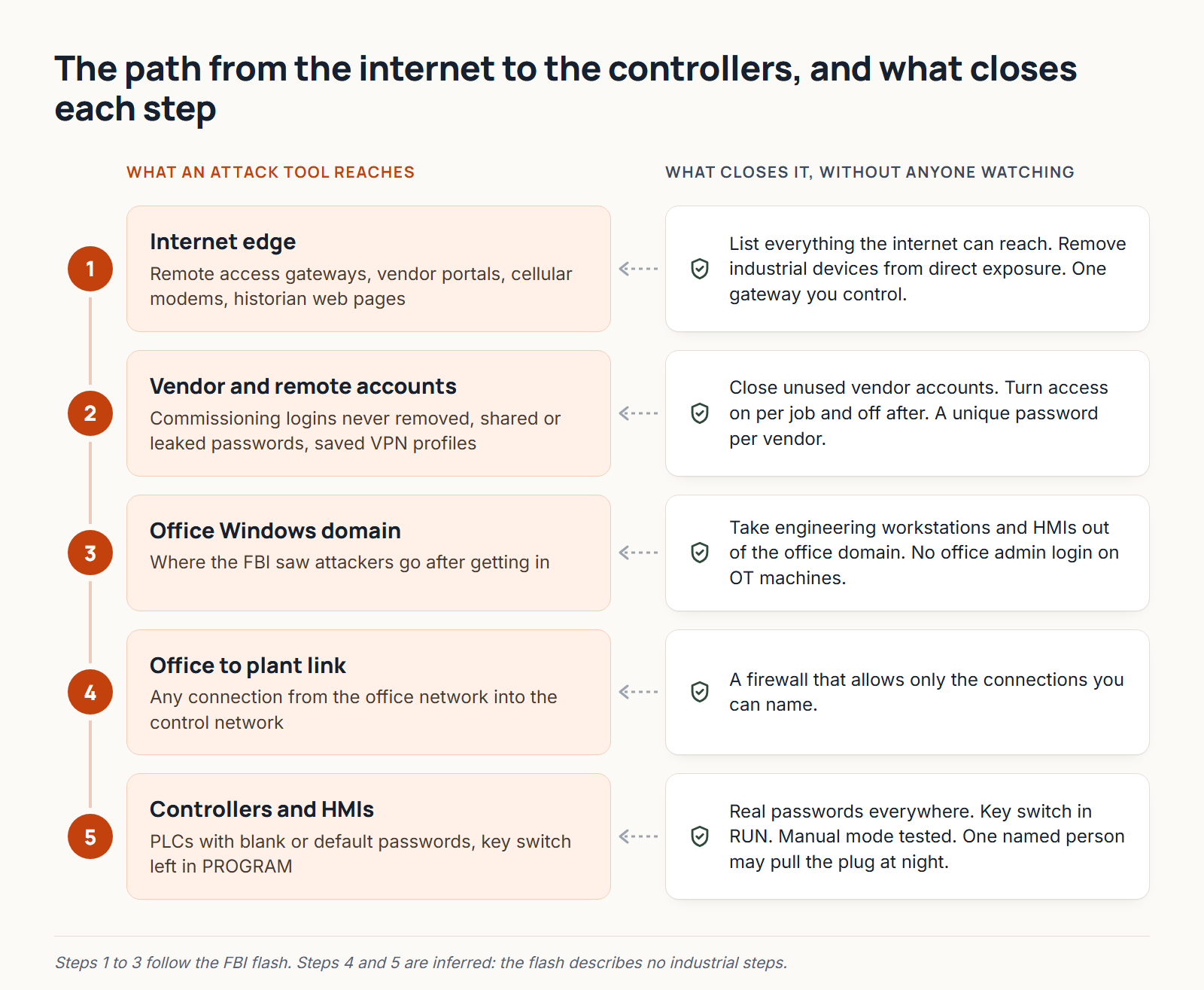
1. List everything you own that the internet can reach. This is the FBI's first recommended action. Include the peripheral things: remote access gateways, vendor portals, cellular modems, the historian's web interface, the backup appliance. Search your own public addresses on a public scanner such as Shodan or Censys and compare the results with what you believed. Anything industrial on that list gets removed from direct internet exposure, and access goes through one gateway you control.
2. Close the vendor and commissioning accounts. Find every remote login a supplier or integrator holds. Remove the ones nobody uses. For the rest, turn access on when a job is booked and off when it ends, and use a unique password per vendor. The flash names compromised third-party credentials as an entry route. In the ConnectWise case it describes, one compromised supplier led to attempted sign-ins at more than 2,250 downstream customer tenants.
3. Give every controller and gateway a real password. No defaults, none left blank, none shared across sites. The water campaign worked because devices were reachable from the internet and had no password set. Put physical or software mode switches in RUN and move them only for planned changes, as the FBI and EPA advise. Before switching back, check the running logic against a known-good copy, because the switch locks in whatever is loaded.
4. Stop the office domain from being a key to the plant. Move engineering workstations and HMIs out of the corporate domain. Do it as a planned change, in an outage window and with the system vendor's agreement. At minimum, make sure an office administrator account cannot log in to them. Put a firewall between the office and control networks that allows only the connections you can name. This is the step that turns "they got domain admin" from an OT incident back into an IT one.
5. Decide now who pulls the plug. Write down, in one line, who may disconnect remote access or the IT/OT link at night without a meeting, and how. Test that disconnect once in daylight so you know what stops working, and make sure alarms and safety functions do not depend on that link. Then check that the plant can run in manual mode, and that someone on each shift has done it. The FBI and EPA note that the damage at the water utilities depended partly on whether operators could switch to manual. A decision made in advance runs at the same speed as the attacker. A decision made by phone tree does not.
What this method cannot do
These five steps reduce the number of doors and limit how far one open door leads. They do not stop a well-resourced attacker who targets your site specifically and is prepared to spend weeks on it. They also lean on evidence that is mostly from IT. The flash is the best current account of how agentic attack tools behave, but it contains no case inside an industrial network. We are reasoning from where these tools have been seen to where they could go next.
The steps also cost something. Turning vendor access on and off adds friction to every support call, and taking HMIs out of the domain means managing their accounts separately. A small team should expect a few complaints in the first month. There will be fewer than after an incident.
The lesson of the flash
The attacker getting faster changes the timing, not the doors. A tool that runs itself still needs an exposed login, a reused password or a vendor account nobody remembers. A small plant team cannot out-watch software, and it does not need to. It needs fewer doors, no shared keys between the office and the plant, and a decision already made about who acts at 2 a.m.
If you want the fundamentals behind these five steps, from how industrial networks are built to where their security gaps sit, the ICS/OT Cybersecurity Fundamentals course is where we teach them.