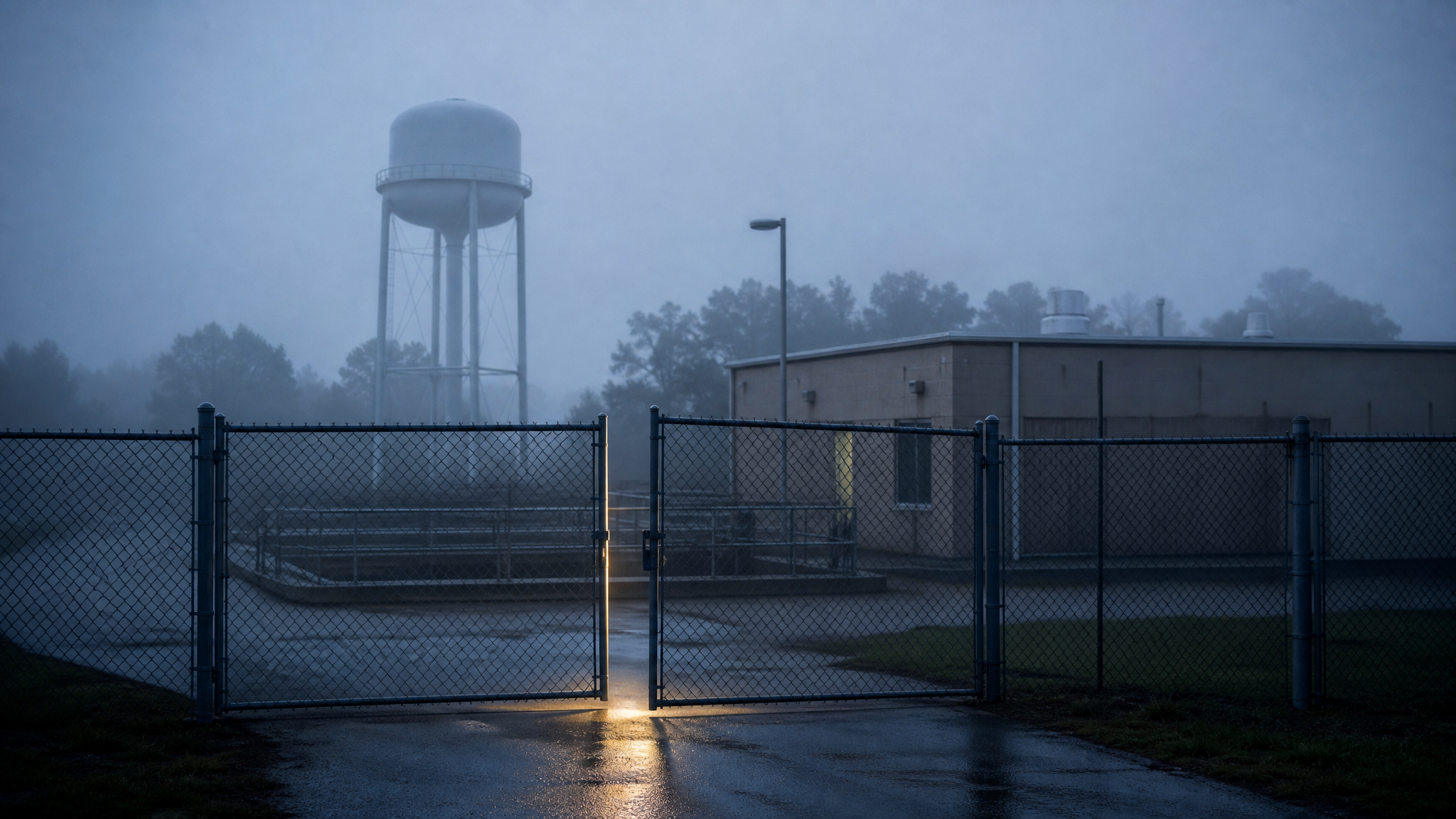
Braham, Minnesota has about 1,700 people and one water treatment plant. On the morning of July 27, 2026, the operators running that plant lost the ability to control it remotely. Someone else had changed the passwords.
By the time the dust settled, more than 30 community water systems across Minnesota had been hit in a coordinated attack. Some issued boil-water notices as a precaution. Maple Plain declared a local state of emergency. None of it touched drinking water quality. All of it happened because a handful of small-town utilities had industrial controllers reachable from the open internet.
That single fact matters more than the question everyone ended up arguing about instead.
What actually happened
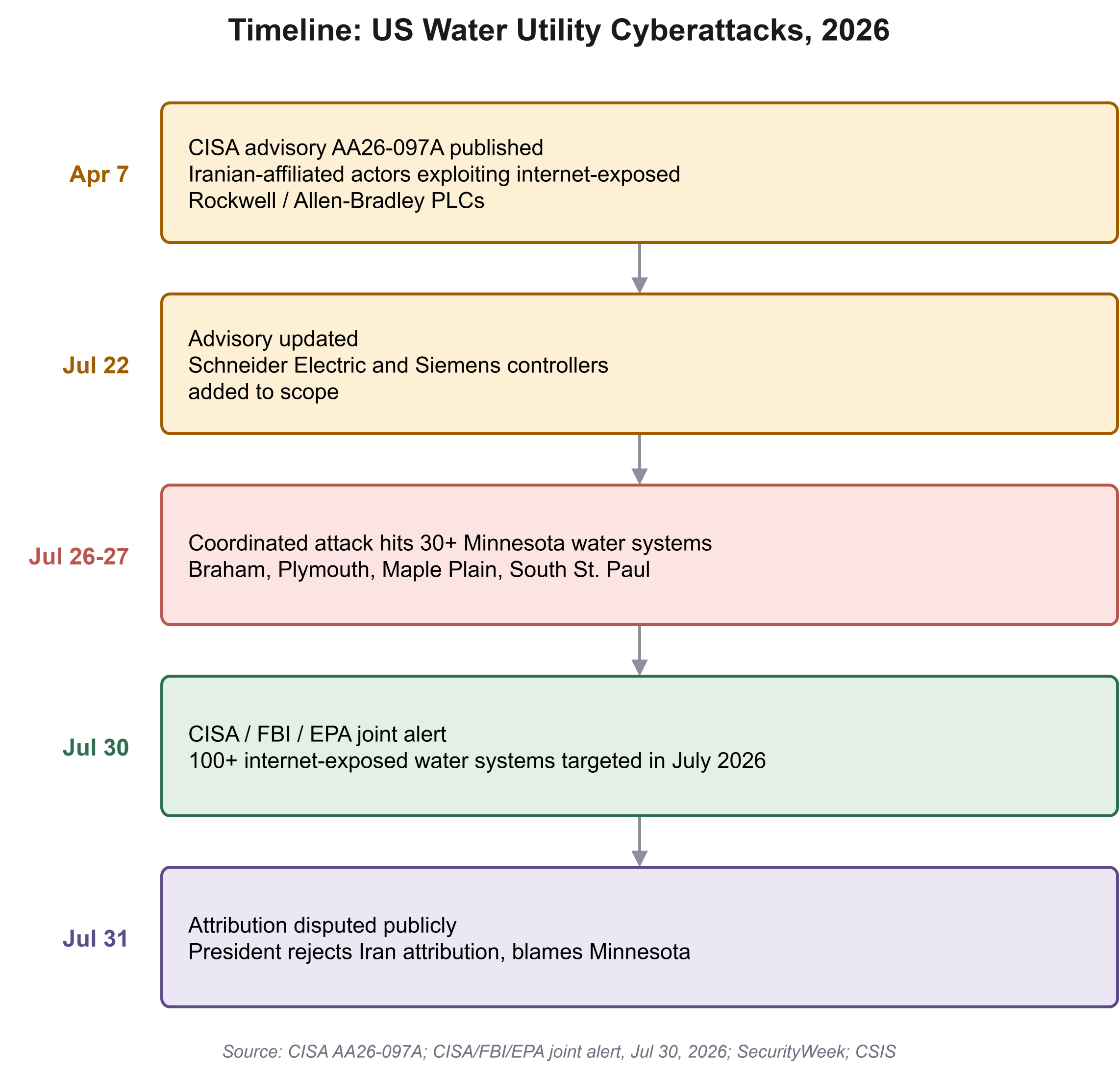
The Minnesota incident on July 26 and 27 wasn't an isolated event. It was the visible edge of a much larger campaign. CISA has said it observed malicious activity against more than 100 internet-exposed water and wastewater systems in July 2026 alone. Researchers at CSIS, working from open-source reporting, were able to independently identify around 55 of those facilities.
The pattern extended beyond Minnesota. In Clayton County, Georgia, a utility serving roughly 300,000 people around Atlanta had a pump station go down. Water pressure dropped and the utility issued a boil-water advisory. The authority said it was investigating whether cyber activity caused or contributed to the disruption. Service was restored within hours. Incidents were also confirmed in Michigan, South Dakota, and New Jersey, with at least 12 states affected in total. Nobody has published a full list of every utility hit.
In every confirmed case, the damage was operational, not chemical. Operators lost remote visibility and control and had to run pumps and treatment steps manually until they regained access. That's a real disruption for a small utility with a skeleton crew. It is not the same as a public health emergency, and no source has reported one.
The break-in didn't require anything sophisticated
This is the part that should worry you more than the headlines do.
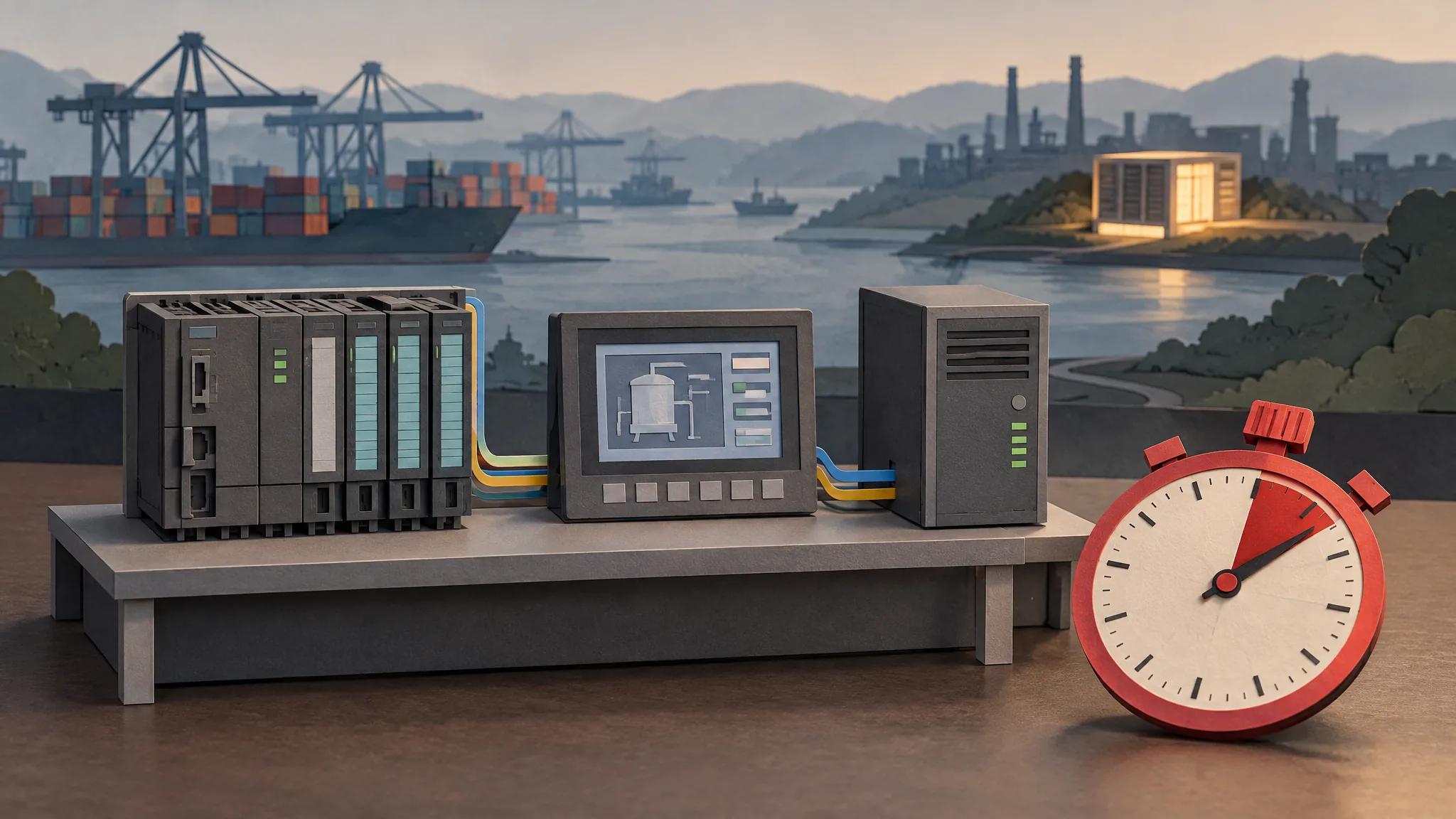
The activity traces back to CISA advisory AA26-097A, first published in April 2026. It covers Iranian-affiliated actors exploiting internet-exposed Rockwell Automation and Allen-Bradley programmable logic controllers, the industrial computers that run pumps, valves, and treatment processes at water plants. A July update expanded the advisory to include Schneider Electric and Siemens controllers as well, noting that other vendors' equipment could be at similar risk.
The technique wasn't exotic. Attackers found PLCs reachable from the public internet, many connected through cellular modems that operators didn't fully account for in their own network inventory. Once in, they changed passwords to lock operators out and changed IP addresses to disconnect or hide the devices. In some cases, they used the same vendor engineering software utilities rely on for legitimate maintenance to pull configuration files off the network.
If that sounds familiar, it should. In 2023, Iran-linked hackers broke into a Unitronics-brand PLC at a water authority in Aliquippa, Pennsylvania. All it took was a default password the plant had never changed. This year's campaign is broader and touches more vendors, but the underlying weakness is the same one security researchers have been flagging for years: a device that shouldn't be reachable from the internet, reachable from the internet.
Worth separating clearly from a different story making similar headlines this year. A separate CISA advisory, AA26-231A, covers AI-generated exploitation scripts targeting Siemens S7 controllers specifically, covered here in an earlier post. That's a distinct campaign with a distinct mechanism. The water-utility attacks didn't need AI to succeed. They needed an exposed device and a weak password.
Who did it became a bigger story than what happened
Here's where the coverage gets messier, and where the actual news value sits.
NBC News reported that Iran was "likely" behind the attacks, citing two people familiar with the incidents. CBS News described the activity as "possibly linked" to Iran-backed hackers. Neither framing is a confirmed government attribution. CISA's own joint alert with the FBI and EPA on July 30 described the tactics and indicators of compromise without naming a specific threat actor or nation.
A joint claim of responsibility circulated on Telegram from CyberAv3ngers and a second group calling itself APT IRAN, stating "our intention in attacking Minnesota was only to warn." Not every outlet treats that claim as confirmed. A separate Iranian-linked hacktivist brand, Handala, was blamed for the Minnesota attack by Iranian state media. Handala itself stayed silent on it. The group had already claimed a different, earlier breach that June, of California water-utility billing systems. That alone tells you attribution here is murkier than a single actor with a single motive.
Then it became political. On July 31, President Trump publicly rejected the Iran attribution, saying he blamed Minnesota for "gross incompetence" rather than a foreign adversary. Governor Tim Walz pushed back, saying other states had been hit too and that the administration knew who was responsible. Fact-checkers at PolitiFact reported that security experts considered it too soon to rule Iran out.
Notice what didn't change while all of that was happening: the exposed PLCs, the reused default credentials, and the missing network segmentation. Whoever was behind the keyboard, the door they walked through was left open by the utility, not by Iran, Minnesota, or anyone's political opponent.
Why water keeps being the easy target
The honest answer isn't secrecy or sophistication. It's structure.
The United States has somewhere between 150,000 and 170,000 separate water systems, most of them small and run by a city, county, or rural water authority. Compare that to the electric grid, where a much smaller number of larger operators are bound by NERC CIP, a mandatory federal cybersecurity standard with real enforcement teeth. Water has nothing equivalent. Federal cybersecurity requirements apply in any meaningful way only to systems serving more than 3,300 people. That leaves a large share of American water utilities outside any binding cyber standard at all.
Money follows the same pattern. Michael Garcia of the Operational Technology Cybersecurity Coalition put it plainly: utilities end up "slicing and dicing an already small grant for the water sector to also include this very important provision of cybersecurity," because a small city budget has to cover cybersecurity, road repair, and payroll from the same pool.
At many of these utilities, there is no security team at all. A licensed plant operator is hired and trained to manage chemical dosing and regulatory compliance. OT security gets layered onto that job as one more responsibility, on top of work it was never designed to include.
James Turgal, a former FBI IT Branch assistant director, points to legacy equipment as part of the same problem. Older installed systems often leave operators without a clear picture of what's actually connected to the internet.
None of that is a criticism of the people running these plants. It's a description of a sector that was never built, funded, or regulated the way the rest of critical infrastructure was.
What actually reduces the risk, regardless of who's behind it
None of this is new advice. It's the same advice the security community has been giving water utilities for years. What changed in 2026 is that someone finally tested whether utilities had taken it.
The question worth asking
Iran, Minnesota's governor, and the White House spent the end of July 2026 arguing about attribution. That argument will probably continue for a while, and it may never fully resolve. Attribution in cases like this rarely does.
The question that actually determines whether your utility is next isn't who's responsible. It's whether your PLCs can be found by the same kind of internet scan that found Braham's. If you don't know the answer, that's the first thing to find out. You can check it this week, not after the next advisory names a new suspect.
Sources: CISA Advisory AA26-097A | CISA/FBI/EPA joint alert, July 30, 2026 | SecurityWeek | Cybersecurity Dive | NBC News | CBS News | CSIS Iranian Cyberattacks Mapping | GovCIO Media | PolitiFact