

Somewhere around day 90, the person you report to will ask you a casual question in a corridor or at the end of a call: "So, how's the team doing?"
Most new managers answer with their own workload. They list what shipped, what slipped and how busy everyone is. That answer tells your boss you are still doing your old job with a bigger inbox.
This post gives you a 90-day plan built so that you have a real answer to that question: what you heard from each person, the rhythm the team now runs on, and one thing that got better because you were there. It assumes nobody trained you. In a July 2026 AMA study, about half the professionals surveyed said they moved into management with no formal leadership training.
You are in large company if nobody trained you
In July 2026 the American Management Association published a study of more than 1,000 professionals. 51% said they were promoted into people management without formal leadership training. Only 27% described their own manager as highly effective, and 66% said they did not get frequent support, guidance or feedback from their manager (AMA, reported by Lab Manager; HR Dive).
Training is only half the problem. Cegos surveyed 4,271 first-time managers across ten countries in March 2025, and 67% reported a growing workload while 47% said they lack time for the human side of the role (Cegos). In that survey 56% had some training before taking the job, and the workload numbers were still that high. Training alone does not seem to free up the hours.
Put the two studies side by side and a pattern shows. A new manager is busy with the work, so the people work gets whatever is left over, and for nearly half of them almost nothing is. The plan below fixes the order: people time goes in the calendar first, and the work fits around it.
There is a newer pressure too. In a Gallup survey of 102 chief HR officers, fielded in February and March 2026, half said they were not very confident or not at all confident that their managers could guide employees on using AI at work (Gallup). Your team is probably already using AI tools, whether or not anyone agreed how. That conversation is now part of the job, and the plan puts it in month two.
The plan in one line: listen, set the rhythm, make one visible improvement
The 90 days split into three blocks of about 30 days. Each block has a few conversations and one check you can run on yourself.
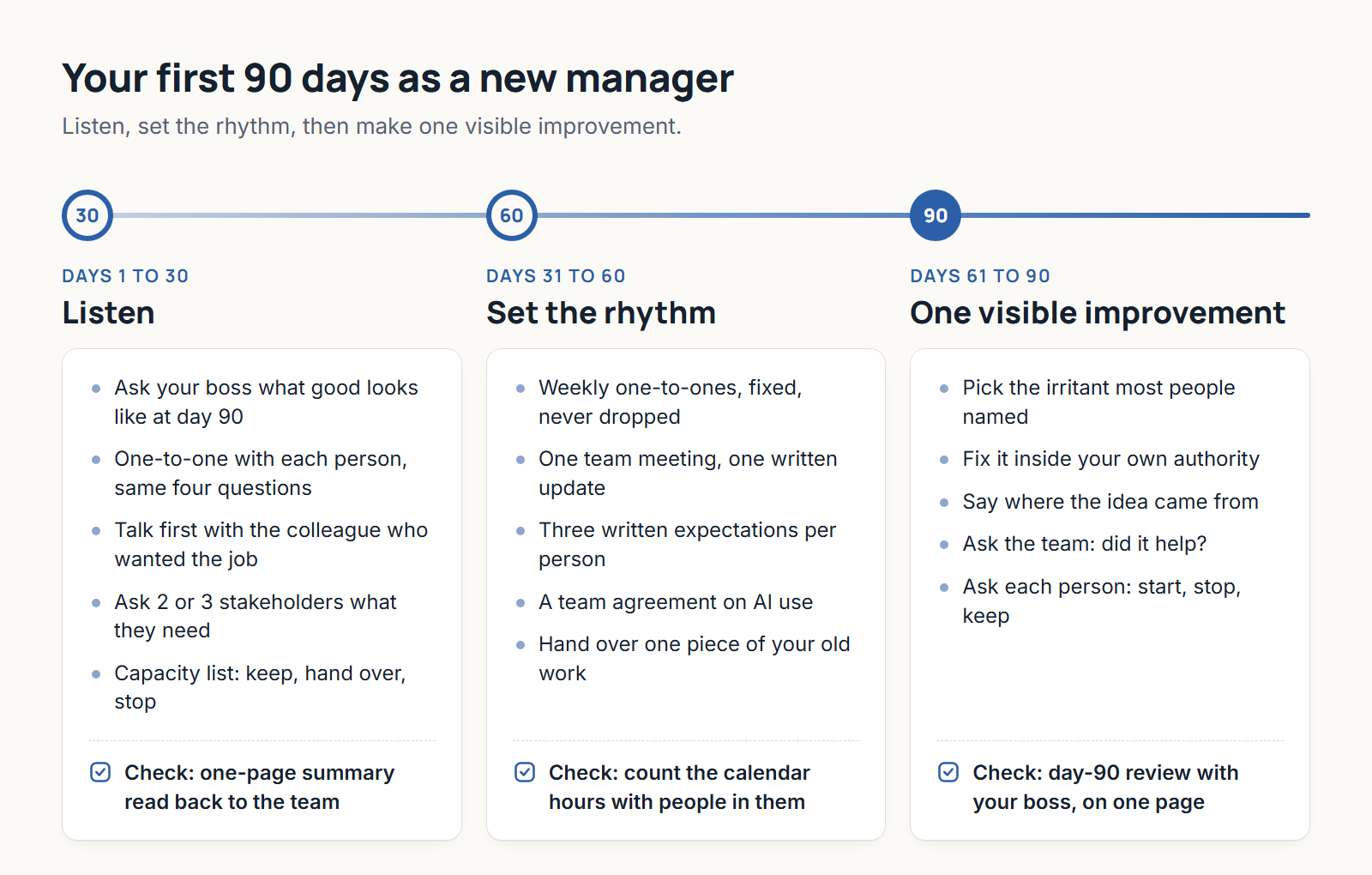
The order matters. If you start with improvements, you fix what you think is broken, and the team watches you fix the wrong thing. If you skip the rhythm, every conversation from the first month is forgotten by the third.
Week one: the conversations that come before any change
Save the announcements. Week one belongs to the conversations every later decision depends on.
The conversation with your boss. Ask three questions and write the answers down:
- "At day 90, what would make you say this went well?"
- "Which decisions are mine now, and which do you want to see first?"
- "Of the work I used to do, what can I stop or hand over, and by when?"
The third question is the one new managers skip. Without it you keep your old job and add the new one, which is one way a workload like the one in the Cegos survey builds up.
A first one-to-one with each person on the team. Thirty minutes, their choice of time. Use the same four questions with everyone so you can compare answers later:
- "What do you work on that you think I don't see?"
- "What gets in the way of your work most weeks?"
- "How do you like to get feedback: in the moment, or saved for a one-to-one?"
- "What did the last manager do that you want me to keep doing?"
Take notes in their words, not yours. You will read some of those words back to them on day 30.
The colleague who wanted your job. If someone on the team applied for the role, talk to them alone, in the first two days and before the other one-to-ones. Say it plainly: "I know you went for this role too. I'd rather we talked about that than worked around it. What would make this workable for you?" Then listen. You are not asking for their approval. You are making sure the most likely source of quiet resistance hears from you before they hear about you.
The check at the end of week one: you have one page of notes per person, and you have changed nothing yet.
Days 8 to 30: listen, and write your own job down
The rest of the first month is the same listening, widened.
Talk to two or three people outside the team who depend on its work: a stakeholder, a customer, the team downstream. One question carries most of the value: "What do you need from this team that you don't get now?" Their answers are often different from what the team told you, and the gap between the two is useful.
Make a capacity list. Write down every recurring task you still do from your old role, then mark each one keep, hand over or stop. A team lead who still runs every client report, reviews every pull request and answers every escalation has no hours left for anyone. The list makes that visible, and it gives you something concrete to bring back to your boss.
Read back what you heard. Near day 30, write one page: the five or six themes from your one-to-ones, in the team's own words, with nothing attributed to a name. Share it with the team and ask one question: "Is this right, and what's missing?" People who see their words on the page know you listened. People who see something missing will usually tell you, and that correction is often the most honest thing you hear all month.
The check at day 30: the one-page summary has been read back to the team, your boss has your capacity list, and the two of you have agreed which task goes first and to whom.
Days 31 to 60: set a rhythm the team can rely on
Month two turns good intentions into fixed habits. A rhythm keeps working on the weeks you are too busy to think about management, and those weeks will come.
Weekly one-to-ones, fixed and protected. Same slot every week, 30 minutes, and you do not cancel. Move one if you must, never drop it. The agenda belongs to the other person first: their topics, then yours, then one question about what is getting in the way.
One team meeting and one written update. One meeting a week for the team to plan and unblock, and one short written update to your boss on progress, risks and what you need. Two fixed points, and the team stops wondering what you expect.
Expectations in writing, one person at a time. In a one-to-one, agree three things each person is accountable for over the next quarter, and write them down where you can both see them. Correcting feedback often goes wrong because the expectation was never clear in the first place. In the AMA study, 55% picked better communication and clearer expectations as the top way to make managers more effective.
One team agreement on AI. Spend 20 minutes of a team meeting on three questions. What do we use AI tools for here? What must a person check before AI-assisted work goes out? What never goes into an AI tool, such as client data or anything confidential? Write the answers on one page and revisit them in a quarter. It is a first step toward the guidance that half of the CHROs in the Gallup survey doubt their managers can give, and it takes less than half an hour.
Hand over one real piece of your old work. Pick something from the capacity list, agree what done looks like and when you will check in, then step back. Checkpoints agreed up front stop you hovering, and they stop the handover becoming abandonment.
The check at day 60: open your calendar for the last two weeks and count the hours with a team member's name in them, then count the hours of individual work you could have handed over. If the second number is bigger, the rhythm is not protected yet. Fix the calendar before you fix anything else.
Days 61 to 90: make one improvement the team can see
Now you have earned the right to change something. Choose one improvement, and choose it from the day-30 summary, not from your own list.
The best candidate is the irritant that came up in the most one-to-ones and that you can fix inside your own authority within 30 days. Requests that arrive through five channels and get lost. A weekly meeting nobody needs. A handover between two people that fails every month. Pick one.
Then run it in three steps. Tell the team what you are changing and which of their comments it came from. Make the change. Two or three weeks later, ask whether it helped, and say what you saw. The improvement matters less than what it shows the team: when they tell you something, it goes somewhere.
The day-90 review with your boss. Book it yourself; don't wait to be asked. Bring one page with four headings: what the team told me, the rhythm we now run, the improvement and its result, and what I need for the next quarter. That page is your answer to "how's the team doing?"
Ask the team the same question. In the last week, ask each person in their one-to-one: "What should I start, stop and keep doing?" Write it down and act on one answer visibly. You are now three months in, and this is your first proper feedback as a manager.
What this plan will not fix
A plan cannot create hours your organisation has not given you. If the capacity list shows your boss expects you to carry a full individual workload and lead the team, the plan surfaces that by day 30. It cannot resolve it for you. The conversation about what to drop is yours to have, and it is easier with the list in your hand.
It will not teach you the hard conversations either. Correcting feedback that lands, a decision half the team disagrees with, two people who cannot work together: the plan tells you when those conversations will come up, not what to say in them. Those are skills, and they take practice.
And it assumes a team that is broadly working. If you inherited a serious conduct problem or a team in open conflict, deal with that first, with HR involved, and treat the 90-day plan as what comes after.
The answer to the corridor question
The new managers who struggle are rarely short of effort. They are short of a structure that protects time for people, so the work wins every week by default. A 90-day plan of listening, rhythm and one visible improvement is that structure, and every part of it fits into a normal calendar.
Your first step today: book the first one-to-one, and write the four questions at the top of the invitation.
If you want to practise the conversations, the free course Leadership for Absolute Beginners, New Manager and Team Lead walks through the situations a first-time team lead faces, including leading former peers, the one-to-one, delegating without hovering and your first month with your own boss, with the exact words that work in each, plus a downloadable Capacity List for the keep, hand over or stop exercise above. If you lead projects as well as people, Leadership for Project Managers is the next step.