On Monday you are handed a programme to replace your company's payroll system, and you have never worked in payroll. By lunchtime a chatbot has explained gross-to-net pay, pay calendars and parallel runs, and you feel ready for next week's steering meeting. That feeling is the problem. In a large 2025 trial, students who practised with ChatGPT did 48 percent better in practice, then 17 percent worse on the exam once it was taken away, and they did not think they had learned any less. Here is how to learn a new subject fast without making that trade.
48 percent better in practice, 17 percent worse on the exam
The trial, run by Bastani and colleagues and published in PNAS in 2025, followed nearly 1,000 high school maths students in Turkey over four practice sessions. One group practised with the textbook only. One had ordinary ChatGPT, and a third had a ChatGPT tutor built to give hints and hold back the answer.
Then everyone sat an exam with no AI. The ordinary ChatGPT group, 48 percent ahead in practice, scored 17 percent below the textbook group. The hint tutor group was 127 percent ahead in practice and then scored about the same as the textbook group, according to Wharton's summary of the study: hints instead of answers removed the harm, but added no learning on top.
The students using AI were also, in that summary's words, "overly optimistic about their learning capabilities". It is the trap we described in why it feels like you are learning when you are not, now one click away.
On your Monday, the chatbot conversation is the practice score. The exam is the steering meeting, when the sponsor asks what happens if the first pay run on the new system fails, and the chat window is closed.
So learning faster is not about taking information in faster. It is about doing the part of the work that builds memory yourself, and using AI to make you think, not to think for you. Not every study agrees, since a tutor built by Harvard physics lecturers beat an active-learning class, tested straight after the lesson, so the design of the tool matters.
One caveat covers everything below. These studies were done with school and university students, not working professionals, so read the numbers as a strong direction, not a promise.
Four moves: map it, try it, teach it, leave it
Each move is work that a chatbot will happily do for you, or that a full calendar squeezes out.
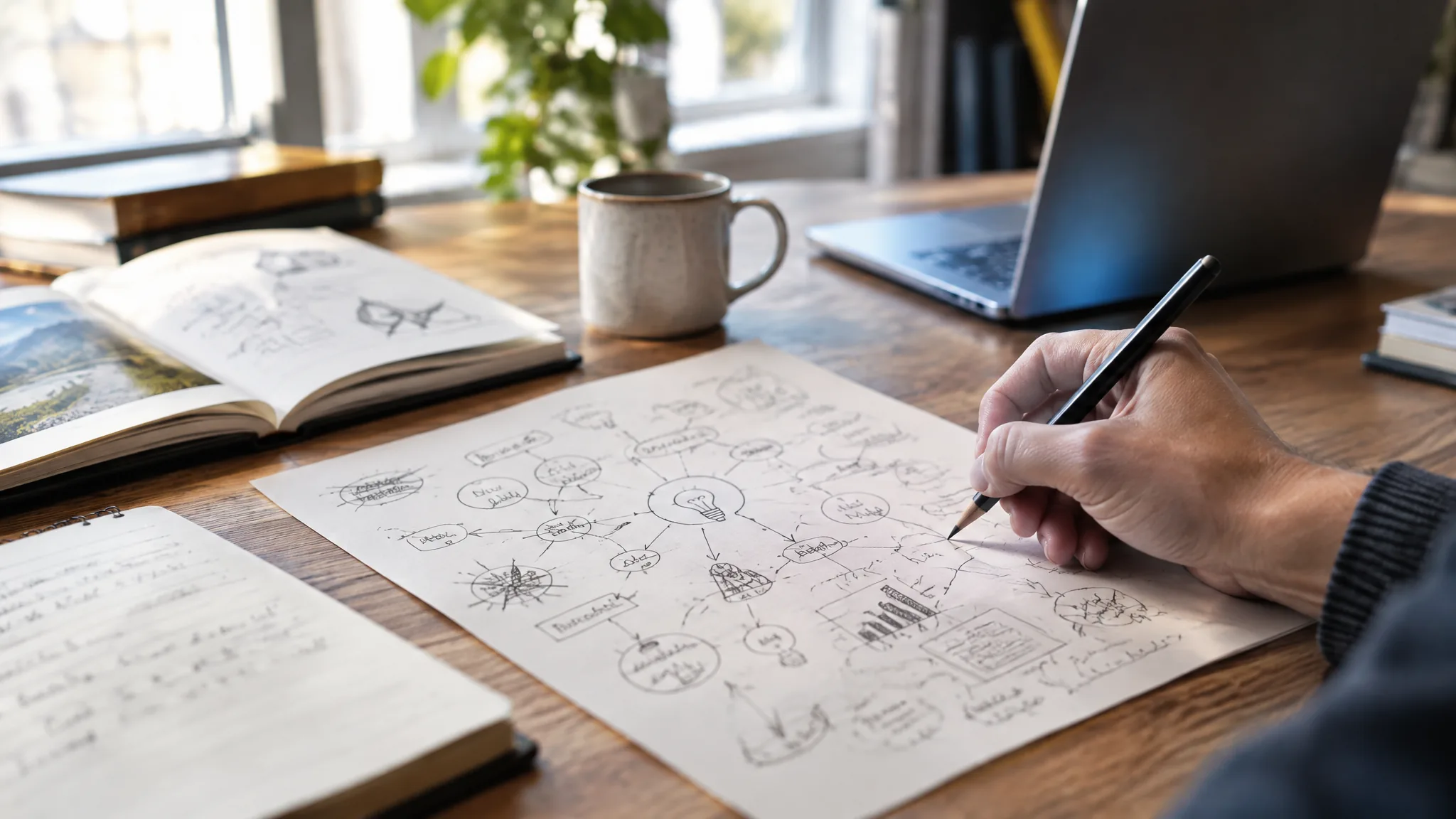
- Map it. Before you study a new field, sketch one page from what you already know.
- Try it. Attempt before you look or ask: recall, answer or draft first, then check.
- Teach it. Explain it to a colleague, write the two-paragraph explainer for your team, or run a ten-minute teach-back.
- Leave it. Stop, and do nothing for ten minutes before the next meeting or the inbox. Sleep. Come back another day.
Map it: one page of what you think the field looks like
Before you read a single page on payroll, take one sheet of paper and ten minutes. Write three things on it, from what you already know:
- What it reminds you of. Payroll might look like a monthly release with a date that cannot move, because payday cannot slip.
- The five or six big ideas you expect. Perhaps how gross pay becomes net pay, the pay calendar, the deductions the law requires, and running old and new systems side by side.
- The questions you need answered. What happens if a pay run fails? Who signs it off? What can only change at year end?
Then fix the map as you learn. Cross out the wrong guesses, add what you missed, and draw a line wherever two ideas turn out to depend on each other.
New material sticks faster when it has something to attach to. A 2007 study in Science found that rats with an established mental map locked in new memories within two days rather than weeks: a rodent result, but one that fits decades of human research behind cognitive load theory.
Having background knowledge is not enough on its own; writing the connections out is the part with evidence, and Fiorella and Mayer's review of generative learning supports summarising, mapping and drawing.
The limit: no study has tested a one-page map as such; its parts are what is supported. And the map has to be yours, because the benefit comes from doing the organising. A map drafted by AI is a tidy page with none of the benefit, so use AI to check yours, with the third prompt below.
Try it: answer before you look, and make AI ask the questions
Before you read the vendor's guide to parallel runs, write two sentences on what you think a parallel run is for. Before you ask the chatbot how gross-to-net works, list the steps you expect. You will be wrong in places, and the check will show you exactly where.
Two findings sit behind this. The first is the generation effect: a 2007 meta-analysis of 86 studies found that people remember material they produce themselves better than material they read complete (d = 0.40, close to half a standard deviation), one of the most replicated results in memory research.
The second is retrieval practice. In a classic 2006 experiment, students who practised recalling a passage kept about 61 percent of it a week later, against about 40 percent for students who reread it, even though rereading won on a test taken straight away. A 2021 meta-analysis of more than 1,600 effects puts it among the two strongest techniques (d = 0.74).
With AI, the rule is never the answer first. Ask for a hint, or ask it to quiz you, which is how the tutor that removed the harm was built.
The limit: trying first works on material you have met at least once. If nothing makes sense yet, read or watch one good source first, then try; for complex material you have not yet understood, the evidence for recall over rereading is disputed.
Teach it: explain it to someone who can ask questions back
Pick one. Explain the parallel run to a colleague over coffee, write the two-paragraph explainer your team will need anyway, or run a ten-minute teach-back and let people ask the awkward questions. The test is whether you can say it without your notes.
A 2019 meta-analysis by Kobayashi pooled 28 studies. Preparing to teach improved learning (g = 0.35), and actually teaching after preparing improved it more (g = 0.56). A larger 2024 update of 39 studies put the overall effect of teaching after studying lower, at g = 0.27, and again found that actually teaching added to what preparing alone gave.
The limit: teaching is not the strongest technique; it adds to testing yourself and spacing your study, and replaces neither. Nor will it deliver the 90 percent retention of the old learning pyramid, a number with no source behind it. And most studies used live teaching, so a written explainer in a team channel is untested; write it anyway, because writing makes you try first.
Leave it: ten quiet minutes before the next meeting
The session ends and the next meeting starts in ten minutes. The usual move is to fill the gap with email or a podcast. Leave it instead: sit, look out of the window, walk without headphones, and let nothing new in.
A 2025 meta-analysis of 37 studies found that quiet rest straight after learning improved later recall (g = 0.45), and the benefit was still visible a week later (g = 0.27). Eyes open or closed, sitting or lying, silence or not: none of it made a significant difference. What mattered was taking in nothing new.
Then sleep on it, and come back another day. A 2023 summary of 19 systematic reviews and meta-analyses found that sleep helps memory, modestly, and less as you get older. Coming back is the bigger lever: spacing your study over days was the strongest technique in the 2021 meta-analysis (d = 0.85), and a 2013 review of ten techniques rated it one of only two with high utility.
The limit: rest protects what you studied. It does not replace testing yourself, and sleep is not a substitute for review, which is why Leave it is the last move, not the only one.
A one-week plan for learning something new between meetings
Under an hour and a half across five working days. Swap your own subject in for payroll. If even fifteen minutes is hard to find, how to learn in 15 minutes between meetings shows how to use the short gaps.
What you take into the steering meeting
Go back to that Monday. The chatbot's explanation of payroll was better written than anything on your map. But the map is what you can defend when the sponsor asks about the first failed pay run, because you built it, tested it and explained it to someone who pushed back.
Learning fast was never about reading faster. It is doing the part that builds memory yourself, and letting AI make you think instead of thinking for you.
Sources: Bastani et al. 2025, PNAS, with figures from Wharton Knowledge | Kestin et al. 2025, via the Harvard Gazette | Tse et al. 2007, Science | Cognitive load theory and expertise reversal, Chartered College of Teaching | Fiorella and Mayer 2016, Educational Psychology Review | Bertsch et al. 2007, Memory and Cognition | Roediger and Karpicke 2006, Psychological Science | Donoghue and Hattie 2021, Frontiers in Education | Kobayashi 2019, Japanese Psychological Research | Kobayashi 2024, Educational Psychology Review | Weng et al. 2025, Psychonomic Bulletin and Review | Weighall and Kellar 2023, Emerging Topics in Life Sciences | Dunlosky et al. 2013, Psychological Science in the Public Interest | Okudaira, Kripke and Webster 1984, Physiology and Behavior | Foster and Wilson 2006, via MIT News