

Three hundred and sixteen, then twenty-eight. That pair of numbers has circulated in scrum master forums and LinkedIn feeds: UK permanent scrum master job adverts, two years apart. Shared without context, it reads like an obituary.
The slump behind them is real enough to take seriously. The pair itself is a snapshot from the bottom of that slump, and the same job board tells a different story today. What the data actually shows is narrower and more useful than "the role is dying": the job title has shrunk, the work has not, and the work is moving to people who own a result.
Where the 316 and the 28 come from
The figures trace back to ITJobsWatch, a UK site that counts IT job adverts in rolling six-month windows and compares each window with the same period one and two years earlier. A count of 316 permanent scrum master adverts, set against 28 two years later, matches the scale of its readings around spring 2025. We could not open that exact snapshot ourselves, so treat the pair as reported, not confirmed by us.
What we can see is the page as it stands on 19 November 2026. For the six months to that date, ITJobsWatch counts 98 permanent scrum master adverts, against 31 in the same period of 2025 and 69 in 2024. The median advertised salary is £68,500, up from £60,000 a year earlier.
So the slump was real: the verified count fell from 69 to 31 between 2024 and 2025. It has since tripled to 98, though the role still ranks 728th among UK IT jobs, below its position in both earlier periods. Its share of all permanent IT adverts, 0.080%, is also still under the 0.10% it held in 2024.
Permanent jobs fell harder than contracts
The same site counts contract adverts separately, and that line looks nothing like an obituary. UK contract scrum master adverts went from 123 to 141 to 174 across the same three periods, at a median day rate of £496.
That split is the first real clue. Companies are still buying scrum master work. The likeliest reading is that they are less willing to keep a dedicated scrum master on the permanent payroll for each team, and more willing to bring one in for a fixed stretch of work.
Two cautions belong here. ITJobsWatch counts adverts, not people in jobs, and it covers the UK only. A fall in adverts can mean fewer roles, or fewer people leaving the roles that exist, and the data cannot separate the two.
The one confirmed cut, and what the company said
The best-documented cut is real and on the record. In January 2023 Capital One announced it would eliminate its Agile job family, about 1,100 technology roles, as reported by The Register and Banking Dive. Staff in those roles were encouraged to apply for other internal jobs.
The company's own explanation matters more than the headcount. It said the agile roles had been critical to its earlier transformation, and that the next step was to build agile delivery directly into its core engineering practices. It also said it was not moving away from agile. The work went to existing engineering and product manager roles; the separate job family went away.
Other names circulate. A memo said to cut agile roles at Salesforce is often repeated, and we found no company statement or reputable report that confirms it. Until one appears, treat it as rumour, along with the unnamed "big tech firms" in most of these threads.
What the official forecasts can and cannot tell you
The US Bureau of Labor Statistics projects 7% growth from 2025 to 2035 for project management specialists, which it calls much faster than the average for all occupations. It counts roughly 1.09 million people in that category, with a median salary of $102,320 and about 76,500 openings a year.
That is good news for coordination and delivery work in general. It does not answer the scrum master question, because BLS has no separate code for scrum masters. They sit inside a much larger group that includes project coordinators, programme staff and delivery leads.
The wider technology market explains a good part of the slump. In the UK, ITJobsWatch's own figures imply that all permanent IT adverts fell by roughly a quarter between 2024 and 2025. In the US, Indeed Hiring Lab still put software development postings 27.5% below their February 2020 level in June 2026. When the teams shrink, the roles that serve the teams shrink with them.
What the numbers do not show
No source we found shows AI replacing scrum masters. The evidence points to three overlapping causes: a technology hiring slump (confirmed), at least one large employer folding agile roles into engineering and product jobs (confirmed at Capital One), and, on our reading of the UK advert counts, a shift from permanent roles to contracts.
AI does not explain the cuts on record, but it does change which parts of the job are worth paying for. Several tasks that once filled a scrum master's week are now cheap to automate: compiling status, chasing updates, writing up a retrospective from sticky notes, nudging people about stale tickets. An AI assistant and a decent board do much of that already.
The hard parts stay hard. Somebody still has to notice that work is waiting three days for review, get two teams to agree on a dependency, and tell a sponsor what the team will not deliver. At Capital One, that responsibility moved to engineering and product managers, not to a tool.
Where the work goes when the title goes
Sort a typical scrum master week into four piles and the job market starts to make sense.
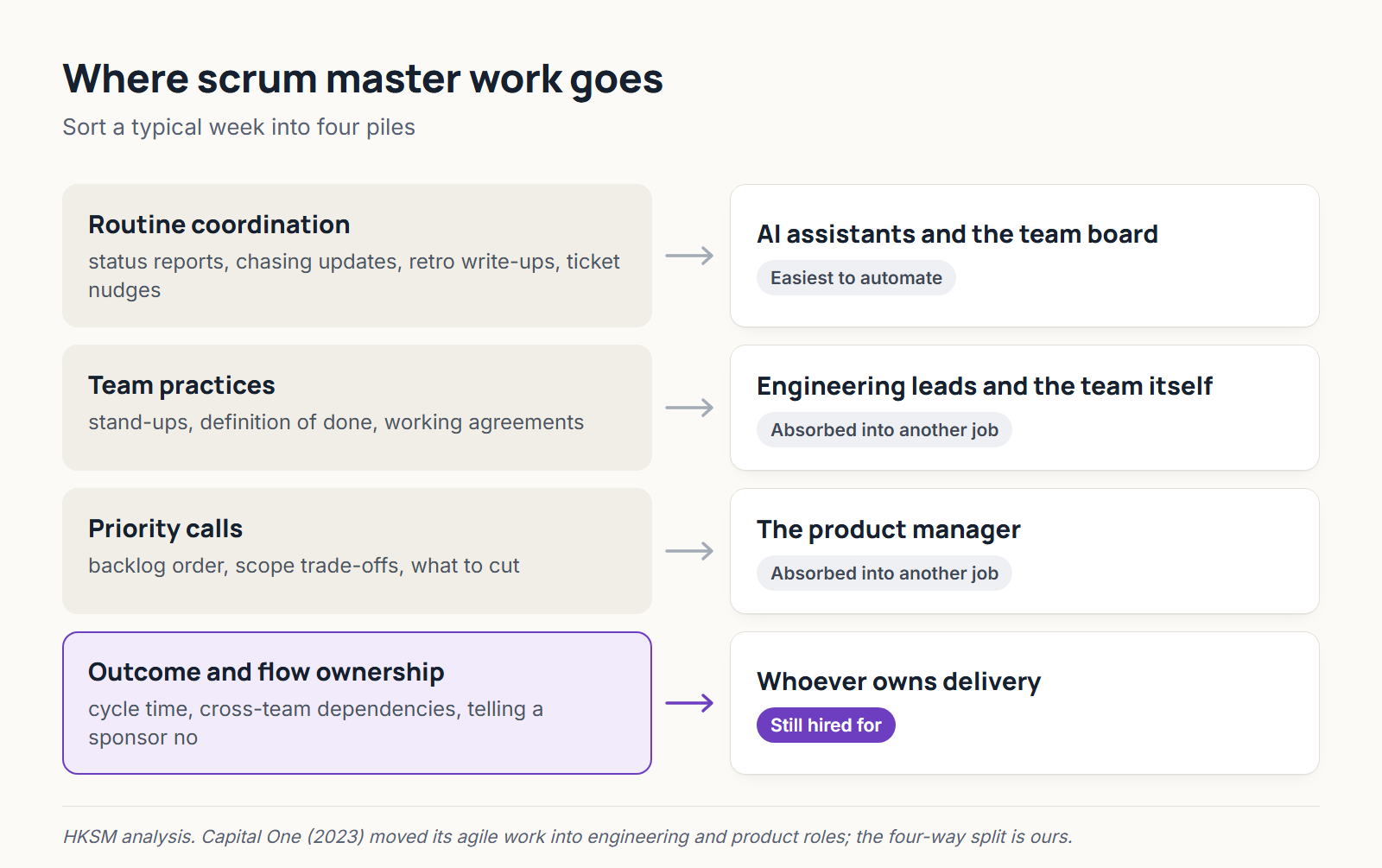
The first pile, routine coordination, is the easiest to automate. The second and third are being absorbed by people who already have another job title. The fourth pile is the one employers still pay for, under titles like delivery lead, agile delivery manager, engineering manager or, sometimes, scrum master. A scrum master whose week is mostly the first pile is exposed. One whose week is mostly the fourth is hard to replace.
Five skills that move with the work
Here is a plan you can start this month. It rests on the evidence above and our reading of it: titles are being folded into roles that own a result, and the parts of the job that hold their value are the ones tied to delivery outcomes.
- Run a two-week audit of your own calendar. Put each meeting and task into one of the four piles. If more than half your hours land in routine coordination, that is your exposure, measured in your own week rather than in a forum thread.
- Own one flow number and report it. Pick cycle time, measure it from your board, and bring it to every review with one action attached. A scrum master who can show the team's cycle time fell is describing an outcome, not attendance at ceremonies.
- Learn enough product work to argue about priority. At Capital One the role was absorbed partly by product managers, so speak their language: outcomes, the cost of delay, what you would cut if the date held. Offer to help with backlog refinement on the value side, not only the format side.
- Take the AI tooling instead of competing with it. Set up the assistant that drafts status, summarises retros and flags stale tickets, then write the team's rules for how AI is used. Hands-on AI experience is still thin among project managers: an unpublished 2023 PMI study, reported second-hand, put it at about 18%, so take the figure loosely. Either way, it is a gap you can start closing this month.
- Practise the cross-team conversation. Dependencies, release coordination and saying no to a sponsor are where agile delivery breaks at scale. Run one dependency session between two teams this quarter and write up what changed. That is a story for your next interview, whatever the role is called.
The limit of this plan is plain. It will not make a shrinking permanent market grow, and it does not guarantee a role. What it does is move your week toward the pile that still has buyers, and give you evidence for it.
The honest answer
The scrum master title is under real pressure in permanent hiring, and the UK numbers show it. The work is not disappearing; it is being handed to people who own a result. Contract demand held up, official forecasts for delivery roles are positive, and the best-documented cut came with a statement that the agile work would continue inside other jobs.
Whether the title survives matters less than which pile your week is in, and that part you can change.
If you want to build the AI side of that plan properly, AI for Agile Project Managers and Scrum Masters covers using AI for the coordination tasks, so your hours go to the work that keeps its value.