ICS/OT Cybersecurity Fundamentals
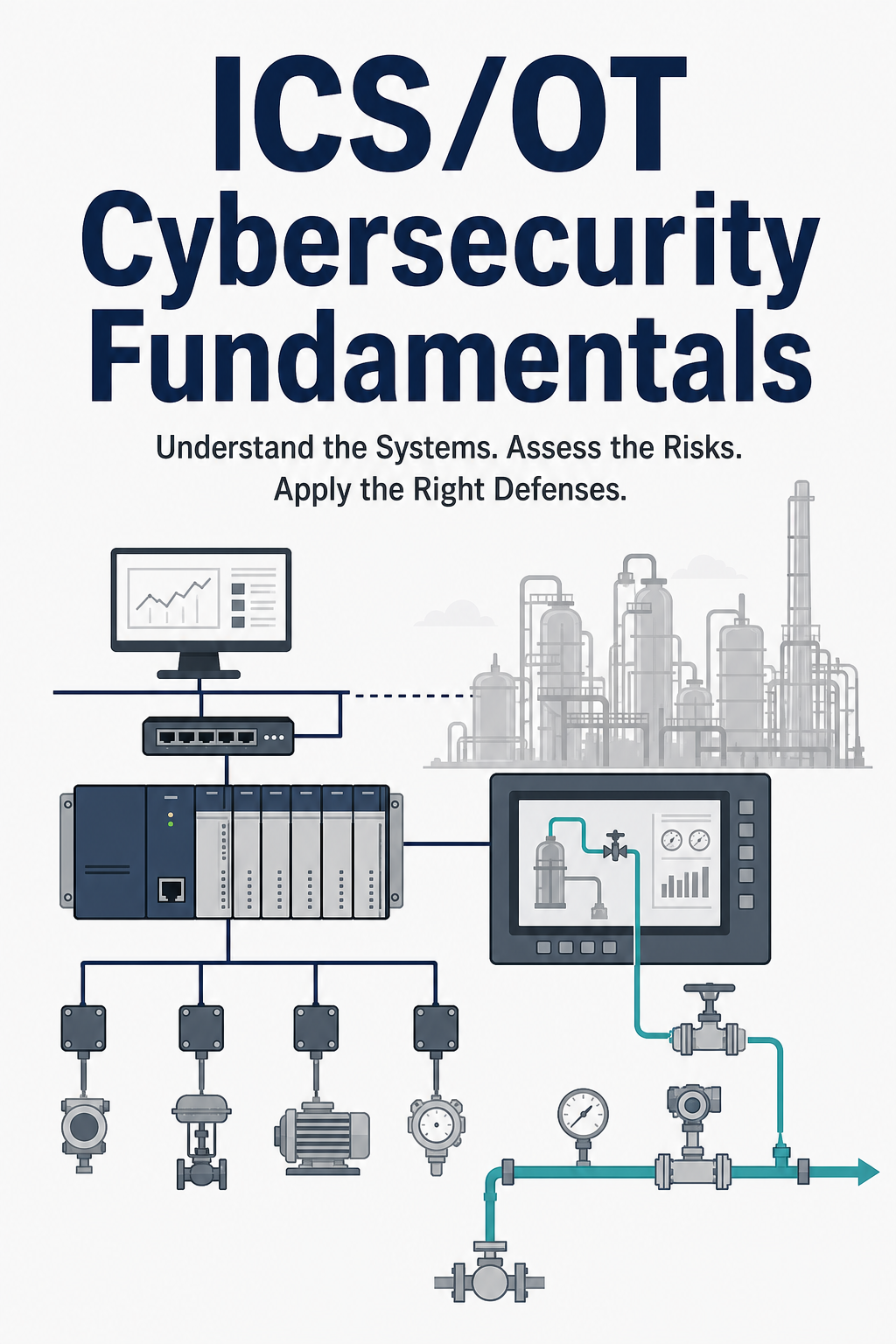
ICS/OT Cybersecurity Fundamentals
Understand the Systems. Assess the Risks. Apply the Right Defenses.
Industrial control systems were designed to run reliably for decades. They were not designed to defend themselves against modern adversaries. ICS/OT Cybersecurity Fundamentals gives engineers, technicians, and IT professionals a clear, practical path from understanding what these systems are to knowing how to protect them.
What This Book Delivers
- ICS foundations first. Understand what PLCs, HMIs, SCADA systems, and DCS platforms actually do before any security concepts are introduced.
- The IEC 62443 framework, applied. Zone and conduit design, security levels, and the risk assessment workflow that the standard defines.
- Real threats, real incidents. Attack reconstructions from Stuxnet to Colonial Pipeline, explained in terms that make the defensive lessons stick.
- OT-specific defenses. Passive monitoring, network segmentation, remote access controls, and vendor evaluation methods that fit operational constraints.
- Risk language that lands. Communicate risk clearly to management, auditors, and IT teams using the vocabulary they expect.
Who It's For
- OT engineers and automation technicians who are being asked to take on cybersecurity responsibilities.
- IT security professionals transitioning into ICS or OT environments.
- Anyone who needs to understand ICS cybersecurity at a working level before applying it on the job.
How It's Structured
- Chapters 1-3: ICS foundations — what the systems are, how they work, and how they communicate.
- Chapters 4-13: Cybersecurity fundamentals — threats, defenses, risk assessment, and the IEC 62443 framework.
- Each chapter builds on the last. No concept is introduced before the foundation for it exists.
AI for Agile Project Managers and Scrum Masters
Become an AI-first leader and transform your agile practice by leveraging artificial intelligence as your most powerful co-pilot. This course is designed to help you drive efficiency, insight, and innovation, ensuring you stay at the forefront of a rapidly evolving project management landscape.
This isn't about replacing human intuition—it's about augmenting it. You'll master prompt engineering to automate mundane tasks, freeing up your time for high-impact strategic leadership and creative problem-solving. Learn to refine backlogs, create strategic roadmaps, and integrate AI seamlessly into your agile ceremonies.
Gain predictive power by using AI-driven insights to anticipate project risks and seize new opportunities for more reliable outcomes. We deliver practical, prompt-based workflows and proven strategies built around real-world agile challenges that you can implement immediately within your framework.
Master foundational AI concepts specifically relevant to Scrum environments while developing advanced skills to handle diverse agile scenarios. You will learn to champion an AI-enabled culture within your organization, fostering a dynamic environment of continuous improvement and superior team delivery.
Learn alongside professionals around the world working in project leadership and delivery.
Explore the Course
Build an ICS/OT cybersecurity foundation that fits the real environment
Standard IT controls can disrupt the industrial systems they are meant to protect. Learn how to assess OT risk, design zones and conduits, apply IEC 62443 security levels, use MITRE ATT&CK for ICS, and establish passive asset visibility without risking production. Eight reconstructed incidents connect attacker techniques to the controls that failed, giving you the vocabulary and judgment to make credible security decisions from day one.
Explore the Course