
Limited-time Udemy offer
$9.99
Project Management From Initiation To Closing With AI
Unlimited redemptions
Available until September 19, 2026 6:21 PM PDT
2A2133BF88C8DF36C1AA
Chapter 13
Every project lives with uncertainty. Some uncertainties can create opportunities, while others can threaten the outcome. In Agile, we call both of these situations risks. A risk is any uncertain event that, if it happens, could affect the project’s objectives in either a positive or negative way. In project management, opportunities are also called risks, because they too involve uncertainty and can influence results, and we put risk and opportunity in the same tracking register. By identifying and assessing risks early and often, Agile teams stay prepared, adapt faster, and make better decisions that improve both predictability and value delivery.
Agile frameworks are often praised for reducing risk naturally. Short iterations, constant feedback, and transparent collaboration already limit many of the dangers that come with traditional, big upfront planning. But this does not mean Agile projects are risk free. Technology can fail. A competitor can release a disruptive product. A key team member might leave. Stakeholders might change their minds about priorities. If Agile teams ignore these risks, they invite costly surprises. Risk management in Agile is not about thick binders of documents or lengthy risk registers. It is about awareness, conversation, and continuous monitoring. The goal is not to eliminate all uncertainty, which is impossible, but to create resilience so the team can adapt when uncertainty turns into reality.
Risks in Agile projects have many sources, and being aware of them is the first step to identifying them. Typical categories include: - Technical uncertainty, such as using a new programming language or adopting an unfamiliar tool. - Business uncertainty, like changing customer expectations or unclear market demand. - Process uncertainty, such as poorly defined requirements or lack of clarity in acceptance criteria. - Team-related risks, including skill gaps, conflicts, or high staff turnover. - External dependencies, like vendor delays, legal changes, or compliance obligations. By exploring each category, Agile teams can uncover risks that might otherwise remain hidden until too late. Knowing where risks might arise keeps the radar active and makes risk identification a shared responsibility across the project.
In Agile, risks are identified continuously, at every stage of the project. The Product Owner, Scrum Master, and Development Team all contribute, and stakeholders often play a role too. Some of the most effective times to identify risks include: - During backlog refinement, by asking, “What could go wrong with this story or feature?” - During sprint planning, when commitments are being made for the upcoming sprint. - In retrospectives, by reflecting on risks that materialized or were narrowly avoided. - During release planning, when long-term risks such as market timing or dependency alignment are more visible. Agile teams often use simple techniques such as brainstorming, checklists, or even risk story cards to capture risks in a way that feels familiar within Agile practices.
Visibility is central to Agile risk management. A hidden risk is almost as dangerous as an unmanaged risk. Agile teams prefer visible, lightweight tools to keep risks top of mind. Risk boards, risk cards on Kanban walls, or digital dashboards in tools like Jira can serve as information radiators. Some teams even treat significant risks like backlog items, giving them priority, acceptance criteria, and a clear owner. By making risks visible, teams create accountability and ensure that risk awareness is part of daily conversations, not something forgotten in a document repository.
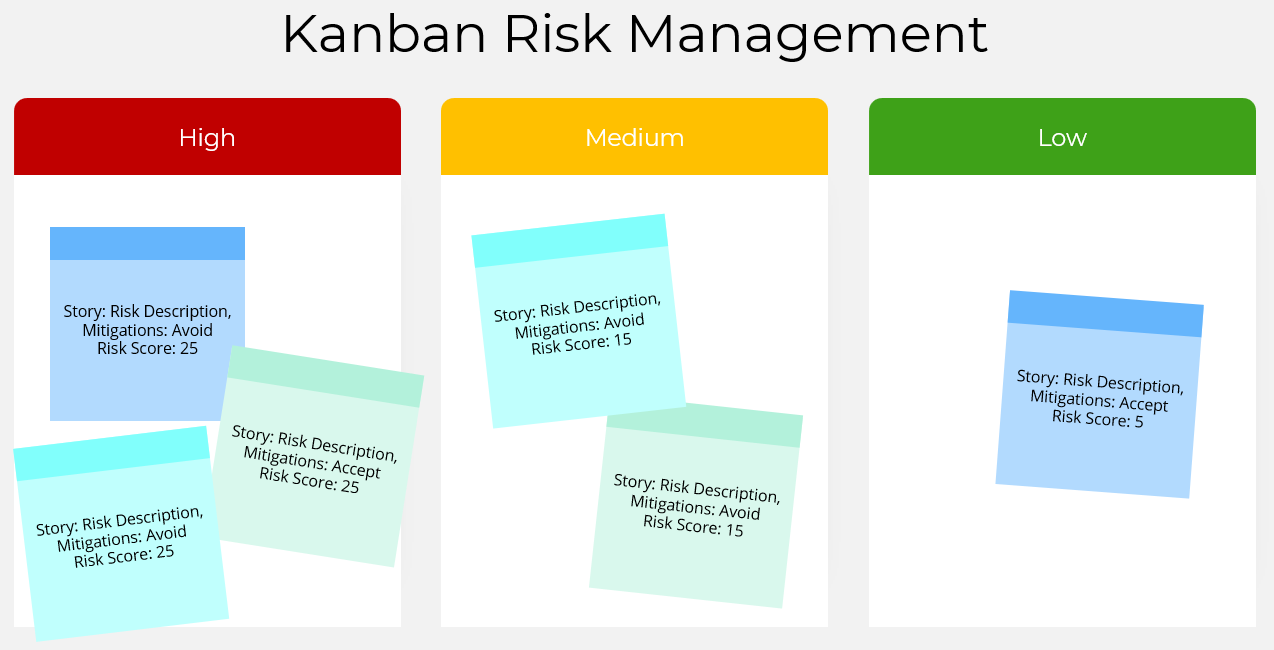
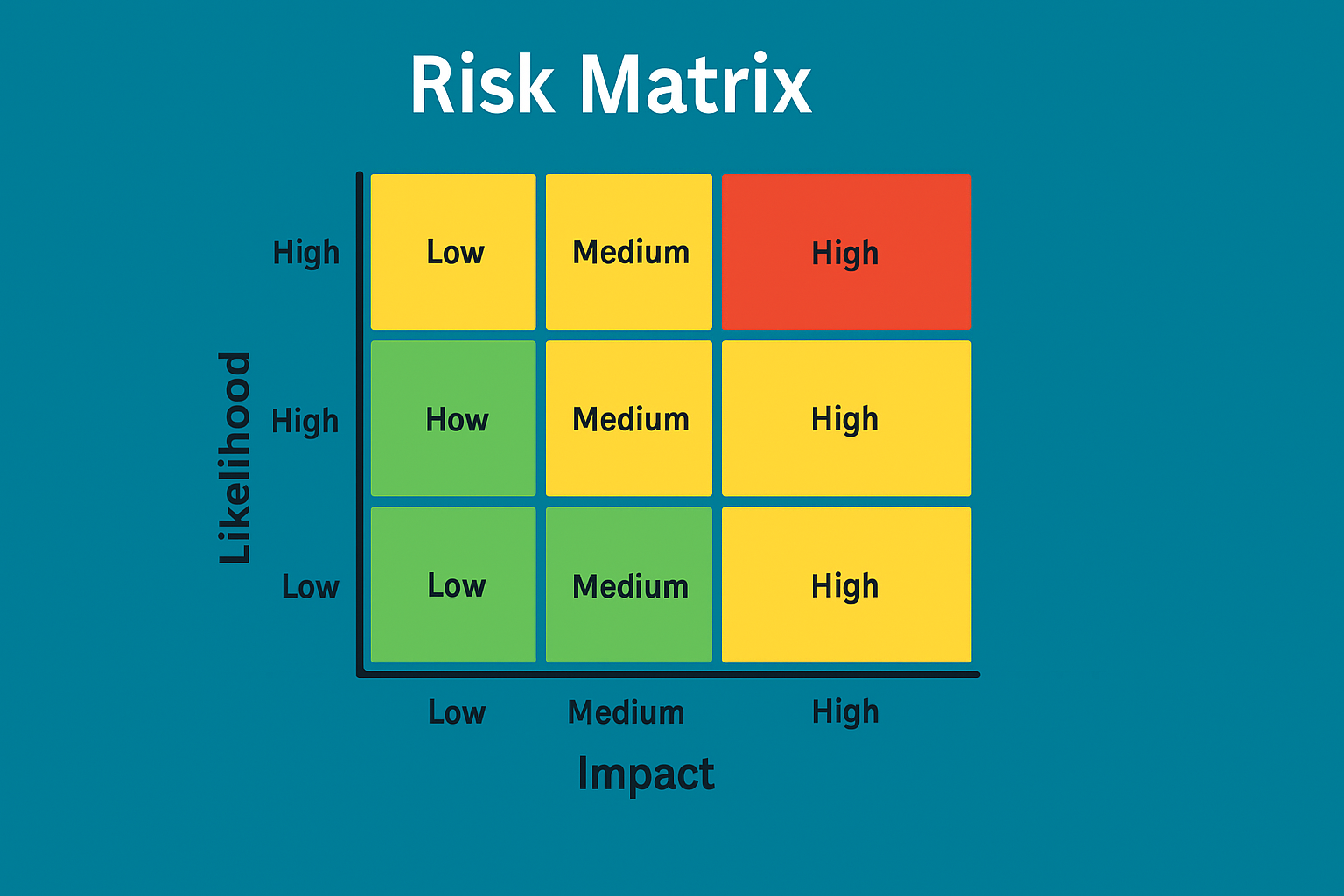
After a risk is identified, the next question is, “How big a deal is this?” Assessment helps the team focus its limited time and energy. Agile teams often use simple scales to evaluate two dimensions: the probability of the risk happening, and the impact if it does. High-probability, high-impact risks are the ones that deserve the most attention. Lower-probability or low-impact risks might still be tracked, but they rarely drive decisions. Many teams use a three-by-three grid with categories like “low, medium, high.” Others prefer a numeric scale, such as one to five. The key is not to chase false precision but to gain enough shared understanding to prioritize action.
A risk matrix combines probability and impact into one view. By plotting risks on a matrix, Agile teams can quickly see which ones require urgent mitigation and which ones can be monitored more casually. For example, a risk of regulatory change with high impact and medium likelihood would appear in the upper-right quadrant, signaling the need for proactive attention. On the other hand, a minor design disagreement with low impact and low likelihood would sit at the bottom left, requiring minimal energy. The simplicity of a matrix makes it accessible for the whole team, not just those with a risk management background.
One common oversight is to treat risk as purely negative. Agile frameworks remind us that risk also includes positive possibilities. For example, a new technology may not only fail but could deliver unexpected efficiencies. A competitor might release a weak product, giving your team a sudden advantage. These opportunities deserve the same identification and assessment process as threats. By recognizing positive risks, Agile teams can position themselves to exploit opportunities rather than letting them pass by unnoticed.
Assessment naturally leads into prioritization. Not all risks deserve equal attention. The Agile team asks, “Which risks could truly derail or accelerate our project?” High-priority risks may shape backlog decisions, influence sprint goals, or trigger early experiments. For instance, if integrating with an external vendor is both critical and uncertain, the team might decide to build a small integration test early. This way, they confront the risk when it is still manageable. By linking risk prioritization with Agile planning and backlog management, the team integrates risk thinking into everyday decision-making.
Agile encourages simplicity, but a few tools are especially useful: - A lightweight risk register or log, often stored in the same system as backlog items. - A probability and impact matrix for quick prioritization. - Risk burndown charts, which track remaining exposure over time and help teams see progress. - Checklists of common risks, used to trigger ideas during planning. - Brainstorming workshops with stakeholders, focusing on “what keeps you awake at night?” The emphasis is always on keeping tools visible, collaborative, and supportive of conversation rather than bureaucracy.
Agile risk management is a team effort. The Product Owner brings awareness of market and business risks, such as shifting customer needs or competitive threats. The Development Team highlights technical and delivery risks, such as integration challenges or skill shortages. The Scrum Master helps the team remain aware of process and organizational risks, while also ensuring risks are discussed in reviews and retrospectives. Stakeholders contribute external insights, from regulatory shifts to customer feedback. By spreading responsibility across the whole ecosystem, Agile projects catch risks sooner and address them faster.
Identifying and assessing risks is not enough if they are not clearly communicated. Agile values transparency, so risk communication happens openly within the team and with stakeholders. Assigning ownership is also key. Each risk should have someone responsible for monitoring it and leading mitigation. Ownership does not mean a person acts alone; it means they keep the risk alive in team discussions and ensure actions are taken. This accountability ensures risks are not forgotten once identified.
Agile does not require separate risk meetings. Instead, risk conversations are woven into existing ceremonies: - Sprint planning includes a review of risks that could affect commitments. - Daily scrums highlight blockers that may evolve into risks. - Sprint reviews invite stakeholder feedback, which often reveals business risks. - Retrospectives explore what risks emerged and how they were handled. This integration keeps risk management lightweight, continuous, and natural for the team, rather than a separate activity that competes for time.
When Agile teams take risk identification and assessment seriously, the benefits multiply. Fewer surprises disrupt delivery. Teams gain confidence in their ability to adapt. Stakeholders see that the team is forward-looking and responsible, building trust and credibility. Even when risks materialize, the impact is often reduced because the team has already discussed options. Most importantly, continuous risk awareness creates a culture of learning and improvement, where uncertainty is embraced as part of progress rather than feared as failure.
Identifying and assessing risks is not a one-time task, nor is it the responsibility of a single role. It is a continuous, collaborative activity that belongs to the entire Agile team and its stakeholders. By scanning for risks, making them visible, assessing their probability and impact, and keeping ownership clear, Agile teams transform uncertainty into insight. They reduce exposure to threats, discover opportunities, and build resilience. In the end, Agile risk management is less about control and more about awareness. With awareness comes adaptability, and with adaptability comes the ability to deliver value even in the face of change.
Identifying and assessing risks is only the first half of the story. Awareness is valuable, but projects succeed when risks are acted upon. This is where mitigation comes in. Risk mitigation refers to the steps a team takes to reduce either the probability of a risk happening, the impact it could cause, or both. In Agile, mitigation is not a one-time event but a continuous cycle of trying, learning, and adapting. Because Agile projects evolve in short iterations, risk mitigation is woven directly into the flow of work, allowing teams to confront uncertainty early and often.
Traditional project management often treats risk mitigation as a set of contingency plans locked away until something goes wrong. Agile takes a more proactive view. Instead of waiting for risks to materialize, Agile teams build mitigation directly into backlog items, prototypes, experiments, and iteration goals. For example, if a new technology is risky, the team may build a quick proof of concept in the first sprint to learn whether it works. This approach lowers uncertainty and prevents the risk from growing unnoticed. In Agile, mitigation is less about paperwork and more about action that creates learning and reduces exposure.
Agile teams use a variety of lightweight but effective strategies to mitigate risks:
These approaches reduce uncertainty and prepare the team to handle unexpected developments with confidence.
Mitigation is only one type of risk response. Agile teams also consider avoiding, transferring, or accepting risks:
Agile projects lean most heavily on mitigation and acceptance, since iteration-based delivery already builds in flexibility. Teams consciously choose their response based on the balance between cost and benefit.
Agile teams treat risk mitigation tasks as legitimate backlog items. These may take the form of user stories, technical spikes, or enabler work. For example, a story could be framed as “As a development team, we want to build a security prototype so that we can reduce the risk of vulnerabilities in our payment system.” By writing mitigation items this way, risks are not invisible—they compete for priority alongside customer features. This transparency ensures that stakeholders see risk management as value-producing work, not hidden overhead.
Risk mitigation works best when everyone shares responsibility. The Product Owner ensures that risk-related backlog items are prioritized according to business value and exposure. The Development Team carries out mitigation tasks, such as experiments, testing, or automation. The Scrum Master helps the team stay mindful of risks and ensures mitigation activities are not ignored under pressure to deliver features. By distributing responsibility, Agile teams keep mitigation visible and integrated into the daily rhythm of work.
While mitigation is about action, teams also need to measure whether those actions are effective. This is where risk burndown charts come in. A risk burndown chart tracks the overall level of project risk over time, showing whether exposure is increasing, decreasing, or staying flat. It is one of the most Agile-friendly ways to visualize risks, because it uses the familiar “burndown” concept already applied to story points or tasks. By seeing risk exposure decline as mitigation occurs, teams and stakeholders gain confidence that uncertainty is being managed effectively.
To build a risk burndown chart, a team starts with a list of identified risks. Each risk is scored based on its probability and impact, often multiplied together to create a numeric value. Adding these values produces a total risk exposure score for the project. At the end of each iteration, the team updates the scores based on new information and completed mitigation actions. The result is a line chart that shows cumulative risk exposure dropping as the project progresses. If the line does not drop, or if it climbs upward, the team knows risk is not being managed effectively and can take corrective steps.
Score each risk:
| Sprint # | Story ID | Probability | Impact | Risk Score |
|---|---|---|---|---|
| 1 | US-01 | 1 | 2 | 2 |
| 1 | US-02 | 9 | 1 | 9 |
| 1 | US-03 | 9 | 1 | 9 |
| 1 | US-04 | 4 | 1 | 4 |
| 1 | US-05 | 6 | 4 | 24 |
| 1 | US-06 | 6 | 8 | 48 |
| 1 | US-07 | 9 | 1 | 9 |
| 1 | US-08 | 8 | 10 | 80 |
| 1 | US-09 | 1 | 6 | 6 |
| 1 | US-10 | 2 | 1 | 2 |
| 2 | US-B23 | 7 | 4 | 28 |
| 2 | US-B24 | 6 | 2 | 12 |
| 2 | US-B25 | 3 | 2 | 6 |
| 2 | US-B26 | 6 | 3 | 18 |
| 2 | US-B27 | 6 | 1 | 6 |
| 2 | US-B28 | 6 | 6 | 36 |
| 2 | US-B29 | 8 | 9 | 72 |
| 2 | US-B30 | 7 | 5 | 35 |
| 2 | US-B31 | 2 | 4 | 8 |
| 2 | US-B32 | 3 | 2 | 6 |
| 3 | US-C81 | 3 | 1 | 3 |
| 3 | US-C82 | 8 | 10 | 80 |
| 3 | US-C83 | 7 | 8 | 56 |
| 3 | US-C84 | 3 | 9 | 27 |
| 3 | US-C85 | 5 | 1 | 5 |
| 3 | US-C86 | 7 | 4 | 28 |
| 3 | US-C87 | 10 | 7 | 70 |
| 3 | US-C88 | 7 | 1 | 7 |
| Sprint | Risk Score |
|---|---|
| 1 | 193 |
| 2 | 227 |
| 3 | 276 |
Imagine a project begins with five major risks, such as vendor delays, security flaws, unclear requirements, integration failures, and staffing shortages. Each risk is scored on a probability and impact scale from one to five. When combined, the initial risk exposure is 70 points. After the first sprint, the team builds a proof of concept for integration and reduces that risk’s probability, lowering the score to 55. By sprint three, security automation is added, and the score drops further to 40. On the burndown chart, the line visibly declines, showing progress. This visualization reassures stakeholders that the team is not just delivering features but also actively reducing uncertainty.
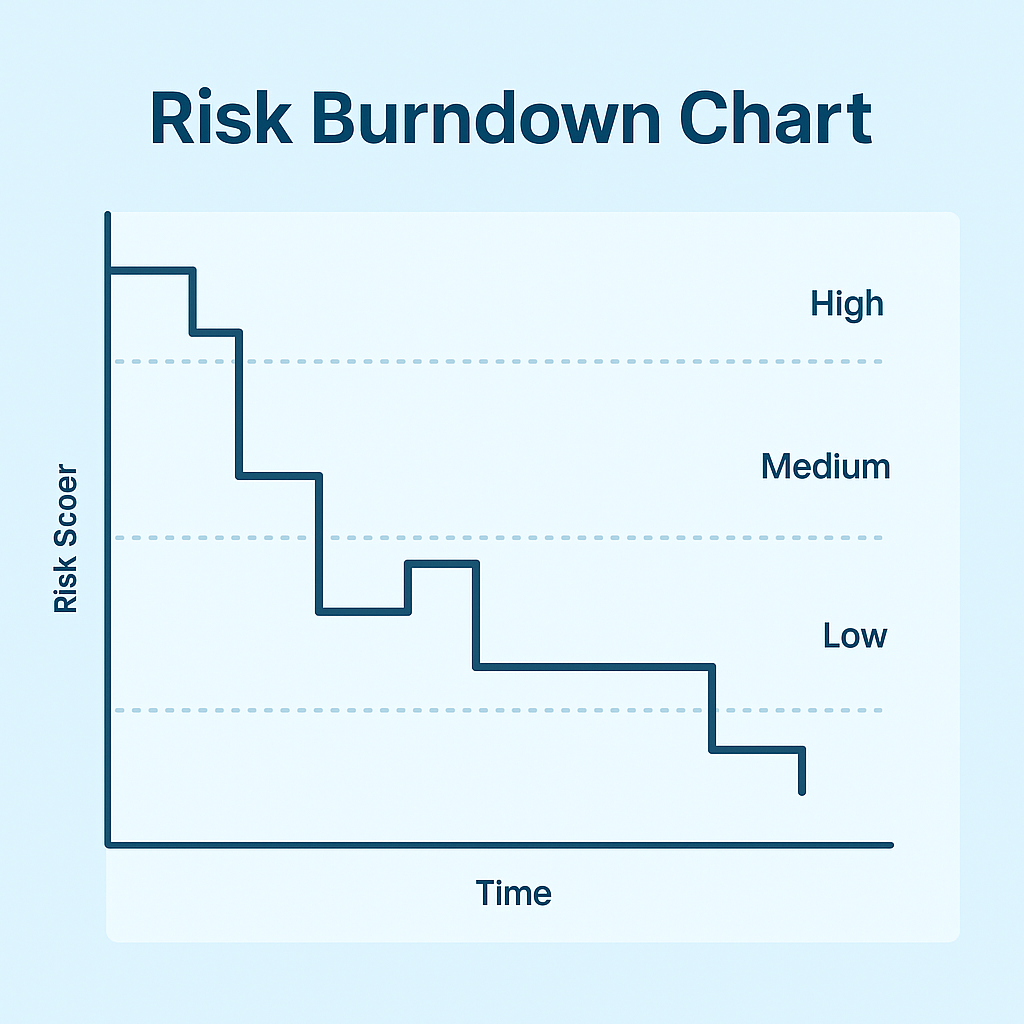
Risk burndown charts offer several clear benefits:
The chart is a simple tool, but it changes the conversation about risk from vague concerns to measurable progress.
Despite their usefulness, risk burndown charts are not perfect. Assigning numerical values to risks can be subjective, and teams may disagree on probability or impact scores. It is also possible for teams to focus too much on the chart itself rather than the underlying actions needed to reduce risk. Finally, if risks are identified late or ignored, the chart may give a false sense of security. Agile teams must remember that the chart is a support tool, not a substitute for thoughtful conversations about risk.
Risk burndown charts work best when integrated into the natural rhythm of Agile events. During sprint reviews, teams can share updated charts to show stakeholders how risk exposure is evolving. In retrospectives, they can reflect on which mitigation strategies worked and which did not. During sprint planning, they can decide whether new mitigation tasks should be prioritized. By weaving the chart into existing events, the team avoids additional overhead and keeps risk management practical and lightweight.
Charts are powerful because they make the invisible visible. A risk burndown chart communicates at a glance what words might take paragraphs to explain. Stakeholders who may not understand technical risks can still see whether exposure is trending up or down. This transparency builds trust and keeps everyone aligned. When combined with backlog visibility, the chart shows not only that risks exist but that the team is doing something concrete about them.
Mitigation should always be tied to value. Reducing risks is not an end in itself; it supports the delivery of valuable outcomes. A project that finishes on time but delivers the wrong product has not succeeded, even if risks were managed. Agile teams therefore tie mitigation efforts directly to customer and business value. For example, mitigating security risks ensures customer trust and regulatory compliance. Mitigating integration risks ensures smooth functionality that adds value to users. By linking mitigation to value, the team ensures stakeholders see risk management as part of delivering results, not a side activity.
Risk mitigation and risk burndown charts turn uncertainty into action and visibility. Mitigation strategies such as prototyping, early delivery, and knowledge sharing reduce exposure before risks can cause harm. Risk burndown charts track whether those efforts are working, providing a clear, simple view of project health. Together, they shift risk management from being a hidden, abstract concern to being an integral, transparent part of Agile delivery. In the end, Agile teams succeed not because risks vanish, but because they continuously act to reduce uncertainty while maximizing value. That balance is the true power of Agile risk management.
Agile frameworks rely on short, repeating cycles of work called iterations or sprints. These cycles are not only a way to deliver value quickly, they are also a powerful form of risk control. By breaking work into small, inspectable increments, teams avoid betting the entire project on assumptions that may prove wrong. Iterative development reduces exposure to failure, allows for rapid feedback, and ensures learning happens early. In this sense, iteration is not just a delivery technique. It is a built-in risk management strategy that keeps uncertainty from growing unchecked.
Traditional, predictive project management often works in a “big bang” style. Teams spend months or years defining requirements, designing solutions, and developing products before customers ever see results. In this model, risks accumulate silently. If requirements change, or if technology fails, the problem may not appear until late in the process, when the cost of correction is highest. Iterative development avoids this by delivering small, usable increments early and often. Stakeholders can inspect real progress, highlight concerns, and steer the project before it is too late.
The essence of iteration is feedback. Each cycle produces a working increment that is reviewed with stakeholders. This regular inspection surfaces risks that might otherwise remain hidden. For example, a team developing a new feature may discover through a sprint review that customers interpret the feature differently than expected. Instead of finding this out at release, the team learns after two weeks. The risk of delivering the wrong product is reduced dramatically. By embedding feedback loops, iterative development ensures that risks are detected while they are still small and manageable.
Many project risks are technical. Will this architecture scale? Will the chosen library integrate with existing systems? Will performance meet customer expectations? Iterative development addresses these questions early. Instead of committing to untested technology for the entire project, Agile teams build small proofs of concept or vertical slices that test assumptions. A sprint dedicated to integrating with a third-party service can reveal whether the service is reliable. By discovering technical failures early, the team avoids catastrophic surprises later and can pivot to safer alternatives.
Business risks revolve around whether the product being built truly meets customer and market needs. Iterative development confronts this risk head-on by involving stakeholders in frequent reviews. Features are demonstrated, feedback is gathered, and priorities are adjusted. If customer expectations shift, the backlog shifts with them. Instead of launching a product that no one wants, the team adapts continuously to deliver what stakeholders value most. This reduces the risk of wasted investment and increases the chance of market success.
Iteration also lowers risks related to the team itself. New teams often face uncertainties around collaboration, communication, and performance. Iterative cycles create regular opportunities to inspect and adapt processes in retrospectives. If a conflict is slowing progress, it can be addressed after a few weeks instead of festering for months. If task distribution is unbalanced, adjustments can be made quickly. By focusing on continuous improvement, iterative development minimizes risks of burnout, low morale, and ineffective teamwork.
Timeboxing, a core Agile practice, plays a central role in risk control. By limiting iterations to short, fixed lengths, teams avoid the danger of endless work on uncertain features. Timeboxes force decisions. If an experiment fails, it fails fast and cheaply. If it succeeds, the result is delivered quickly to customers. Either way, the team learns. This rhythm of timeboxed experimentation ensures risks are surfaced and resolved at a predictable pace, reducing the likelihood of runaway issues.
Iteration goes hand-in-hand with incremental delivery. Each cycle produces a working product increment that can potentially be released. This reduces the risk of “nothing to show” until the very end. Even if the project ends early, the organization still has usable results. Incremental delivery also reduces financial risks. Organizations begin to see returns on investment earlier, and they can choose to stop funding a project if risks outweigh potential benefits. This flexibility makes iterative, incremental delivery a natural hedge against uncertainty.
Agile teams often use spikes—short, timeboxed efforts to explore a technical or business uncertainty. Spikes are a direct application of iterative risk reduction. For example, a team unsure whether a database can handle expected traffic may create a spike to test performance under load. The results guide future decisions. By turning big unknowns into small experiments, spikes transform vague risks into clear information, allowing the team to move forward with confidence.
Risks evolve over time. A project may start with high technical uncertainty but later face business or regulatory risks. Iterative development keeps the team responsive. Because each sprint includes planning, review, and retrospective, the team has built-in checkpoints to detect and respond to new risks. This ongoing cycle prevents the project from drifting into danger unnoticed. Instead, the project remains adaptable, with a structure that welcomes change rather than resists it.
Agile teams often use metrics like velocity, defect trends, and customer satisfaction to gauge progress. These same metrics also signal risk levels. If velocity fluctuates wildly, there may be process risks. If defects rise, quality risks are surfacing. If stakeholder feedback shows misalignment, business risks are emerging. Iterative development makes these signals visible early. Each iteration provides new data, and the team can act before small issues grow into project-threatening risks.
In large or scaled Agile initiatives, risks exist at multiple levels. Teams face delivery risks, programs face dependency risks, and portfolios face strategic risks. Iterative development still applies. At the team level, iterations reduce delivery risks. At the program level, multiple teams coordinate their iterations through mechanisms like Scrum of Scrums or Nexus. This coordination ensures dependencies are surfaced and managed regularly, reducing the risk of large-scale integration failures. At the portfolio level, iterative funding and frequent value reviews minimize strategic risks. Across all levels, iteration acts as a safeguard against uncertainty.
Consider a healthcare project building a new patient portal. Early assumptions about user needs included mobile-first design and complex reporting features. By delivering in iterations, the team discovered that patients cared more about appointment booking than reports. Through iterative reviews, the risk of building irrelevant features was avoided. On the technical side, early integration sprints revealed that the hospital’s legacy system could not support real-time updates. This discovery allowed leadership to invest in system upgrades early, avoiding failure at launch. Iteration, in this case, reduced both business and technical risks, ensuring the project delivered real value.
While iterative development is powerful, it is not without challenges. Teams may fall into the trap of treating iterations as mini-waterfalls, delaying feedback until the end of each cycle. If increments are too large, risks remain hidden. Some stakeholders may resist frequent reviews, preferring long planning cycles. To be effective, iterations must remain small, increments must be working and testable, and stakeholders must be engaged. Without these conditions, the risk-reducing power of iteration weakens.
Using iteration as a risk strategy requires a mindset shift. Teams must value learning over perfection. They must see early failure as a success if it reduces uncertainty. Stakeholders must accept that plans will change as feedback is incorporated. Leaders must embrace transparency, even when it reveals uncomfortable truths. These shifts are not always easy, but they are essential. Iteration only reduces risk if the organization is willing to act on what is learned.
Iterative development is more than a way of organizing work. It is a built-in risk management practice that makes Agile powerful. By delivering small increments, teams reduce the risk of building the wrong thing. By engaging stakeholders regularly, they reduce the risk of misalignment. By testing technology early, they reduce the risk of failure at scale. By improving processes each sprint, they reduce the risk of team dysfunction. Iteration transforms uncertainty from a threat into an opportunity for learning. In Agile, minimizing risks is not an afterthought—it is the natural outcome of working iteratively and adaptively, one cycle at a time.
Identifying, assessing, and mitigating risks are powerful steps, but they only work if risks are clearly communicated and owned. Without communication, risks remain invisible until they cause damage. Without ownership, risks drift with no one responsible for monitoring them or taking action. Agile principles emphasize transparency, collaboration, and accountability. Communicating risks openly and assigning clear ownership ensures that risks do not fall into gaps and that the team can respond quickly. This explores how Agile teams share risk information, define ownership, and create a culture of accountability.
One of the cornerstones of Agile is transparency. Work, progress, and challenges are made visible to everyone involved. The same applies to risks. Agile teams do not hide risks in thick reports that only managers see. Instead, they use simple, visible methods to radiate risk information. These can include:
The goal is to keep risks in plain sight, so they are part of everyday conversations and decisions, not hidden away in documents that no one reads.
Risk communication in Agile is not about formal reports. It is about frequent, open conversations. Effective communication follows a few key principles:
By making risk communication a natural part of Agile ceremonies, teams ensure that risks are continuously monitored and that everyone stays aligned on priorities.
Agile provides built-in opportunities for communication. Risk discussions fit naturally into these events:
These regular touchpoints make communication continuous and adaptive, not isolated or reactive.
Clear ownership is the second half of effective risk management. Every significant risk should have a named owner. Ownership means responsibility for monitoring the risk, updating its status, and ensuring mitigation steps are carried out. Importantly, ownership does not mean acting alone. Owners coordinate with others but remain accountable for keeping the risk visible and managed. In Agile teams, risk ownership can be distributed: a Product Owner may own business risks, a developer may own a technical risk, and a Scrum Master may own a process or organizational risk. What matters most is that no risk is left unassigned.
Different Agile roles contribute to risk ownership in complementary ways:
This shared model ensures coverage across all dimensions of the project. Risks are not the sole responsibility of management but are distributed to those closest to the work.
Agile teams often visualize ownership alongside risk status. A risk board, for example, may include not only the risk description and its severity but also the name of the owner. This prevents confusion about who is responsible. Digital tools like Jira or Trello can assign risks to specific team members just like user stories. By linking ownership to visibility, the team creates accountability that is transparent to everyone, including stakeholders.
One challenge in Agile risk management is balancing collective responsibility with individual accountability. Agile values collaboration, so the whole team remains aware of risks and contributes to solutions. At the same time, individual ownership ensures follow-through. Without ownership, risks can fall into a “somebody else’s problem” trap. Without collaboration, owners can become isolated. The balance is achieved when risks are discussed openly by the team but tracked and monitored by a named owner who ensures progress happens.
Risk communication should not focus only on threats. Opportunities—positive risks—deserve attention too. For example, discovering that a vendor offers a new service that could accelerate delivery is a positive risk. Communicating opportunities ensures the team does not miss out on benefits simply because it was focused only on dangers. Ownership of opportunities is just as important as threats, because someone must champion the actions needed to exploit them.
Some risks exceed the scope or authority of the team. In these cases, communication must extend beyond the team to leadership or organizational stakeholders. For example, a regulatory risk may require input from legal experts, or a vendor dependency risk may require action from procurement. Agile teams communicate these risks openly, often using risk radiators at program or portfolio levels. Escalation is not a failure—it is part of ensuring that risks are handled at the right level of the organization.
When Agile teams communicate risks openly and assign ownership clearly, several benefits emerge:
These benefits combine to create a culture where risk management is a natural part of daily work, not an afterthought.
Despite best intentions, teams sometimes fall into pitfalls with risk communication and ownership:
Avoiding these pitfalls requires a supportive culture, visible tools, and a focus on learning rather than punishment.
Consider a software company building a mobile app with a tight deadline. A developer identifies a risk that the app store approval process could take longer than expected. The risk is communicated at sprint planning, logged on the risk board, and ownership is assigned to the Product Owner, who works with the app store to clarify requirements. Updates on this risk are shared at daily scrums. Because it was communicated early and owned clearly, the team avoids a late surprise. The app launches on time, and stakeholders see that the team is proactive, not reactive, in managing risks.
Communicating and owning risks in Agile teams ensures that uncertainty is managed with transparency and accountability. Communication makes risks visible, while ownership makes them actionable. Together, they prevent risks from slipping through the cracks and transform risk management into a collaborative, continuous practice. Agile teams that master these habits build trust, reduce surprises, and increase resilience. In the end, risks are not only managed—they are turned into opportunities for learning and growth. That is the true power of Agile risk communication and ownership.
In Agile projects, risks change quickly and often appear without warning. Teams need ways to spot, analyze, and manage these uncertainties in real time. Artificial Intelligence is not a magic solution, but it is a powerful assistant. AI can quickly analyze backlogs, patterns, and historical data, giving teams insights that would be slow to generate manually. This shows how AI can help identify, assess, and respond to risks using simple prompts that fit naturally into Agile practices.
Prompt: “List potential risks for this Agile project backlog [insert backlog items], and categorize them by business, technical, process, and team risks.” This prompt helps teams uncover risks they might overlook. By inputting backlog items, AI can generate a categorized list of possible risks, such as shifting customer priorities, dependency on third-party tools, or unclear acceptance criteria. Teams then discuss, refine, and validate the list. The real benefit is speed. AI gives a first draft, and the team applies their context to confirm accuracy.
When AI outputs risks grouped into categories, the team can see patterns. Business risks often involve customer needs and market conditions. Technical risks focus on system integration or new tools. Process risks highlight unclear requirements or bottlenecks. Team risks involve skills, morale, or availability. Having risks grouped this way makes it easier to assign owners and to focus mitigation on the areas of greatest concern. AI ensures no category is ignored and sparks richer team conversations.
Prompt: “Create a probability and impact matrix for the following identified risks [insert risks], with a simple ranking of high, medium, or low.” With this prompt, AI can generate a table that quickly shows which risks are most serious. Teams provide the list of risks, and AI suggests probability and impact scores. While final judgment rests with the team, AI helps speed the process and provides an objective baseline. This is especially useful for teams new to risk assessment, who may not yet have consistent scoring practices.
The matrix highlights risks with both high probability and high impact, which should receive priority attention. Low-probability, low-impact risks can usually be monitored without action. AI-generated matrices serve as a starting point for discussion, not a replacement for human judgment. The team uses the chart to debate and refine the values. This collaborative process turns a simple AI output into a practical decision-making tool. The outcome is a clear picture of where the team must focus energy first.
Prompt: “Suggest risk mitigation strategies for these top five risks [insert risks], using Agile-friendly approaches like spikes, prototypes, or backlog prioritization.” This prompt helps teams brainstorm concrete steps to reduce risk exposure. AI can recommend targeted actions, such as running a prototype to test a risky integration, or reordering the backlog to tackle high-uncertainty items earlier. The advantage of using AI here is variety. It may suggest options the team had not considered, giving them more tools to choose from.
AI-generated mitigation ideas often translate directly into backlog items. For example, an AI suggestion to “run a two-day spike to test new API performance” can be written as a technical story. This keeps risk work visible and ensures it competes for priority like any other user story. By tying mitigation actions to backlog management, teams can balance delivering features with reducing uncertainty. AI helps by generating concrete, backlog-ready suggestions that save time and promote action.
Prompt: “Summarize the pros and cons of accepting, avoiding, transferring, or mitigating this risk: [describe risk].” This prompt helps teams think critically about response strategies. AI can quickly outline the benefits and drawbacks of each approach for a given risk. For example, accepting a risk may save time but leave the project exposed. Avoiding a risk may be safe but costly. Transferring may reduce exposure but increase dependency. Mitigation may lower probability but require effort. Having the pros and cons written clearly supports structured team decisions.
Using AI to summarize risk response options creates clarity. Instead of debating from scratch, the team begins with a balanced overview. This helps reduce bias and speeds discussion. Teams then apply their context—such as budget, deadlines, or customer needs—to choose the best option. AI does not make the decision but ensures that all options are visible and that trade-offs are clear. This combination of AI insight and human judgment leads to more confident risk responses.
AI is not here to replace Agile teams or traditional risk management practices. Instead, it is a fast, supportive assistant that helps teams identify risks, assess probability and impact, generate mitigation ideas, and weigh response strategies. By using prompts like the ones we explored, teams can save time, broaden their thinking, and make risk management more visible and practical. The true value comes when AI insights are combined with team knowledge, experience, and context. Together, they create a stronger, more adaptive approach to risk management in Agile projects.
Industrial control systems cannot be secured like ordinary IT. A forced reboot, aggressive scan, or incompatible patch can interrupt production and create real safety consequences. Effective OT security begins with understanding the systems, constraints, and risks unique to industrial environments.
This course gives IT professionals, engineers, operators, and security practitioners a practical foundation in ICS threats, zone and conduit design, risk assessment, passive asset visibility, and vendor evaluation. You will learn how IEC 62443, NIST CSF, and MITRE ATT&CK for ICS apply where availability and safety come first.
Eight reconstructed incidents—including Stuxnet, Triton, Ukraine 2015, Colonial Pipeline, and PIPEDREAM—show how attackers move through OT environments, what they target, and which defenses could have changed the outcome.
Watch the course preview, then build the vocabulary, frameworks, and judgment needed to take credible first steps in ICS/OT cybersecurity.
Explore the CourseLearn how to use AI to create charters, WBSs, schedules, risk registers, and executive reports while staying in control. This course gives you prompt templates and practical workflows based on real project work. Practical skills, tools, and guidance you can apply right away. Covered by Udemy's 30-day refund policy.
Learn MoreUnlimited redemptions
Available until September 19, 2026 6:21 PM PDT
2A2133BF88C8DF36C1AA