
Picture an Upwork posting that asks one freelancer for AI-generated video, editing and motion graphics in a single brief. The report uses combinations like that one to illustrate the new bundles it found. A joint study by OpenAI and Upwork, published on 10 November 2026, uses postings like that one to make its main point: AI is not only taking tasks away from freelancers, it is changing which tasks clients buy together.
The finding reaches well beyond freelancing. If you manage projects or run delivery, your own job is a bundle of tasks too, and the same forces are likely to pull it apart and put it back together. This post covers what the study actually measured, what it did not, and a task audit you can run on your own role this week.
What the study measured, in plain terms
The report, titled The Rebundling of Freelance Work in the AI Age, compares two data sets. One is a sample of more than 36,000 ChatGPT conversations, sorted into Upwork's own work categories. The other is Upwork Marketplace job postings, the work clients pay freelancers to do.
The two look very different. Content writing accounts for 14.5 percent of the sampled ChatGPT conversations but about 1.3 percent of Upwork postings. Graphic design, video and animation, quality-assurance testing, mobile development and web development go the other way: much bigger on Upwork than in ChatGPT. People use the chatbot for text and advice, and they still hire people to build and produce things.
The headline number needs careful reading. The authors gave each of 63 work subcategories an "AI intensity" score: how big its share of ChatGPT use was, compared with its share of Upwork postings in early 2023. They then tracked each subcategory's share of all Upwork postings from the first half of 2023 to the second half of 2025.
What "losing share" means, and what 43 of 63 does not mean
In 43 of the 63 subcategories, the movement fitted a substitution pattern. Work that is relatively more common in ChatGPT than on Upwork lost share of postings, or work that is relatively rare in ChatGPT gained share. Content writing is the clearest case: its postings fell more than twice as fast as Upwork postings overall. Video and animation went the other way and grew by about a third relative to the whole marketplace.
"Losing share" means a smaller slice of all postings. It is a relative measure. It does not say how many writers lost work, and the report gives no earnings figures for those categories.
The other 20 subcategories broke the pattern. Six were relatively common in ChatGPT and still gained share; fourteen were relatively rare there and lost share anyway. The authors are direct about it: a simple substitution story explains only part of what happened. They also stress that the two data sets are not matched, that neither represents the labour market as a whole, and that the results are descriptive, not proof of cause. Both organisations behind it sell AI or freelance work; read the conclusions with that in mind.
Bigger budgets, about the same hourly rate
The money findings are the part most worth a project manager's attention. The study compared postings that involve AI (asking for AI skills, AI tools, or improving AI-generated output) with postings that do not.
| Measure, AI-related vs other postings | Raw gap | After controlling for subcategory and month |
|---|---|---|
| Fixed-price budget | about 70% higher | about 52% higher |
| Posted hourly rate | about 9% higher | about 1.5% higher |
| Hours worked in the first 90 days (hired hourly contracts) | not stated in the text | about 41% higher |
Read those three lines together. Clients are not paying much more per hour for AI work. They are buying more hours and bigger projects. The authors suggest a rebound effect, as in energy: when something gets cheaper to do, people may do more of it, try more alternatives, and spend longer on refinement.
In project terms, AI-related work arrives with more scope. These postings start out bigger than similar non-AI work, with larger budgets and about 41 percent more hours in the first 90 days. Whoever scopes and manages that work has more to manage.
How the work is being rebundled
Inside AI-related postings, the work is spreading out. The report measures how concentrated the task mix is, and between early 2023 and late 2025 it went from the equivalent of about 15 equally common task clusters to about 21, a rise of roughly 45 percent. Building chatbots and machine-learning models is still the biggest cluster, but its share fell from 21.8 to 17.8 percent while video production, marketing automation, social media campaign management and AI integration grew.
AI-related postings contain only slightly more tasks each: 3.35 on average against 3.19 for other postings. The difference is in the combination. Pairs of tasks that clients rarely requested together before the generative-AI era make up 8.4 percent of the task pairs in the average AI-related posting, against 2.4 percent in other postings. Most of those unusual pairs join two familiar tasks, often an AI task with a traditional one, such as chatbot development plus application integration.
The report's conclusion is the sentence to keep. Value, the authors write, "may increasingly lie in defining the problem, connecting tools and activities, applying domain judgment, and delivering a finished outcome." Earlier Upwork research, mentioned in the report without a full citation, suggests the same direction: single AI-execution tasks are becoming more common but less lucrative, while demand grows for work that supervises, reviews and corrects AI output.
Why this lands on the project manager's desk
Look at that list again: define the problem, connect the pieces, apply judgment, deliver a finished outcome. That is close to a description of project management. It is also a warning, because a project manager's week holds plenty of tasks that are not on that list.
Take a delivery lead on a software rollout. Her week includes the Friday status report, meeting minutes, the first draft of a risk log, a stakeholder update email and a slide for the steering group. AI drafts most of those well today. The same week also holds the hard parts: getting the sponsor to choose between two dates, deciding what "done" means with a sceptical operations team, and stopping a vendor from quietly shrinking the scope. No chatbot does those.
The study shows AI-related work more often arriving as a combined bundle, with bigger budgets attached. If most of your hours sit in tasks a chatbot drafts well, your role is being unbundled, whether or not anyone has said so. If most of them sit in the joining work, AI is more likely to make your role bigger, the way AI-related projects on Upwork are bigger than the rest.
Audit your own role in one afternoon
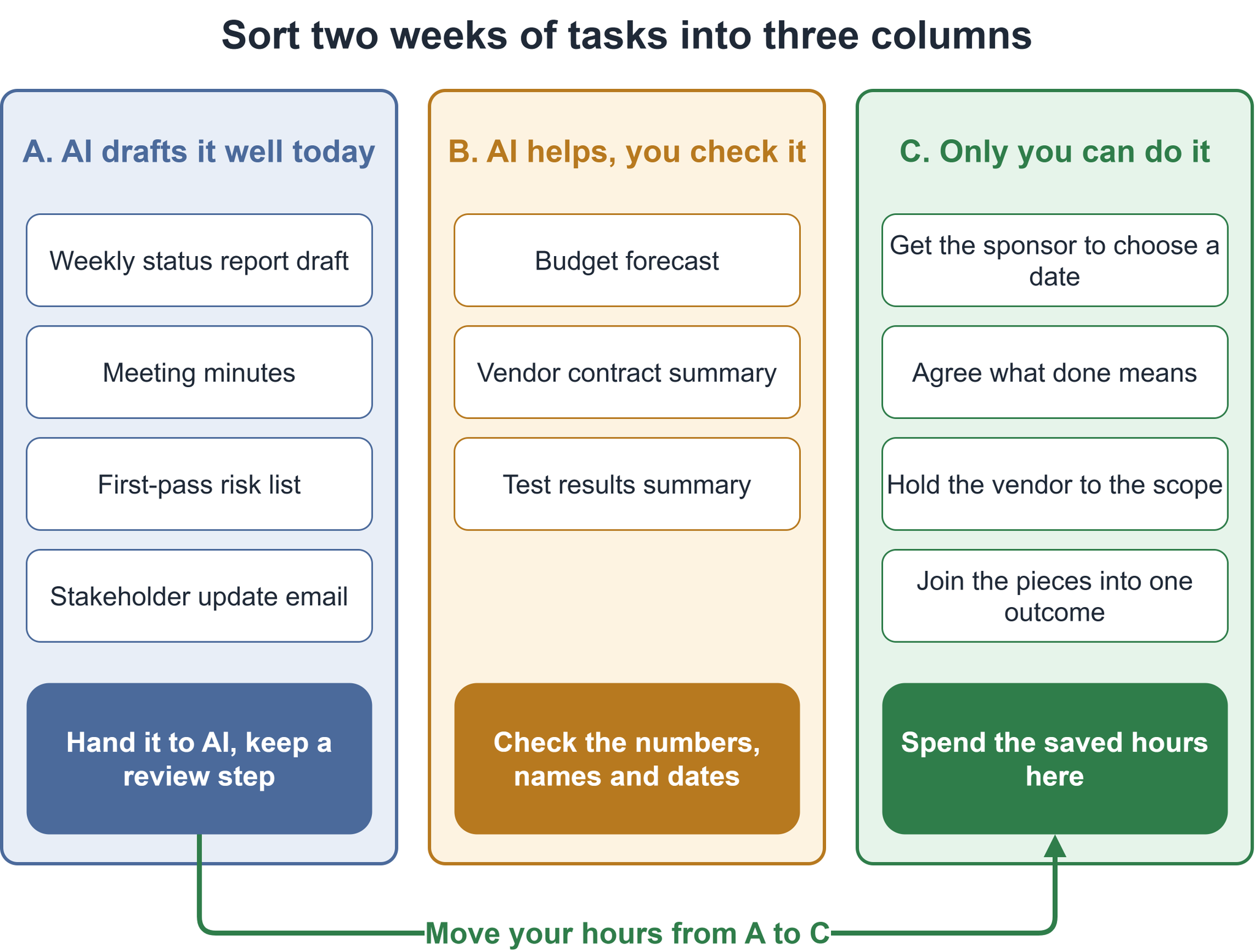
The audit takes about three hours, and it works for any delivery role, not only project managers.
- List your real tasks. Go through the last two weeks of your calendar, sent email and documents. Write one line per task, in verbs: "draft weekly status report", "chase test results from vendor", "agree release date with sponsor". Aim for 25 to 40 lines.
- Sort each task into one of three columns. Column A: AI drafts it well today. Column B: AI helps, but a person must check it, because the facts, names or numbers matter. Column C: only you can do it, usually because it needs a decision, a relationship or accountability.
- Put hours against each column. Rough estimates are fine, because you are looking for the shape. A week that is 60 percent Column A is a warning sign. A week that is 60 percent Column C is a strong position.
- Hand Column A to AI with a review step. Set up one repeatable way to produce each document, and keep a short check: numbers, names, dates, and whether you would sign it.
- Spend the saved hours in Column C on purpose. Book the conversation with the sponsor you keep postponing. Run the risk review in person. Take on the integration or the cross-team piece nobody owns.
- Rewrite your CV around bundles, not tasks. "Prepared weekly status reports" describes a Column A task. "Set up AI-drafted weekly reporting with a review step, and used the time saved to run fortnightly risk reviews with the vendor" describes a bundle. Use your own real figures, or none.
- Prepare one interview story about joining things up. Pick a time you combined two kinds of work that do not usually sit together, such as a data migration and a training plan, and explain the outcome. That is the kind of combination the study found in AI-related postings.
- Repeat the audit every quarter. Column A grows as tools improve. A task that sat in Column B in spring may move to Column A by autumn.
What the audit cannot tell you
The audit shows where your hours go, not what your employer values. Some organisations still pay for the polished status report and ignore the hard conversation that made it worth reading. If that is your situation, the audit is still useful: it gives you the evidence for a conversation with your manager, or for your next job search.
The study has the same limit at a larger scale. It describes one freelance marketplace and one chatbot, from early 2023 to mid-2026. It does not prove that AI caused the changes, and the authors say so. What it does show, with a large data set behind it, is a pattern: AI-related postings carry bigger budgets and more hours than other postings, and AI-related work is spreading across more kinds of tasks.
Your job description is being rewritten task by task, and it is better to do the rewriting yourself than to find out at the next restructure. Start with the two-week task list; it is the step everything else depends on.
If you want a structured way to bring AI into project work, AI for Project Managers covers using it across planning, reporting and risk. And if the audit points you towards a new role, How to Land the Job and Interview for Project Managers covers the CV, the interview and the salary conversation.
Source: "The Rebundling of Freelance Work in the AI Age", OpenAI and Upwork, November 2026. Summary at openai.com.